If you are familiar with New Zealand Sauvignon Blanc, chances are that it was from Marlborough. This region, situated on the South Island, has been a staunch supporter of this grape variety and is credited with putting it on the world stage with its bold style. Of course, Marlborough successfully grows other grapes such as Pinot Noir and Chardonnay.
With the region’s growth and popularity, member wineries have banded together to ensure that their appellation is protected through the creation of Appellation Marlborough Wine (AMW), which was trademark registered in 2018.
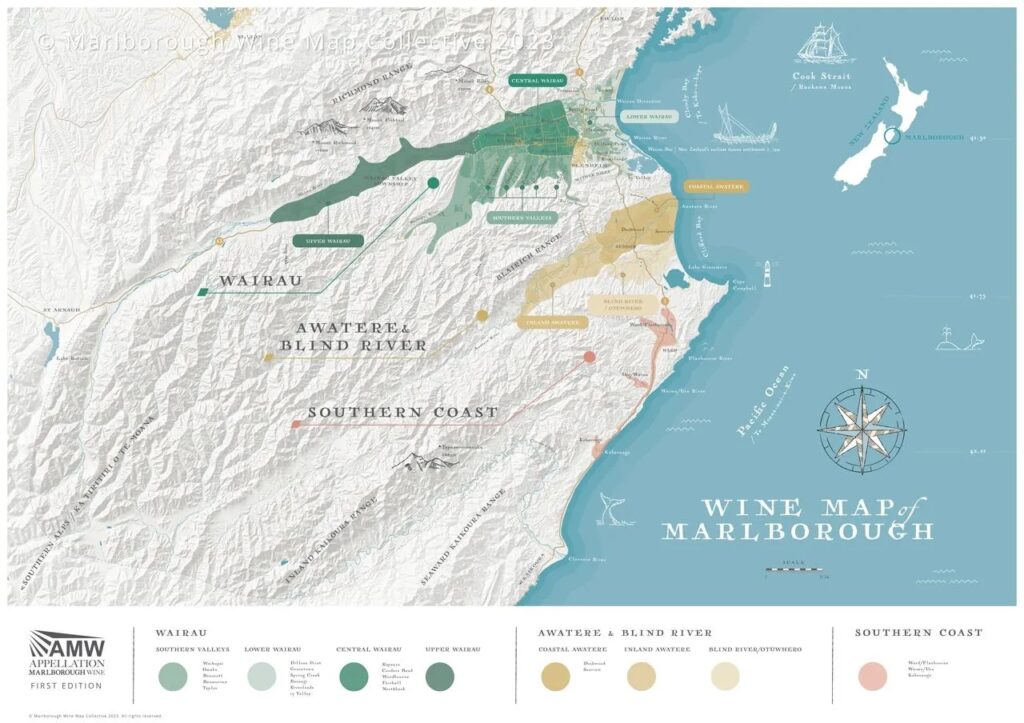
More recently, AMW released the ‘Wine Map of Marlborough’ as a way to delineate the wine-growing region in more detail. AMW’s primary purpose is to guarantee origin and typicity of the Marlborough wines as well as to safeguard the region for the future through its commitment to sustainability processes and standards. Any wine bearing the AMW mark is guaranteed to be produced from 100% Marlborough grapes.
In keeping with this mission, AMW commissioned New Zealand cartographer, Roger Smith, and local designer, Megan Boreham to produce this official map. The venture took two years, but the map’s debut in 2023 beautifully coincides with the 50th anniversary of the first commercial planting of grapevines within Marlborough. Moreover, the project seeks to recognize the micro-climates and diverse soil types found within Marlborough and, additionally, it codifies formal borders for areas that have been identified more colloquially over the past several decades. The map is considered to be a work in progress as borders are more clearly defined and new sub-regions are introduced.
For now, the Marlborough region can be subdivided into three main macroregions: Wairau; Awatere and Blind River; and Southern Coast. Within each, there are further demarcations of sub-appellations such as Lower Wairu and Central Wairu within Wairau.
Of course, maps are great resources and tools, but if you are really looking to discover Marlborough’s wines, the best way to do so is to pick up a bottle and enjoy it.
TASTING NOTES Here are a few Marlborough Sauvignon Blancs that I recently enjoyed:
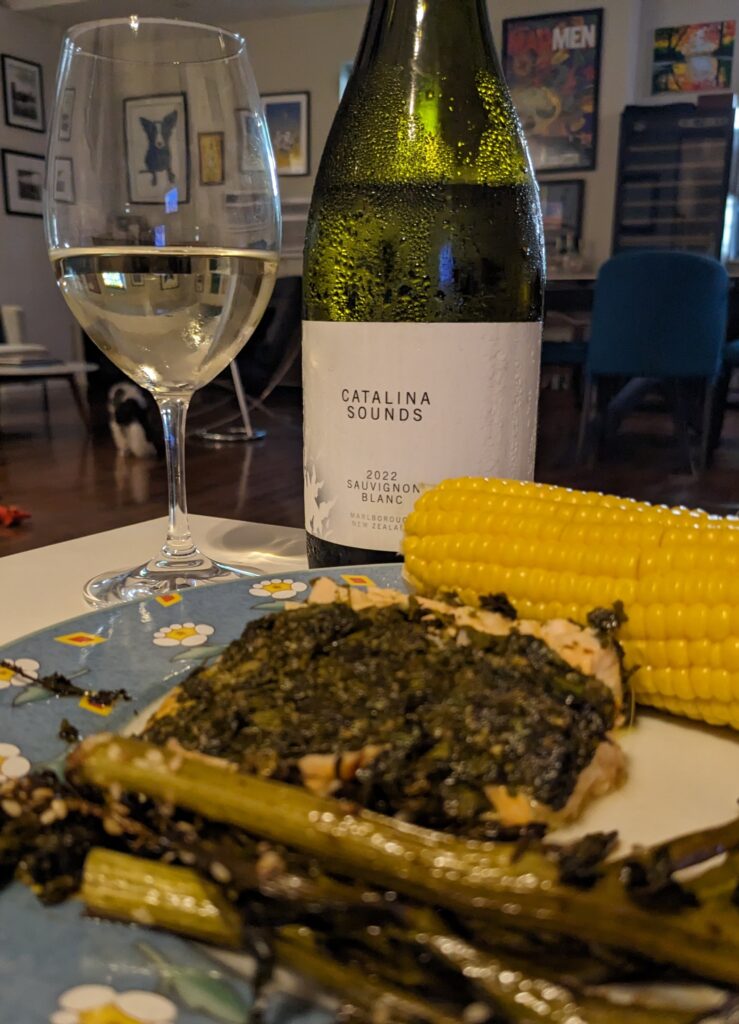
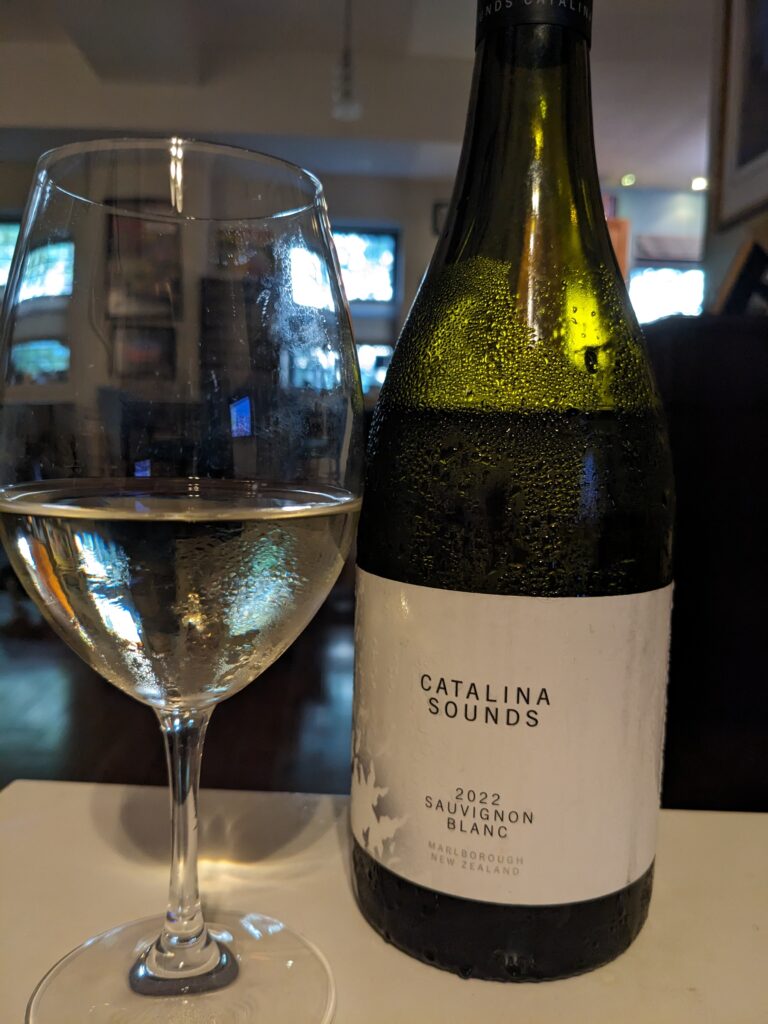
Catalina Sounds Sauvignon Blanc 2022, Marlborough, NZ, $27 Pronounced nose, jumped out of the glass with aromas of grass, cat’s pee, grapefruit and lime. The palate was bright and lively, with fresh citrus fruit, medium body, medium-plus acidity and long length.
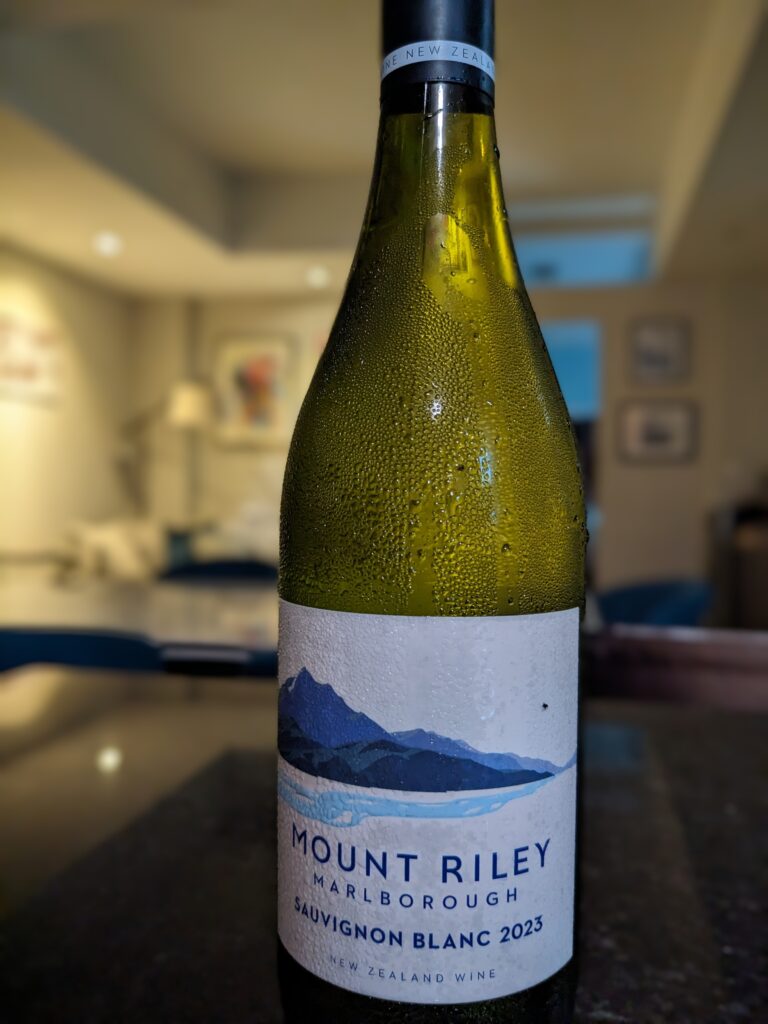
Mount Riley,Sauvignon Blanc 2022, Marlborough, NZ Less pronounced than the Catalina Sounds, but certainly no shrinking violet. Aromas of lemon, lemon candy and slight hint of herbs greet the nose, joined by minerality on the palate, with vibrant acidity, medium body and long length.
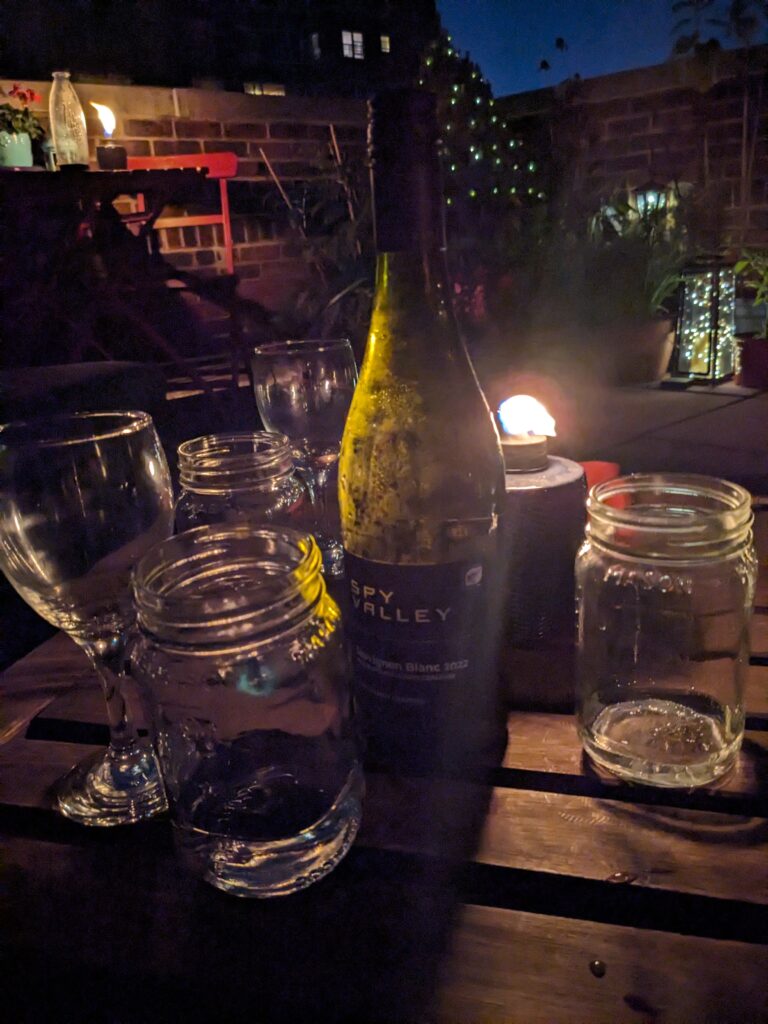
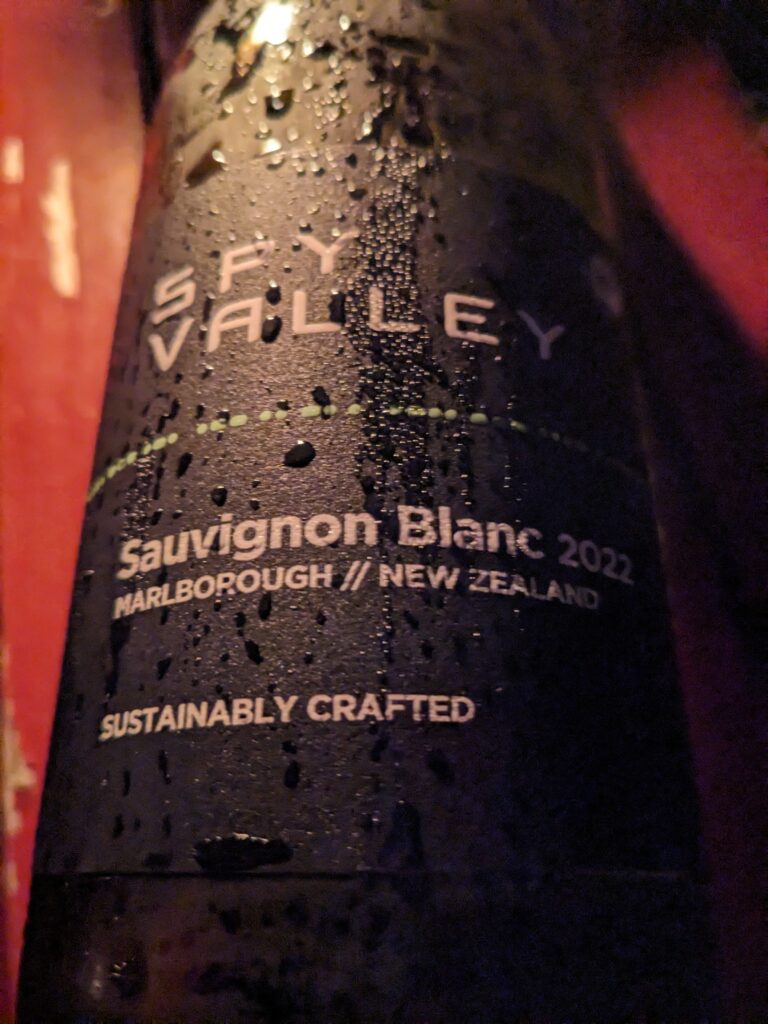
Spy Valley, Sauvignon Blanc 2022, Marlborough, NZ, $22 This wine is beautifully aromatic with minerality, honeysuckle, herbs and lemon/citrus, all of which persist on the palate. Good acidity, medium bodied, culminating in long length.
Last week we were excited to participate in a Silent Disco event at Fort Tryon Park with friends and neighbors. Yet, at the last minute, the event was postponed due to inclement weather. Yuck! (And good call on the organizers’ part as dancing in the rain with expensive headphones isn’t a great idea). But, we were disappointed not to get together and enjoy each other’s company.
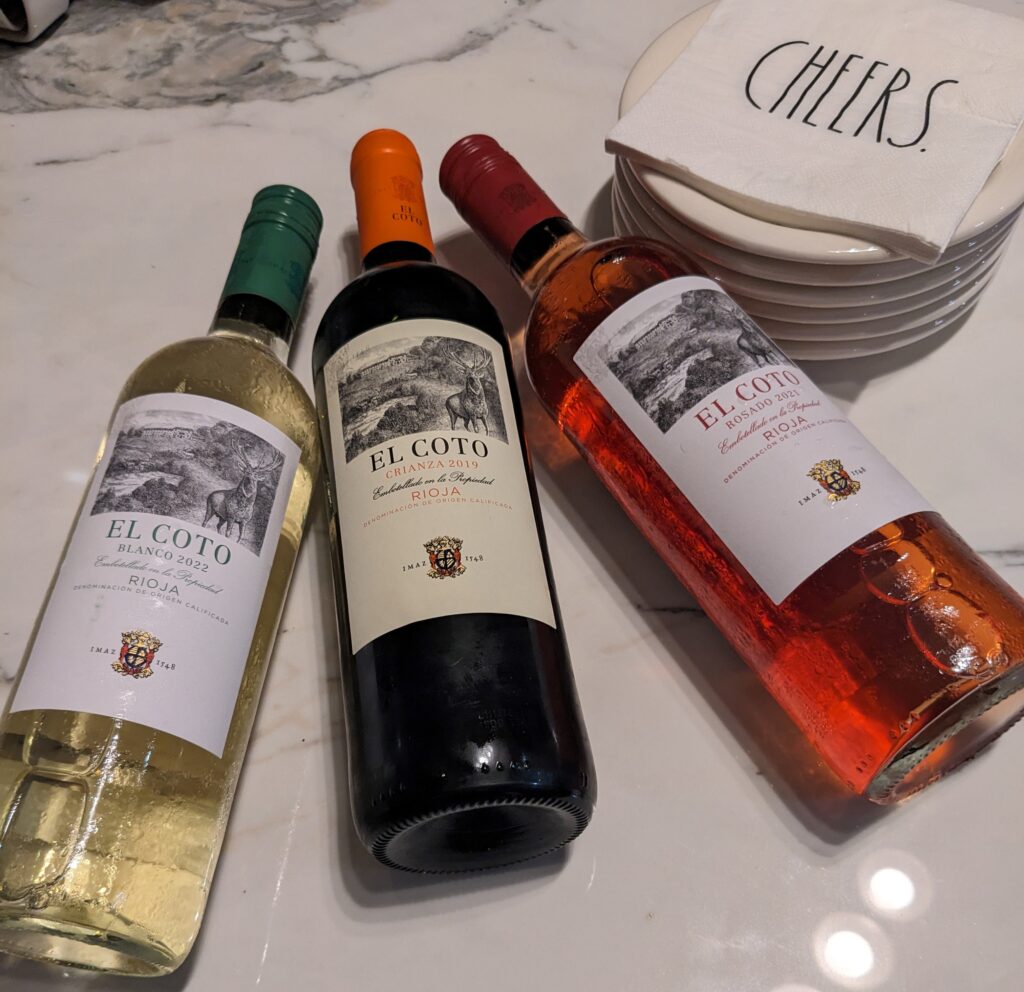
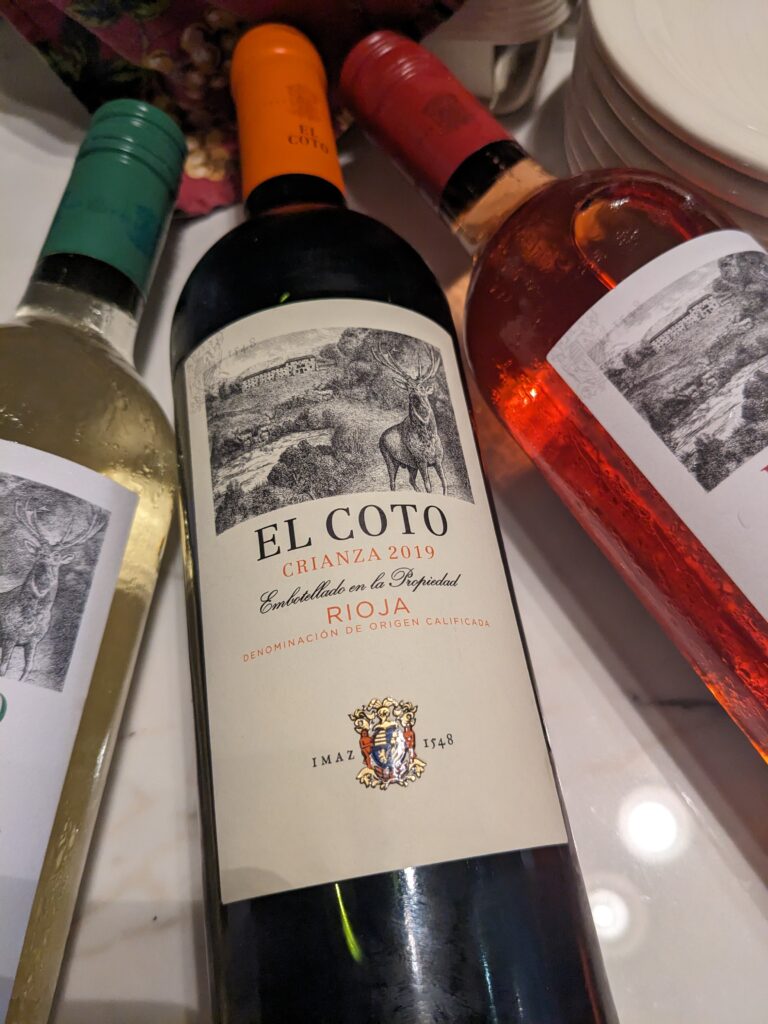
Accordingly, we moved the celebration indoors, sans dancing, and invited the group to gather at our apartment. I offered up wine; our neighbors said they’d bring snacks. True to their word, H and T arrived at our door with a tray, bearing cheeses, salami, fruit and crackers. Meanwhile, I had set the table with a few snacks of our own and had chilled several wines from El Coto. Situated in Spain’s Rioja region, this winery was established in 1970 and is still going strong.
Despite the wet weather, it was still a hot and muggy summer night, so we were all eager to enjoy some chilled wines. The El Coto Blanco and El Coto Rose were the perfect options to pair with our impromptu party!
I opened up the rose first and the bottle was soon empty (a clear crowd favorite!), necessitating that we turn our attention to the white, which was also greatly appreciated by our guests. As it grew late, we wrapped up our conversations, and cleaned up as everyone soon cleared out. All in all, it was a lovely evening!
A few days later, I opened up the El Coto Crianza, which had been touted as being a red wine capable of being chilled. My previous experience with chilled reds has been primarily limited to Beaujolais and other fresh and fruity reds; I wondered how the Rioja would fare with time in the fridge. I needn’t have worried; it was really nice and paired well with my leftover paella.
Looking for refreshing wines to enjoy on a hot summer day? Look no further than this trio from El Coto!
TASTING NOTES
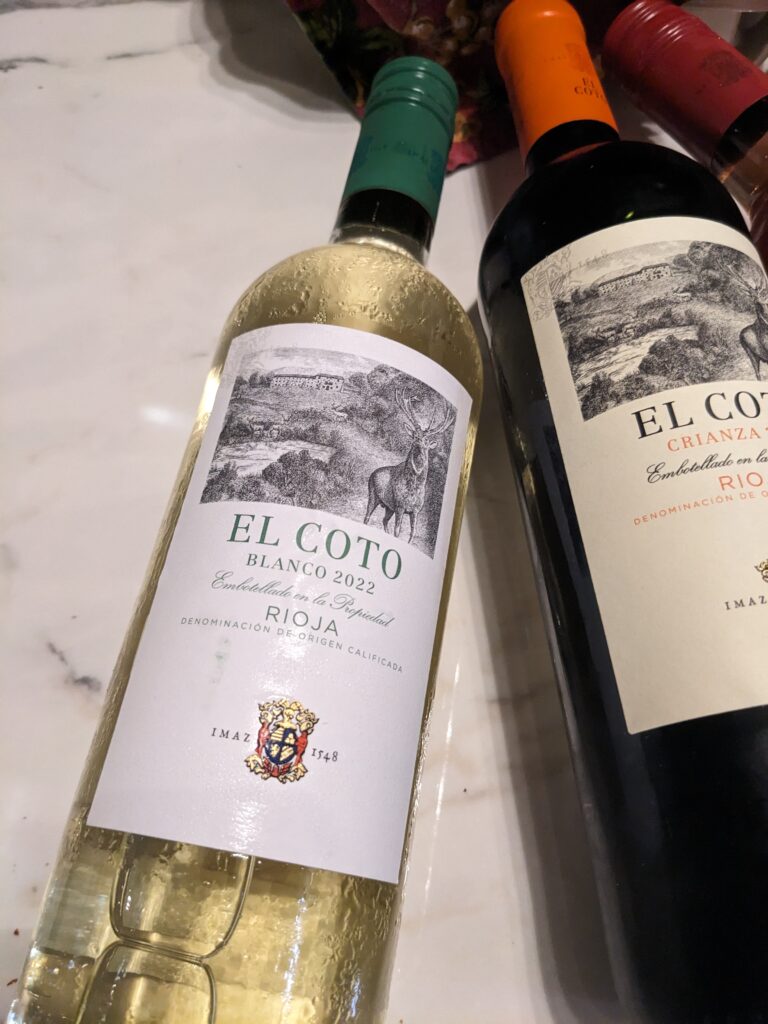
El Coto Blanco 2022, Rioja, Spain, SRP $11.99
This wine is a blend of 93% Viura, 4% Sauvignon Blanc and 3% Verdejo. It displays notes of citrus and pear on the nose. The dry palate provides medium acidity, medium body and flavors of citrus, pear and apple, culminating in long length.
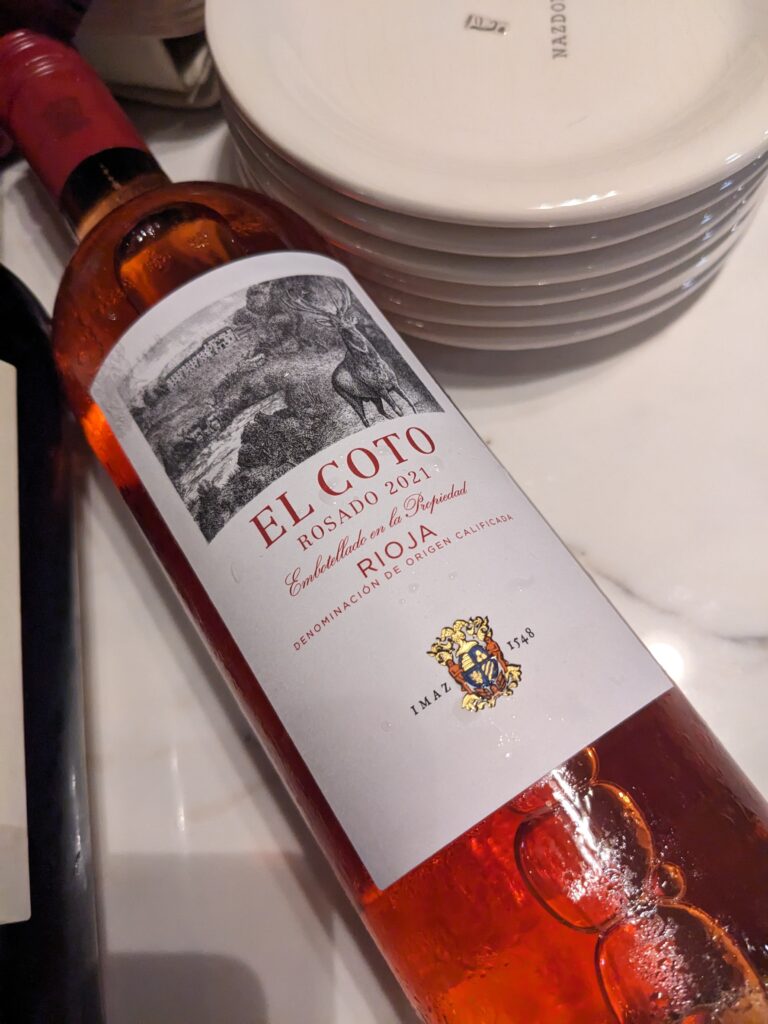
El Coto Rose 2021, Rioja, Spain, SRP $11.99
Bringing together Rioja’s traditional Tempranillo (90% ) and Garnacha (10%), this beautifully-hued salmon pink wine offered up aromas and flavors of raspberry and strawberry. It is fresh and lively, with medium acidity, medium body, and medium plus length. Easy drinking and very food friendly.
El Coto Crianza 2019, Rioja, Spain, SRP $16.99
Sporting 100% Tempranillo, this wine was aged in oak for at least 12 months with an additional six months in bottle, prior to release, as befits its Crianza designation. Aromas of wood, blackberry and raspberry greet the nose. The palate is dry, with bright acidity, flavors of berries, oak and spice, with medium plus body and medium length.
It’s the duck days of summer. It’s been super hot and then…not! But, if you are a lucky duck, you’ve got Duck Pond Cellars’ wines in your glass. In particular, their Natural Path Production wines perfectly hit the spot whether it’s 70F or 90F.
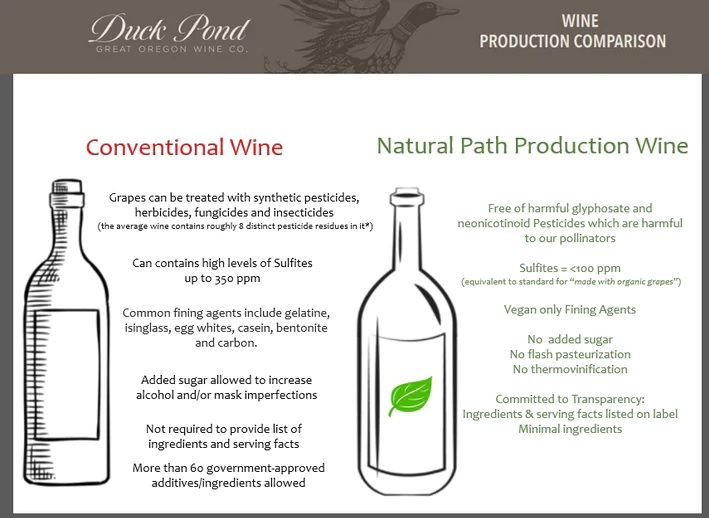
The Dundee, Oregon-based winery was founded in 1993 and has always been committed to sustainability. Its grapes are organically farmed and hand-harvested, with continued attention to detail once they reach the winery. More recently, they have become involved in the Clean Label Project, a non-profit organization “whose mission is to bring truth and transparency to food and consumer product labeling.”
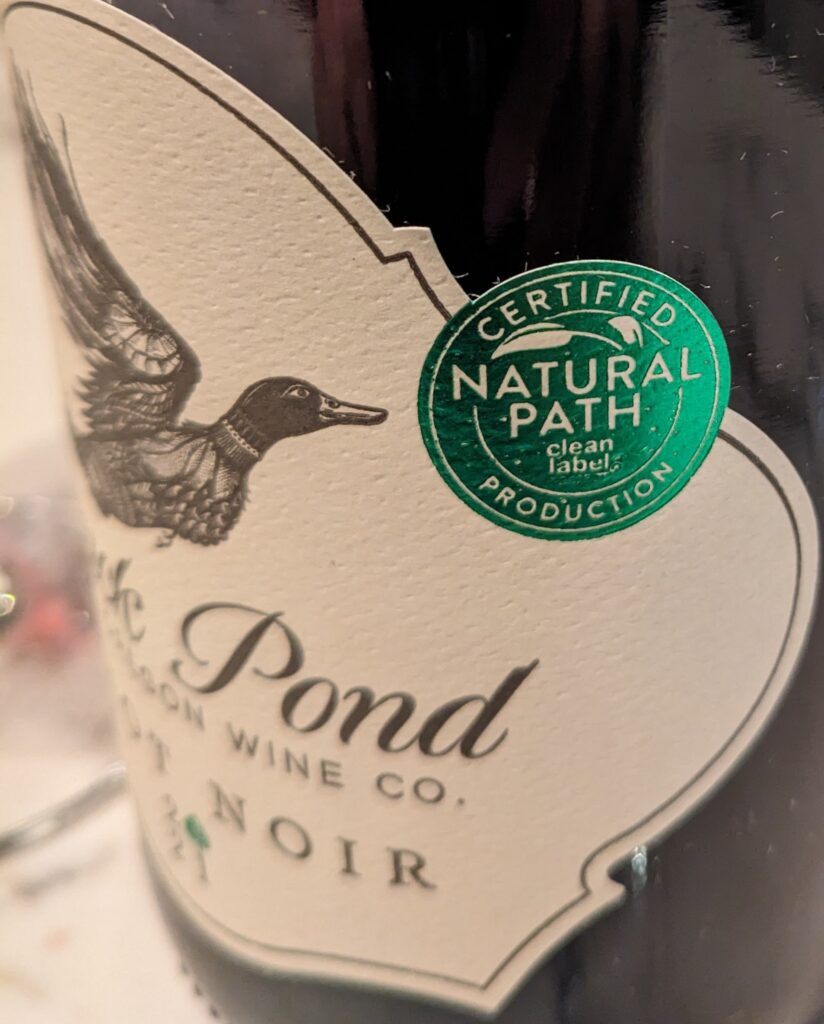
Launched under the Natural Path Production line, Duck Pond’s first wines were certified by this organization with the 2020 vintage, making them the first wines in America to receive this certification.
In adherence to the certification program, the ingredients are clearly stated on the label. Additionally, they testify to low sulfite use (<=100 PPM), vegan-only fining agents and the non-use of Glyphosate and Neonicotinoid pesticides.
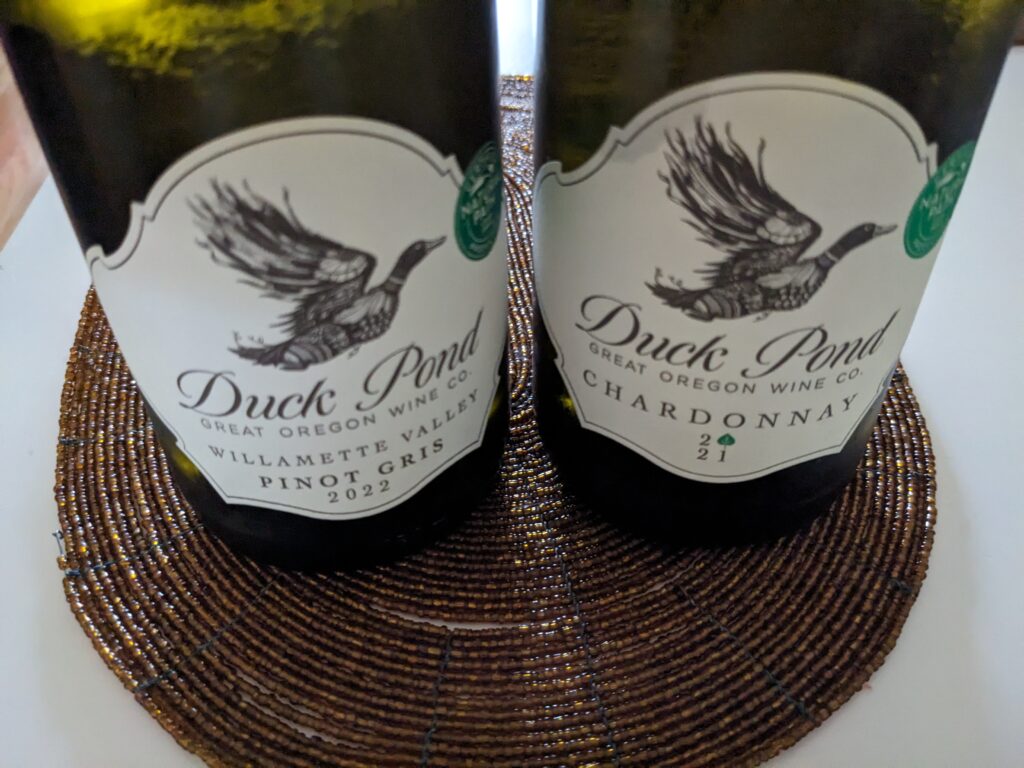
Equally important to Duck Pond’s focus on natural production, is that these wines are well made and well-priced, ranging from $15-$19 per bottle (winery prices; might be higher at your local wine shop). As of now, there are four wines in the Natural Path line up: Pinot Gris, Chardonnay, Rose (not tasted) and Pinot Noir.
Duck Pond Cellars Natural Path Production Pinot Gris 2022, Willamette Valley (OR), USA, $16.00 On the nose, this wine displays notes of tangerine and smoke, which persist on the dry palate. The wine is quite luscious, with bright acidity, medium body and long length.
Duck Pond Cellars Natural Path Production Chardonnay 2021, Oregon, USA, $15.00 This wine offers up melon and butter aromas and flavors, and an oak undercurrent, with medium acidity, medium plus body, and long length. It was a crowd pleaser at a recent gathering of friends.
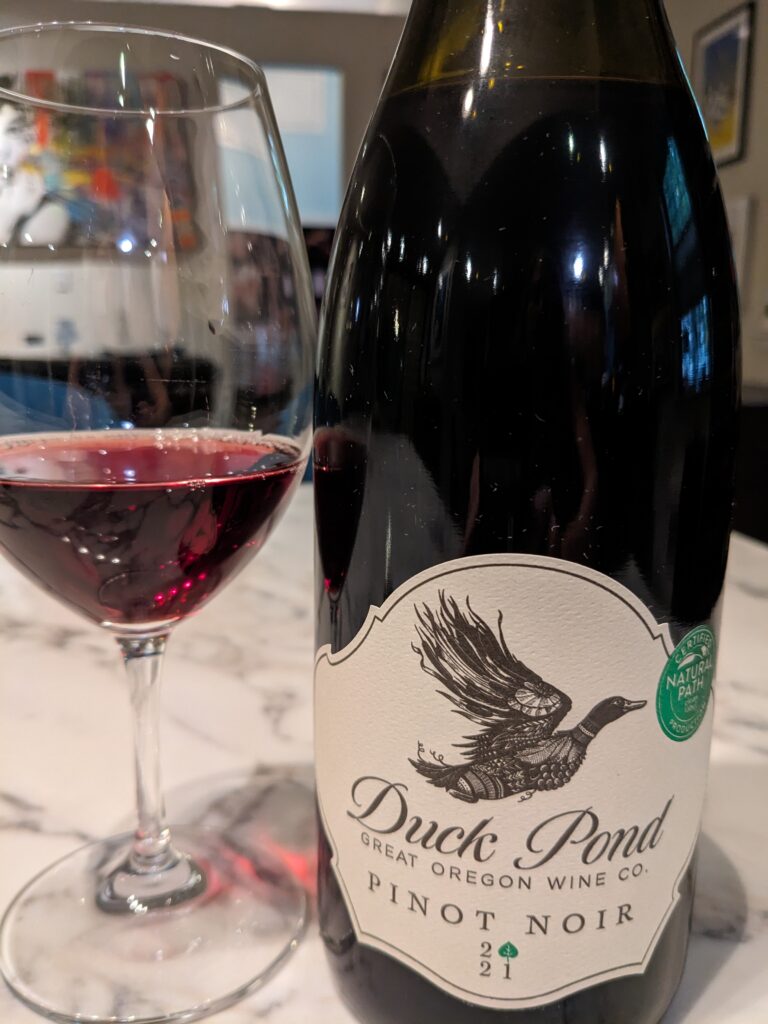
Duck Pond Cellars Natural Path Production Pinot Noir 2021, Oregon, USA, $19.00 Fresh aromas of cherry and raspberry greet the nose. The dry palate provides ripe black cherries, herbs, and an earthy undercurrent, with medium plus acidity, medium plus body and medium plus length. Really lovely.
Summertime… and the living is easy (or at least less encumbered compared to winter – no hats, gloves or scarves or bulky winter coats).
The Summer Solstice is upon us, and, although the weather doesn’t quite feel like it, it is indeed summertime and the season for barbecues, picnics and other outdoor endeavors. It’s a great time to gravitate towards fresh whites, lighter reds and the ubiquitous roses. Sparkling wines are also a fabulous option for this time of year (check out my story on Moscato d’Asti).
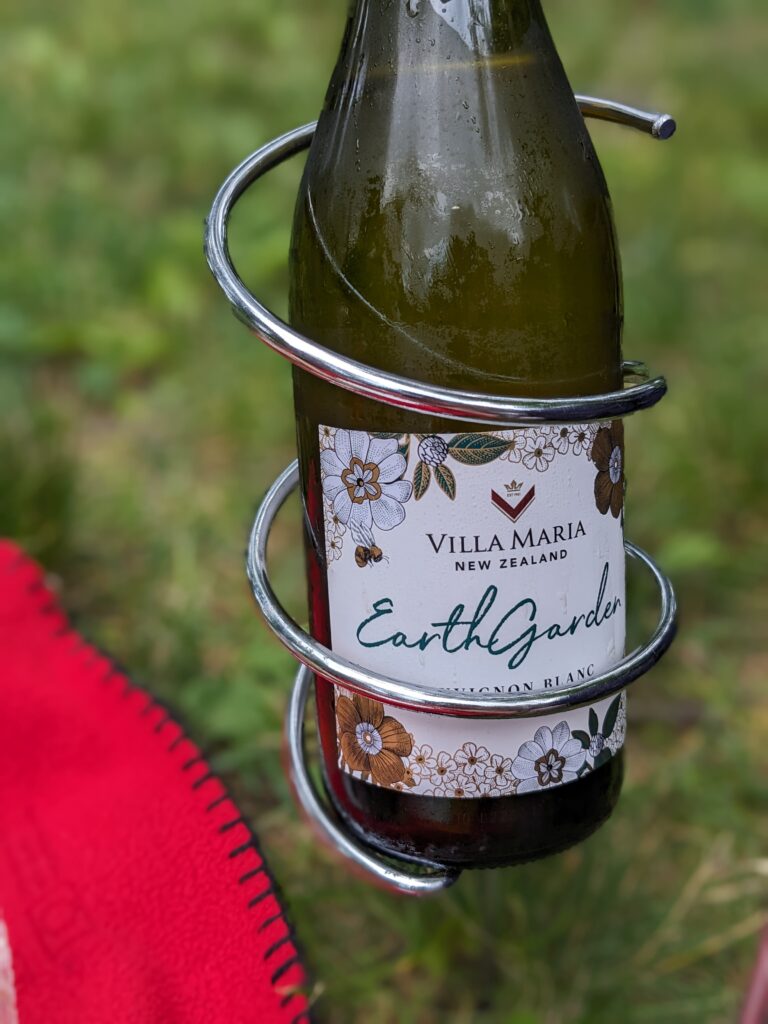
Villa Maria EarthGarden Sauvignon Blanc 2022, Marlborough, New Zealand, $20.00 From one of my favorite NZ producers, this wine is produced as a blend of 100% Sauvignon Blanc grapes harvested from several vineyards, all of which are sustainably grown. What that means is that the vineyards are free from synthetic pesticides and herbicides and are planted with a plethora of wildflowers to attract bees and beneficial insects. The nose offers up pronounced aromas of grapefruit and a slight herbal note. The medium bodied palate is fresh and bright, with grapefruit, herbs and the addition of lime, culminating in long length.
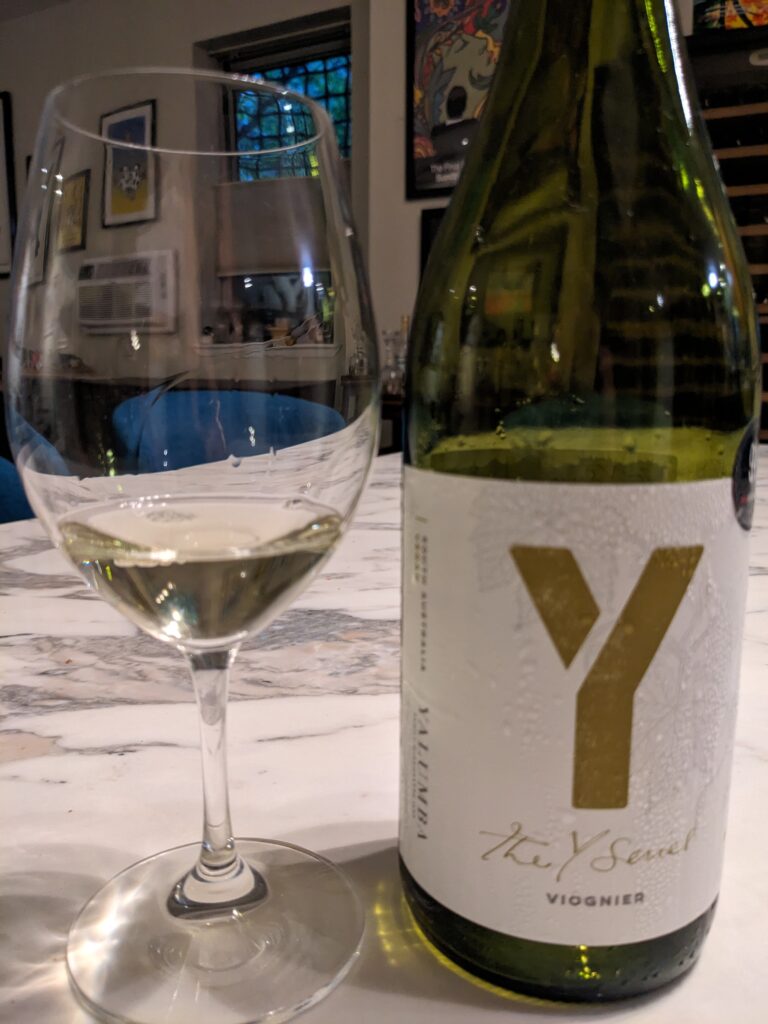
Yalumba Y Series Viognier 2021, Barossa Valley, Australia, $14.00 This wine underwent wild fermentation and lees aging, both of which add depth and complexity to the wine. With distinct floral, tangerine and tropical fruit aromas on the nose, the full bodied palate provides good acidity, joined by flavors of ginger and citrus, with long length.
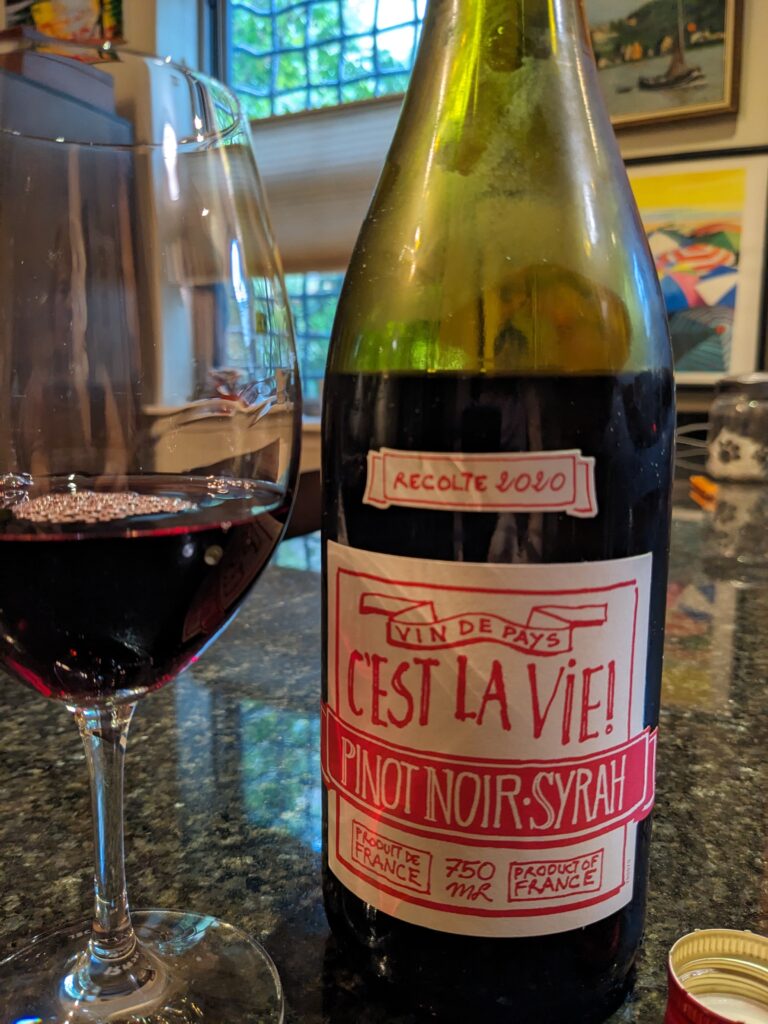
C’Est La Vie Pinot Noir Syrah 2020, Vin de Pays, France, $13.00 From Burgundian producer, Albert Bichot, this red blend (60% Pinot Noir and 40% Syrah) is a fresh and lively, easy drinking wine that’s perfect for a picnic or barbecue. With aromas of spice, earth, smoke and berries, it is dry, yet ripe, on the palate with medium+ acidity, medium+ body and medium+ length.
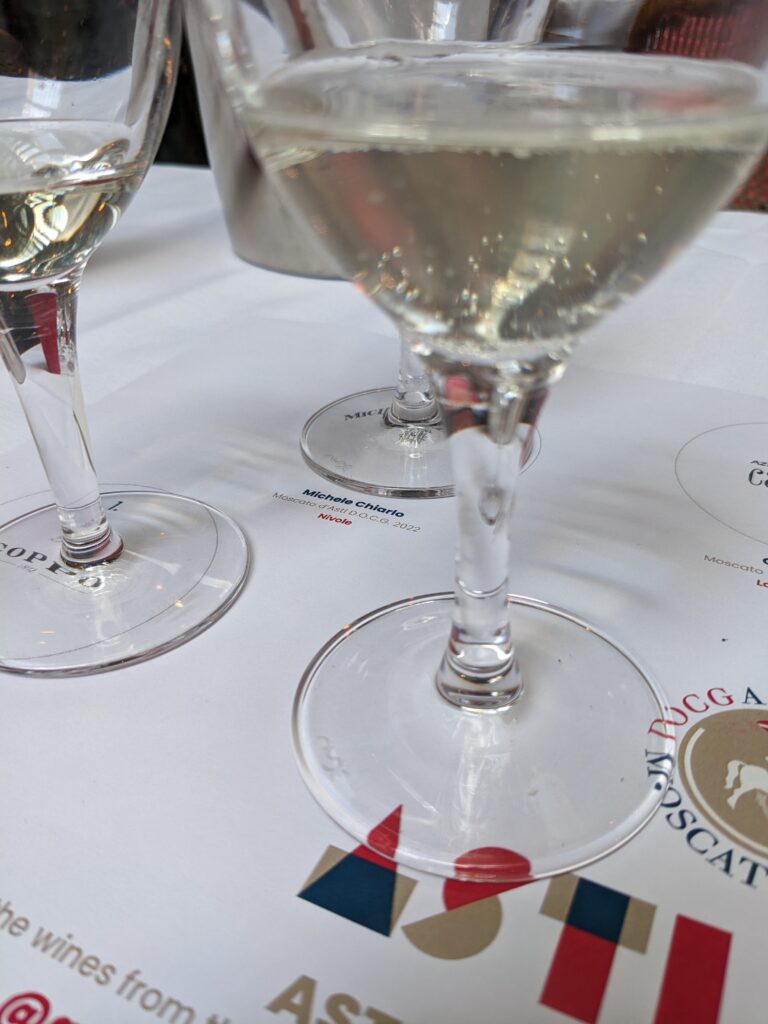
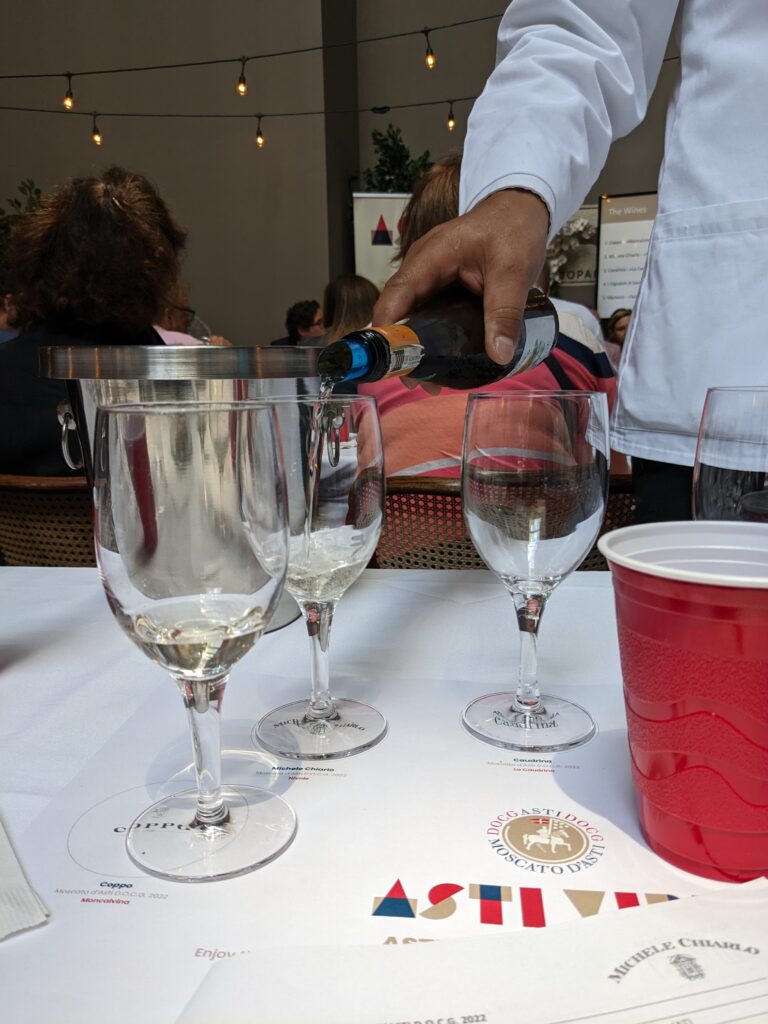
Are you in an Asti vibe? A recent Masterclass was the perfect opportunity to reacquaint myself with these sweet, sparkling wines from Italy’s Piedmont region. With the goal of transferring the grape to the glass, these wines benefit from the Moscato Bianco grape variety’s highly aromatic character.
Situated within Piedmont is the province of Asti, at the foot of the Italian Alps. The climate is influenced by both the mountains and its proximity to the sea and the soils are comprised of ancient sea beds. Viticulture must be manual due to the significantly steep vineyards. The various altitudes and variety of soils conspire to produce a range of aromatic compounds that provide complexity in the glass.
Here, Moscato Bianco grapes have been grown in the area since 1510, a transplant from the Middle East. There are 51 towns who lay claim to the Moscato d’Asti DOCG, which was the first sparkling wine produced in Italy back in 1865 by Carlo Gancia.
Utilizing the Charmat Method, the wines are pressurized in stainless steel tanks, preserving the aromatics in the wine and adding a slight effervescence, with a maximum of 2 bars of pressure (by contrast Champagne and other fully sparkling wines have 5 yo 6 bars of pressure).
The production method also requires that the wines maintain sweetness. Consequently, they generally range from 120-150 g/l of residual sugar, which is well balanced with sufficient acidity and bubbles. This also means that these wines are much lower in alcohol with 5-6% alcohol by volume.
With this lightness, freshness and lower alcohol, these are great wines for the heat of summer and are a perfect pairing with fruit, light desserts or an excellent counterbalance to a salty, savory dish such as prosciutto with melon.
TASTING NOTES
Coppo Moncalvina Moscato d’Asti DOCG 2022, Piedmont, Italy Coppo has been making Moscato since day one of the winery, among its other wines. Aromas of floral notes, gardenia and pear greet the nose. The palate is medium sweet, light bodied, with good effervescence and freshness. The acidity and sweetness are well balanced, with flavors of lemon candy and floral, culminating in long length.
Michele Chiarlo Nivole Moscato d’Asti DOCG 2022, Piedmont, Italy At Chiarlo, they take great pride in managing the Moscato vineyards with the same care they give to Barolo vines. The wine displayed lots of visible bubbles, with aromas of peach and blossom. The palate was less sweet than the Coppo, with great acidity, light body, peach flavors, persistent bubbles, and long length.
Caudrina La Caudrina Moscato d’Asti DOCG 2022, Piedmont, Italy Redolent of honeysuckle, this wine is medium sweet, yet fresh, with lovely effervescence; flavors of honey, honeysuckle and hint of herbs; culminating in medium+ length.
I Vignaioli di Santo Stefano – Ceretto Moscato d’Asti DOCG 2022, Piedmont, Italy A fresh nose with honey and cantaloupe aromas and flavors, this wine is off dry, with bright and lively acidity on the palate. The mouthwatering character of the wine lingers in the medium+ length.
Marenco Scrapona Moscato d’Asti DOCG 2022, Piedmont, Italy The mention of Scrapona on the label refers to a specific vineyard from which the grapes for this wine are harvested. Slight skin contact resulting in a hint of color. White flowers, fresh, balanced, lightly sweet, pear, honey, long length with a clean finish.
Fortified wines aren’t very well known among most consumers, And, no, it has nothing to do with vitamins. Rather, the fortification comes in the form of the addition of a grape-based spirit to raise the alcohol level and consequently halt the fermentation process. As a result, some of the sweetness in the wine remains instead of being fully converted to alcohol as would be the case with a dry wine.
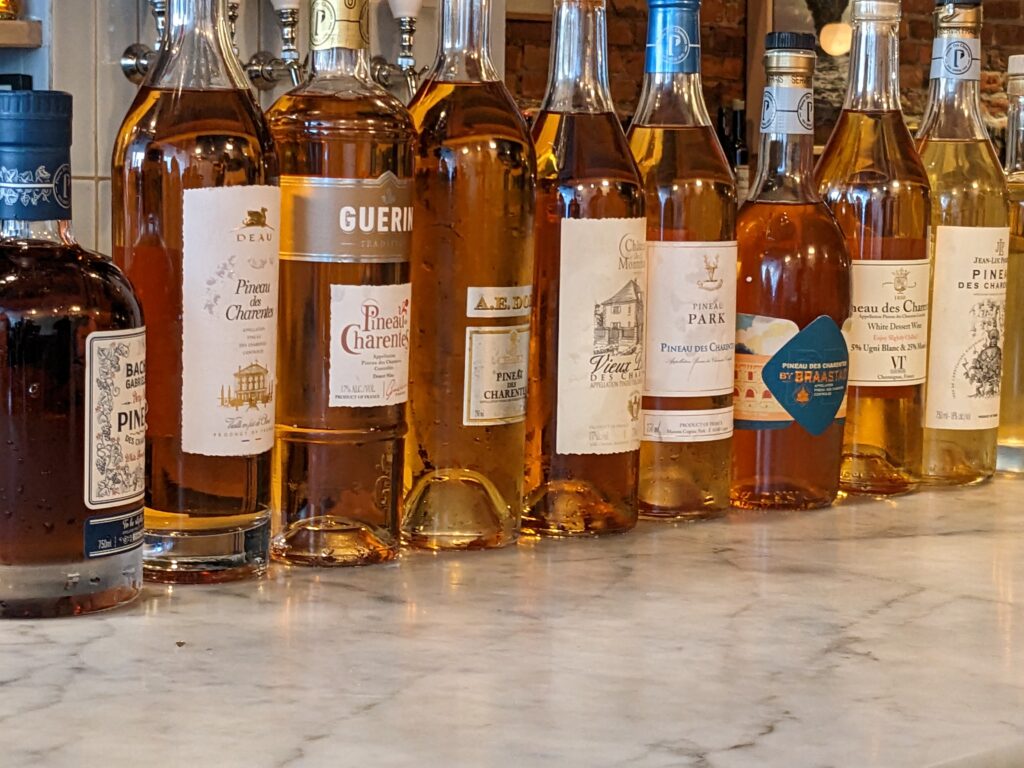
While Port, Sherry and Madeira are more recognizable in this category, Pineau des Charentes is definitely deserving of consideration. It hails from the Charente and Charente-Maritime regions of France, which is where Cognac is made and has had Appellation d’Origine Contrôlée (AOC) status since 1945, which guarantees quality and an adherence to minimum production requirements.
In particular, it must be aged for at least 18 months, 12 of which must be spent in oak. Wines designated as “old” must age for a minimum of seven years, while the “very old” must age for 12 years. Produced from Ugni Blanc, Colombard, Folle Blanche and other local grape varieties, it shares many similarities with Cognac, but are generally sweet wines, with an alcohol level of 17% (compared to 40% proof Cognac).
Not surprisingly, with its freshness and lower alcohol, it is well suited to cocktails. In fact, it is quite versatile and diverse in its expression, yielding a wide range of options. These wines can also be enjoyed on their own and can be a great pairing throughout the meal – not just with dessert – despite their sweetness. Rather, they are quite food friendly, a point made abundantly clear at a recent dinner at l’Accolade in New York City’s West Village neighborhood.
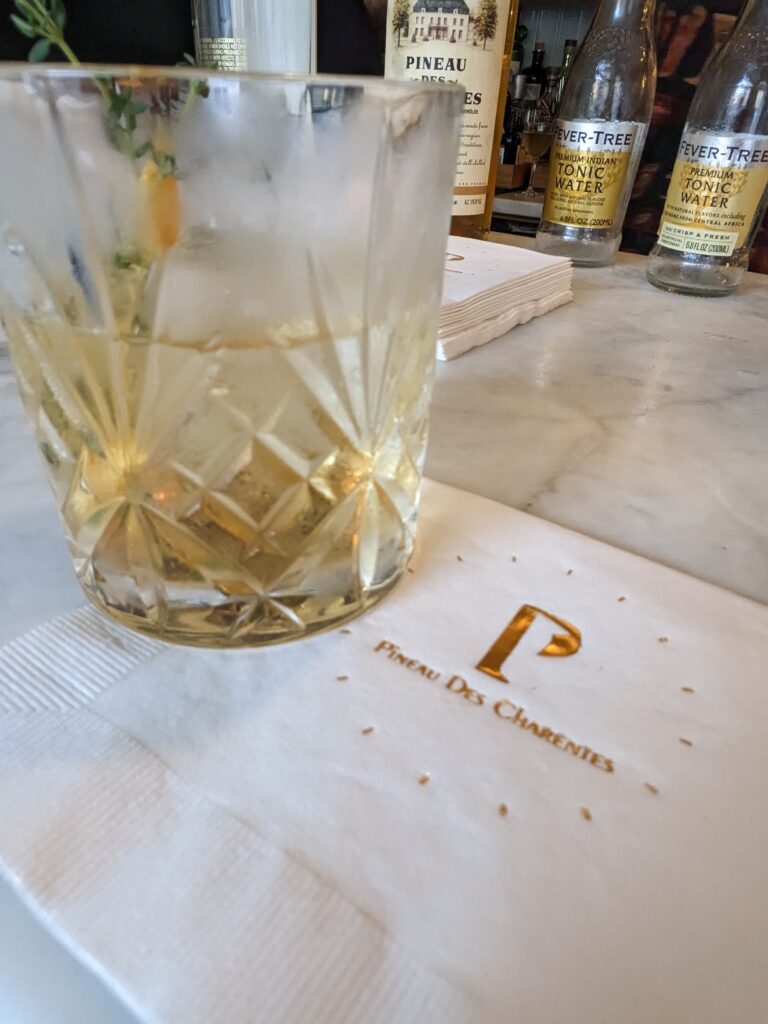
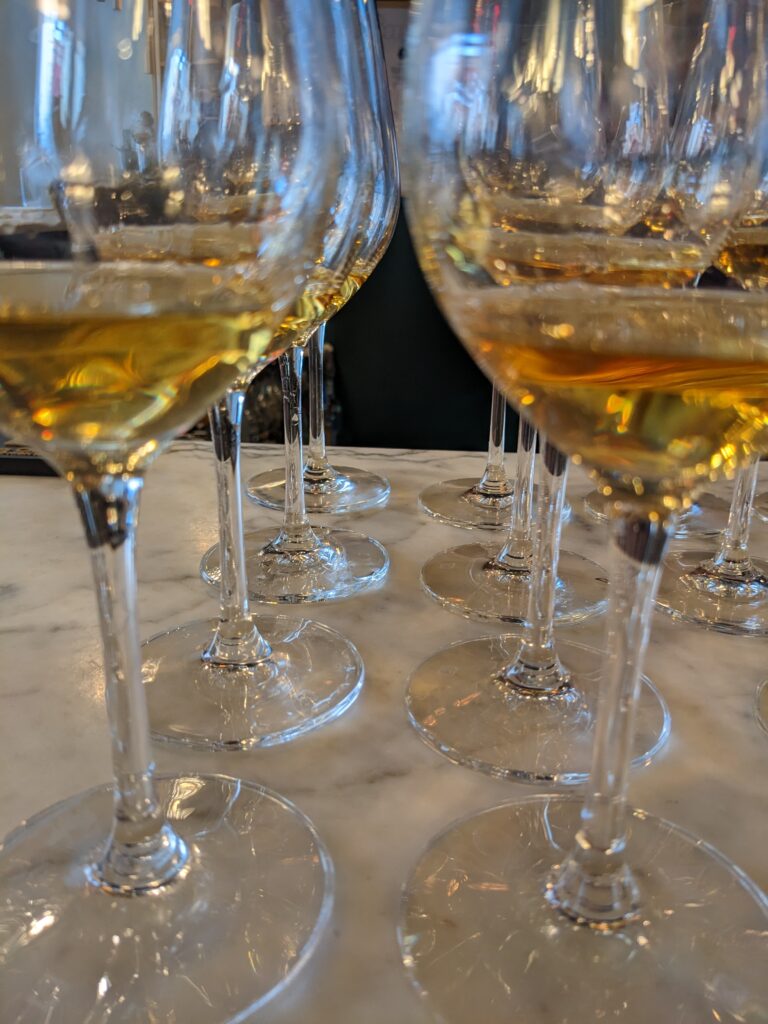
Presided over by Ms. Franky Marshall, who bills herself as a modern bartender, the evening got off to a great start with a Pineau & Tonic with thyme and grapefruit, which beautifully displayed the freshness, balance and aromatics of this wine. Franky has been working with Pineau des Charentes since 2017, and, once we were seated, paired each dish with a different Pineau option. In this fashion, she joked that we were “speed dating” the wines.
I was very impressed with the breadth and depth of what was in the glass and really enjoyed drinking the Pineaus with the meal.
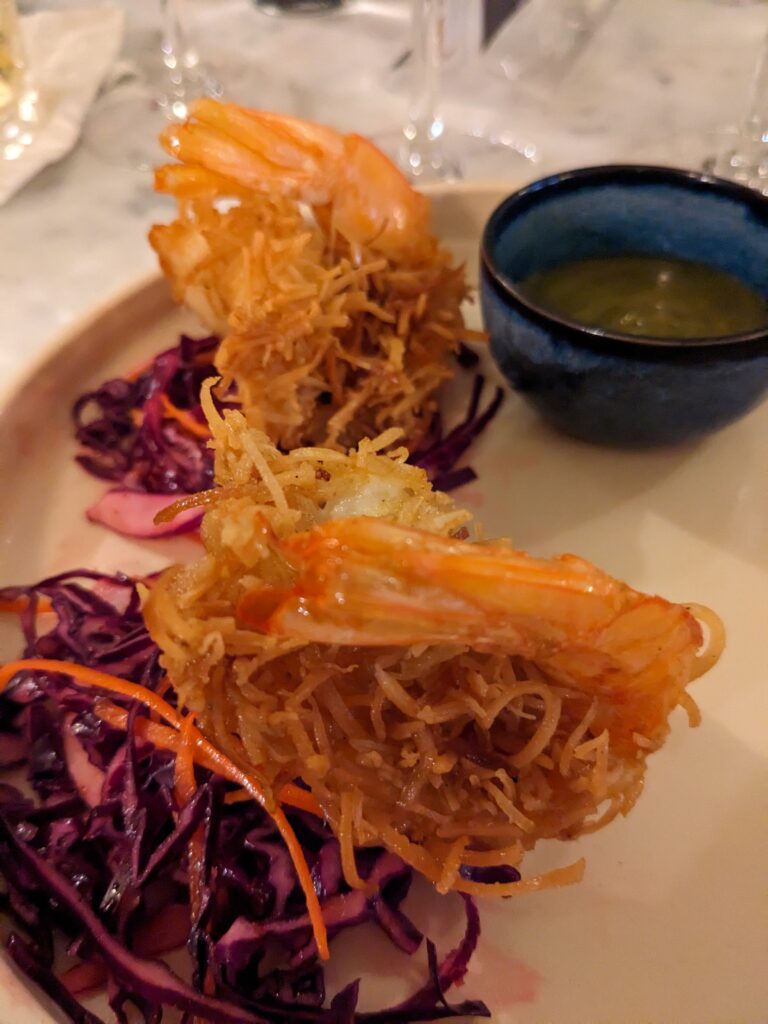
With my Coconut Shrimp appetizer, prepared with coconut, peanut dressing and a pepper cabbage salad, I enjoyed two Pineau des Charentes. The first of which was distinctly floral with maple aromas and flavors, while the second option was more intense and heavier in its texture and weight on the palate. They each matched well, but I was more partial to the former, as a counterpoint to the dressing.
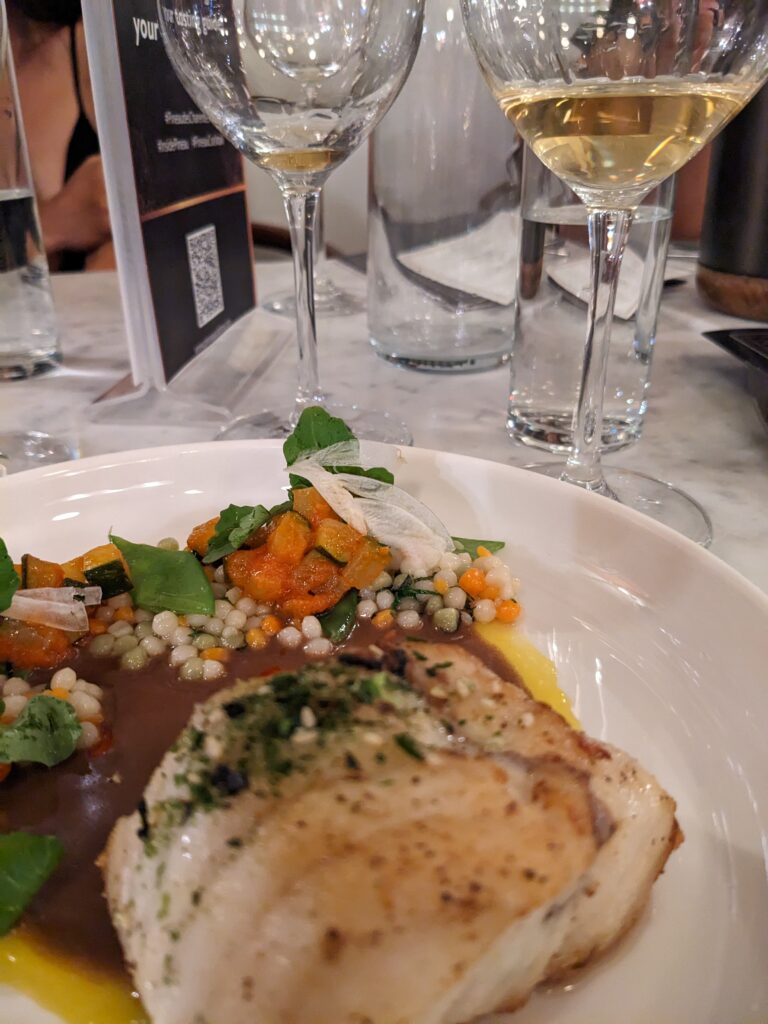
My main course of Monkfish served with zuchini, shrimp nage and mango puree was accompanied by one with caramel notes and a clean finish and another that was lighter, with bright acidity. Both were really lovely with the richness of the dish.
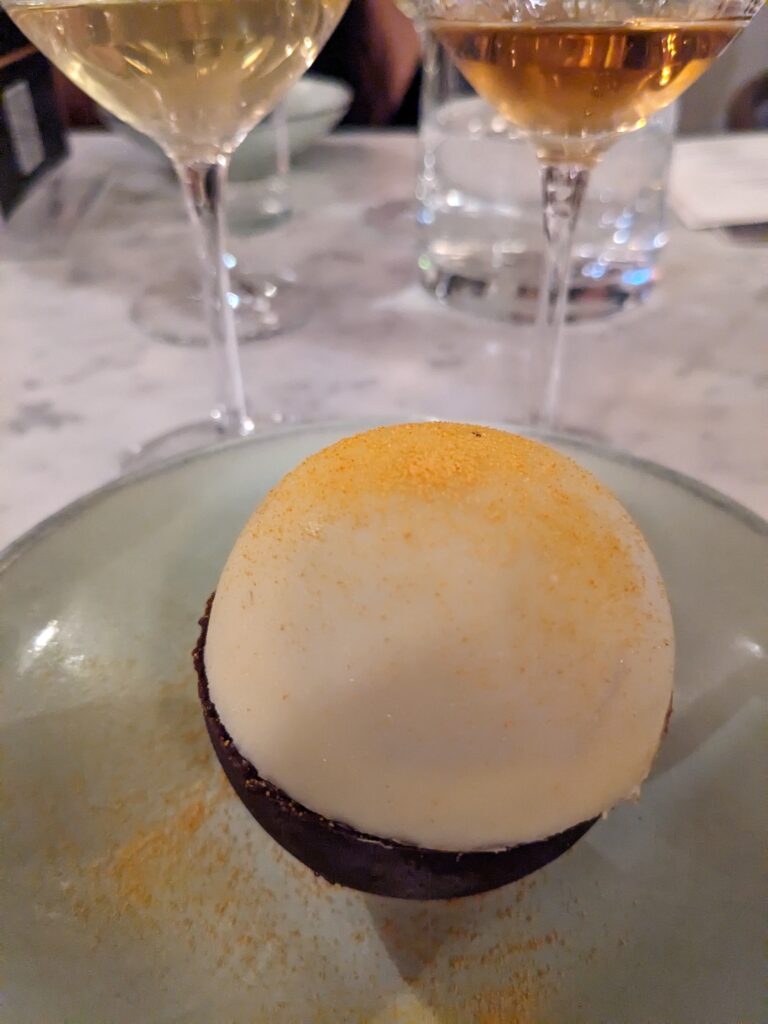
For dessert, I had the chocolate mousse with almondine, orange chocolate cake and almond puree. My Pineau pairings included a wine with light citrus notes that was medium sweet yet well balanced, with an herbal undercurrent. The other was more complex, with fuller body, caramel, burnt orange and rancio aromas and flavors, that had been aged for 15 years. The two wines paired really well, but the second wine was my favorite of the two for its complexity and rancio character.
If these wines are not on your radar (and likely they aren’t), I encourage you to seek them out or perhaps encourage your favorite bartender to try their hand at Pineau cocktails – for a twist on a classic or their own, new creation.
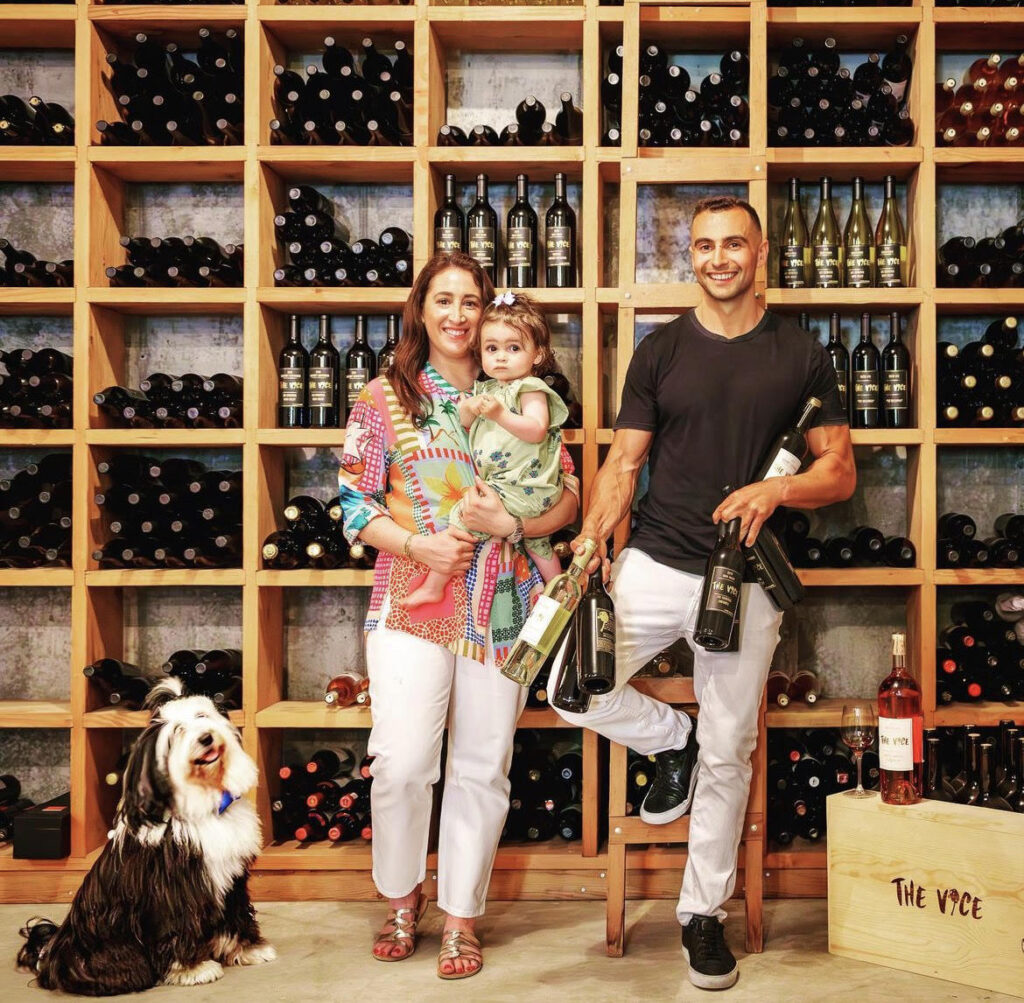
What’s your vice? For Malek Amrani and his wife, Tori Greenberg, the answer is wine. A former sales professional for Moet Hennessy and Diageo, Malek has a keen understanding of the wine world and consumer preferences. He also counts pizza and triathlons among his “moral faults”, while Tori’s other vices include fashion, sleep and rose.
The pair always dreamed of owning their own winery and now they do. In fact, while they launched The Vice several years ago, they recently opened a permanent location in St. Helena in the Napa Valley, further cementing their dream.
On the joint holidays of National Wine Day and National Chardonnay Day, Malek hosted a virtual tasting with members of the media to celebrate the opening as well as the release of their 100th wine. As a self-defined “luxury wine brand,” the wines are produced in small, numbered batches.
Primarily focused on Napa Valley terroir, The Vice’s mission is to make exceptional wines accessible. In pursuit of this goal, Malek currently works with 18 different varieties, sourced from 14 of Napa’s 16 AVAs. Their white label wines are their house tier, while the black label is reserved for single vineyard wines.
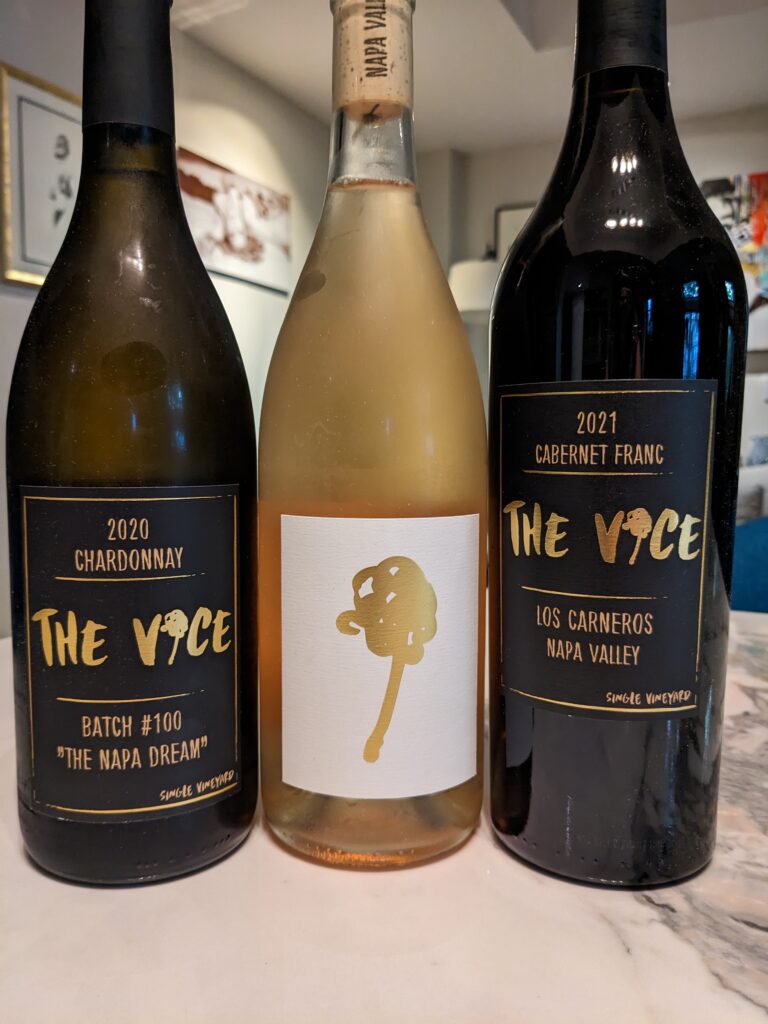
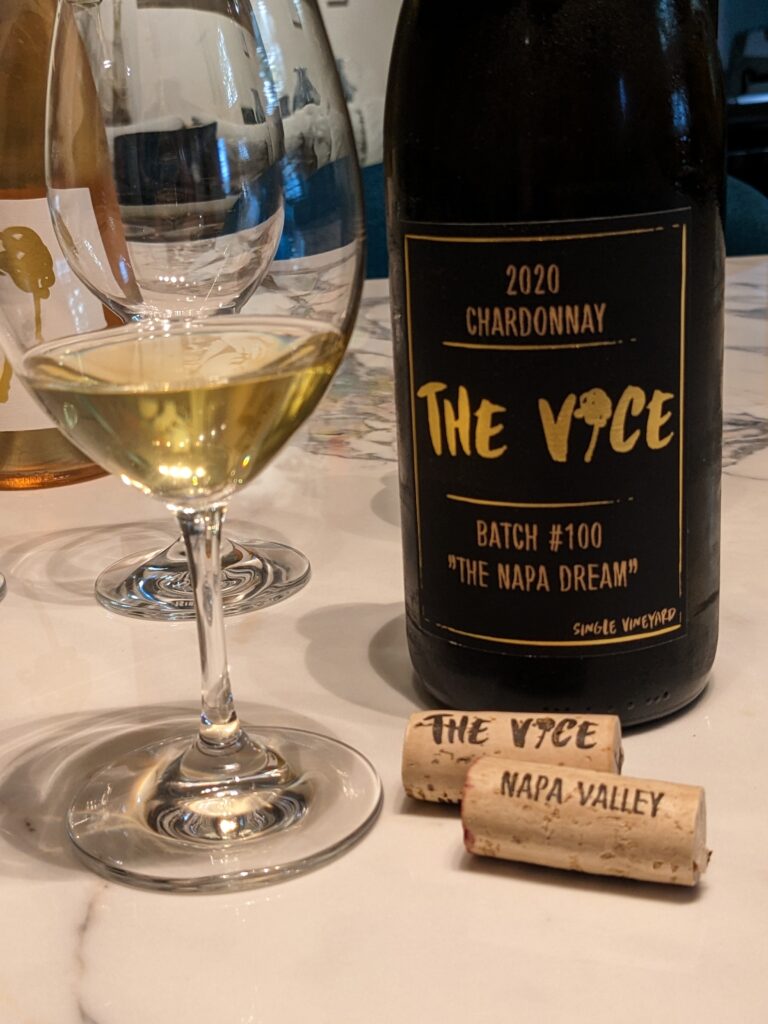
Among the most recent batches is the aforementioned 100th wine. Aptly named The Napa Dream (and also referred to as Batch #100), it is a Chardonnay sourced from a Certified Napa Green vineyard situated “at the far eastern edge of Los Carneros AVA”. It spent 30 months in new French Oak barrels.
TASTING NOTES
The Vice The Napa Dream Batch #100 Chardonnay 2020, Los Carneros (CA), USA, $46.00 This wine is deep golden yellow with nutty, butterscotch aromas that persist on the dry, rich full-bodied palate. It has bright acidity and flavors of roasted nuts, caramel, citrus and minerality, culminating in long length. Lovely and complex.
The Vice Orange of Viognier ‘Brooklynites 6.0’ 2022, California, USA, $33.00 With Viognier grapes sourced from Napa’s Oak Knoll District and Brentwood, Contra Costa, this wine brings together two different climates and thus a diversity of expression. It offers up floral and peach aromas, which persist on the palate with fresh acidity, medium body and long length. It is really refreshing, easy to drink (too easy!?!) and food friendly.
The Vice The OG, Cabernet Franc 2021, Los Carneros (CA), USA, $54.00 As Malek shared at the event, Cabernet Franc is fast becoming the hottest grape in Napa Valley (more so than Cabernet Sauvignon). Leafy and cranberry aromas greet the nose, with a dry palate, bright acidity, medium+ body and flavors of wet leaves and plum, with long length. Powerful, yet balanced.
As I’ve written before, the Malbec grape originated in France and is currently grown in Bordeaux, the Loire Valley and Cahors. But, despite Malbec’s association with France, it is planted in much greater numbers in Argentina. More specifically, Argentina’s long relationship with Malbec dates to 1853 when agronomist Michel Aimé Pouget brought the grape to from Europe to the New World country, having been hired to run an agricultural school there. In addition to the school’s influence, Argentina’s early viticulture was also shaped by Italian and French immigrants, who brought their grape growing experience and expertise with them.
Not surprisingly, I have had the opportunity to compare and contrast Malbec-based wines in the past, both with regard to producer as well as with regard to region of production (i.e. Argentina vs. France).
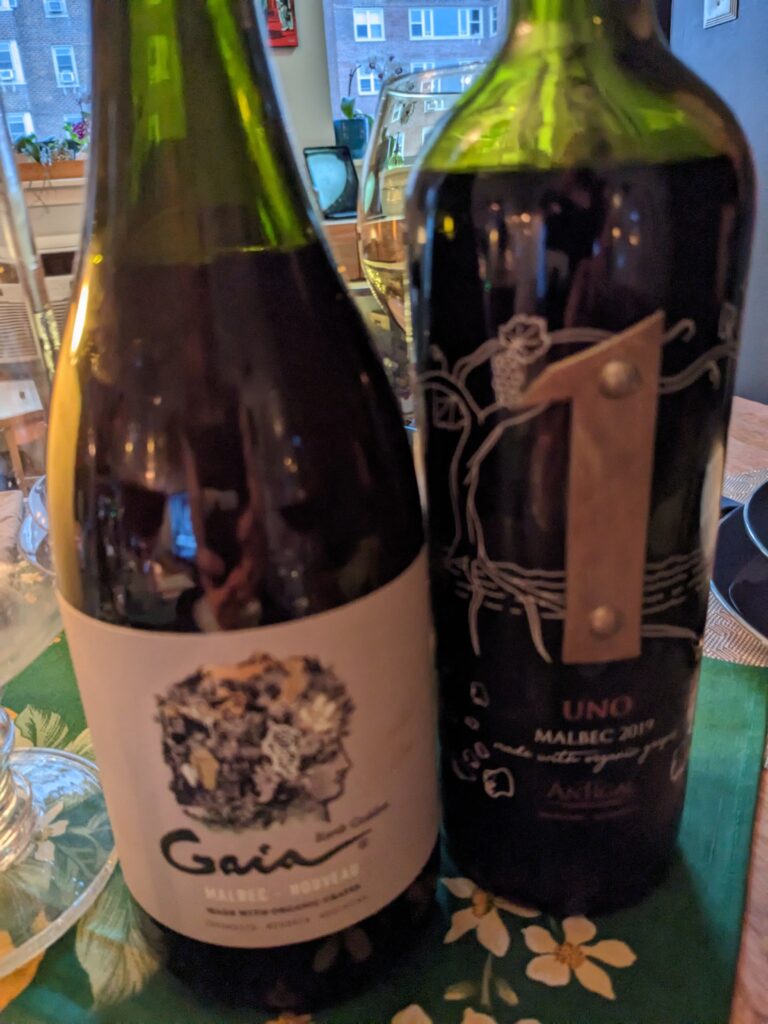
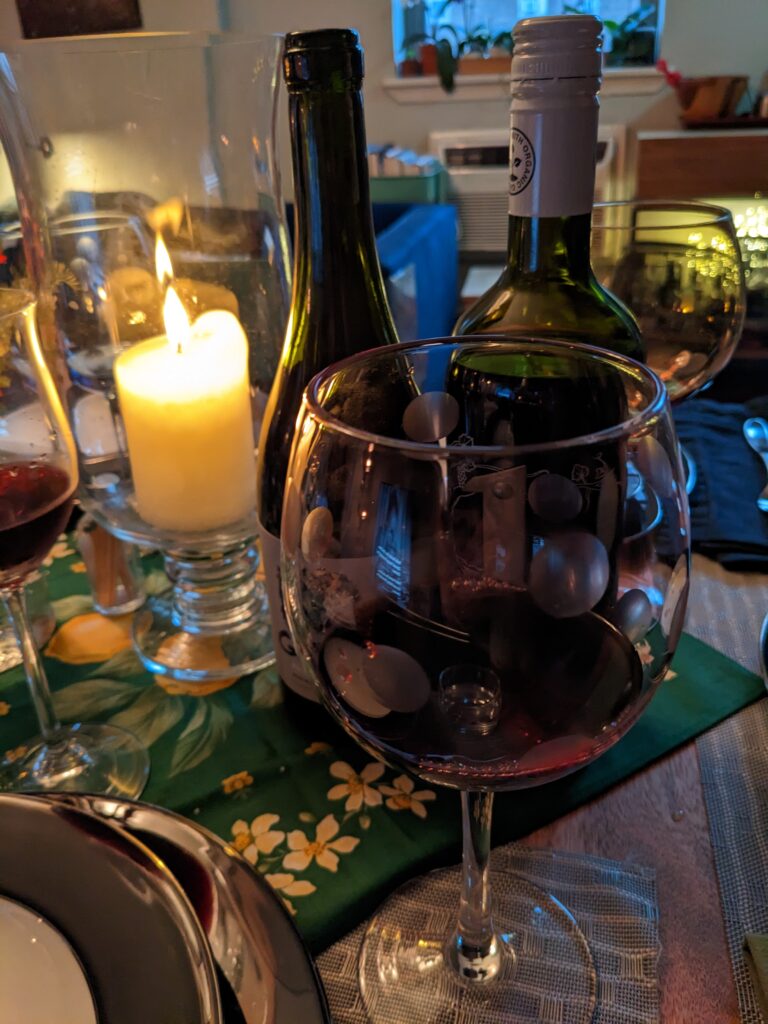
However, I recently had the particularly interesting chance to taste two Malbecs side-by-side, which differed markedly in winemaking approaches: traditional red wine production vs. carbonic maceration.
Traditional red wine production is fairly well known and understood by consumers, but carbonic maceration is less familiar, since it is mostly confined to the production of Beaujolais Noveau. Utilizing intracellular fermentation, carbonic maceration typically produces lighter style wines with a fresh fruit flavor profile. This was not a winemaking technique brought to bear on the Malbec grape… until now. In fact, there appears to be a trend among Argentine producers (see: this story) in using this unusual approach with Argentinian grapes.
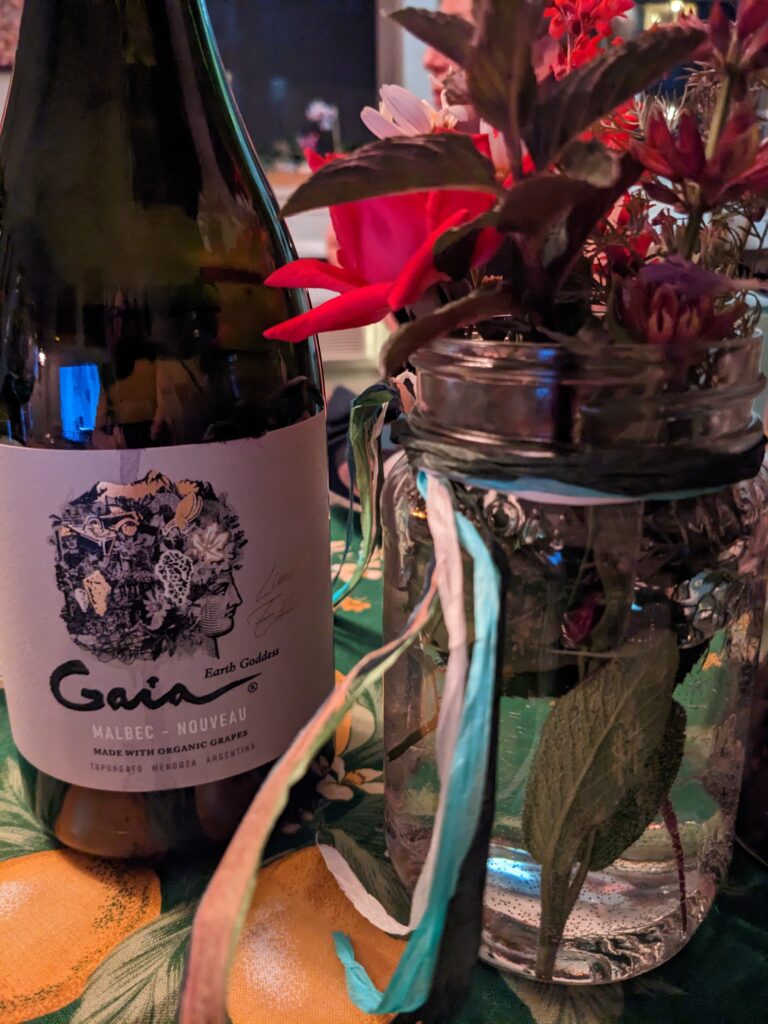
Now, joining this small coterie of carbonic macerators, Domaine Bousquet has added its Gaia Nouveau Malbec to the mix. Produced with certified organic Malbec grapes, winemaker Rodrigo Serrano decided, “Why not try to make a carbonic maceration Malbec?” Answering his own question affirmatively, the first wine was made with the 2022 vintage to rave reviews.
The counter balance, with a more traditional approach, was Antigal’s Uno Malbec 2019, also made with organic Malbec grapes and produced solely in stainless steel tanks (no wood/oak influence).
I was previously introduced to Antigal in 2018 (see story). Obviously a lot has happened in the world since then, so it was a pleasure to receive a sample of the current vintage of this wine to reacquaint myself. Proudly bearing its metallic numeral 1 breast plate, this wine comes from Antigal’s Uno collection.
Domaine Bousquet Gaia Nouveau Malbec 2022, Uco Valley, Argentina, $20.00 (100% Malbec, certified organic) This wine presents with fresh berry aromas. It is light bodied, with fresh berries and a hint of earth, with lively acidity and bright freshness on the dry palate with long length.
Antigal Uno Malbec 2019, Uco Valley, Argentina, $18.00 (100% Malbec, organic grapes) This wine has a pronounced nose with black and blue fruit, spice and vanilla, which persist on the dry palate, with ripe, medium-firm tannins, culminating with medium+ length.
Earth Day has come and gone, but while the holiday is a reminder that we must protect and cherish our planet, a single day is obviously not enough to do so. To a very real and certain extent, EVERY day should be Earth Day!
Although we can find fault with many industries and organizations, within the world of wine, there are a number of important and impressive examples of wine regions and individual wineries who are making the investment and having an impact with their actions.
In particular, Domaine Bousquet stands as a beacon, having been organic from the “get go”. Along these lines, winery owner, Anne Bouquet refers to herself as an “Organic Revolutionary” and an “International Citizen”, both of which are well deserved and apt descriptors of her commitment to sustainability in all that they do. She is joined by lead winemaker, Rodrigo Serrano, in their quest to lead the region in organic viticulture and sustainability efforts. This “teacher’s soul” has been at the winery for the past five years, and is truly passionate about details in achieving these overarching goals.
The winery has been Certified Organic for over 25 years and has also been certified by Demeter and Biodyvin for its conversion to biodynamic viticulture. They have recently added ROC (regenerative organic certification) certification to their list of organic certifications and are 360 sustainable.
Equally telling, as of this year (2023), they are now a certified B Corp organization. “B Corp Certification is a designation that a business is meeting high standards of verified performance, accountability, and transparency on factors from employee benefits and charitable giving to supply chain practices and input materials.” (From B Lab) Some of their wines also are certified as organic Kosher, Vegan and Gluten-free.
Yet, they are not content to rest on their laurels; future endeavors seek to reduce their CO2 and H2O footprints, especially as there is less snow in the mountains due to climate change.
The winery is also expanding its focus to address other issues such as making low calorie wine, low alcohol wine and organic wine (as opposed to making wine with organic grapes, but with conventional winemaking). In this regard, the biggest challenge is to avoid using SO2, which is an antioxidant and anti-microbial, among other things. These expansions have been challenging, but rewarding as the results are finally realized in the glass.
Across the pond, the Vino Nobile di Montepulciano consortium in Italy’s Tuscany region has been similarly hard at work in pushing a sustainability agenda. The result of its hard work was its award of the Equalitas standard’s sustainability certification, making it the first (and currently only) Italian wine denomination to achieve this milestone. The certification trademark extends to the entire region and is the result of a program initially implemented in the early 1990s and then built upon over the years.
To receive this prestigious certification entails “compliance with a high number of environmental requirements (like biodiversity and the measuring of carbon and water footprints) and socio-economic requirements (like verifying that the principles of freedom of association and equal opportunity are respected).”
Among these efforts, in 2006, the consortium partnered with the municipal government to collect organic waste from the vineyards for use in the production of combustion biomass to supply energy to school and government buildings. Further, the region’s Carbon Footprint project became a national model in 2015.
Of course, these commitments are not at the expense of their commitment to making high quality wine. Vino Nobile di Montepulciano is among Italy’s top designated wines having been promoted to DOCG status in 1980. Yet, it often gets overshadowed by its Tuscan neighbors: Chianti Classico and Brunello di Montalcino, whose wines also sport the Sangiovese grape.
The good news is that these wines are often well priced and provide great drinking pleasure. So you can feel good about their commitments to the Earth as you enjoy swirling, sipping and savoring them in your glass.
TASTING NOTES
TASTING NOTES: Domaine Bousquet
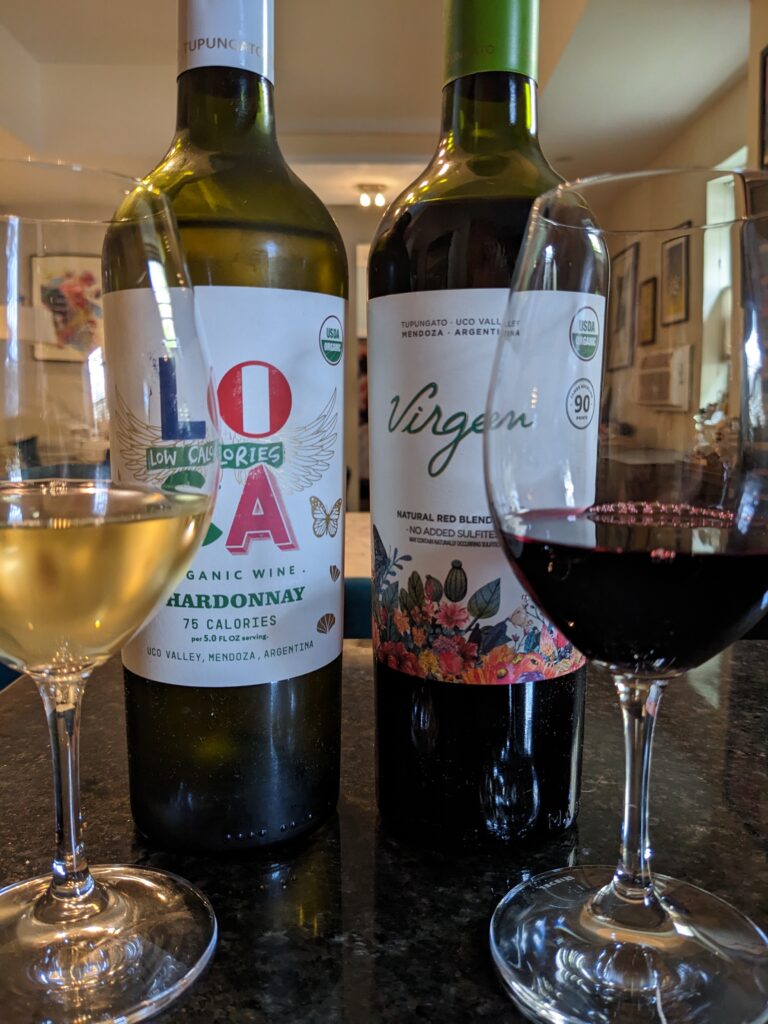
Domaine Bousquet LO CA Chardonnay 2022, Uco Valley, Argentina, $14.00 LO CA is a local calorie and low alcohol wine, which required numerous attempts to get it right due to ensure a wine that was stable and of the quality they desired. The resulting wine has 9% abv and 2% residual sugar. Green apple, musk and citrus greet the nose and persist on the palate with high acidity, minerality, medium body and long length.
Domaine Bousquet Virgin Red Blend 2021, Uco Valley, Argentina, $13.00 A combination of 35% Malbec, 35% Cabernet Sauvignon and 35% Cabernet Franc, this wine is USDA-certified organic and sulfite-free. A fresh and easy drinking wine, it offers up berries, plum, floral and black cherry, with medium acidity, medium body and good length.
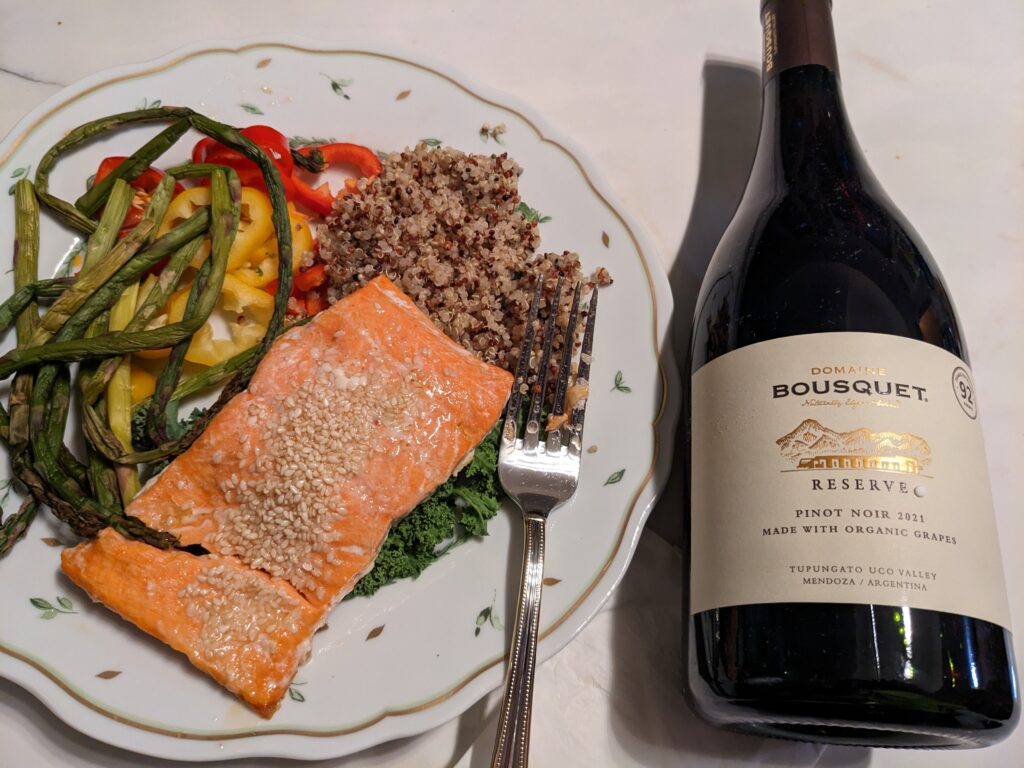
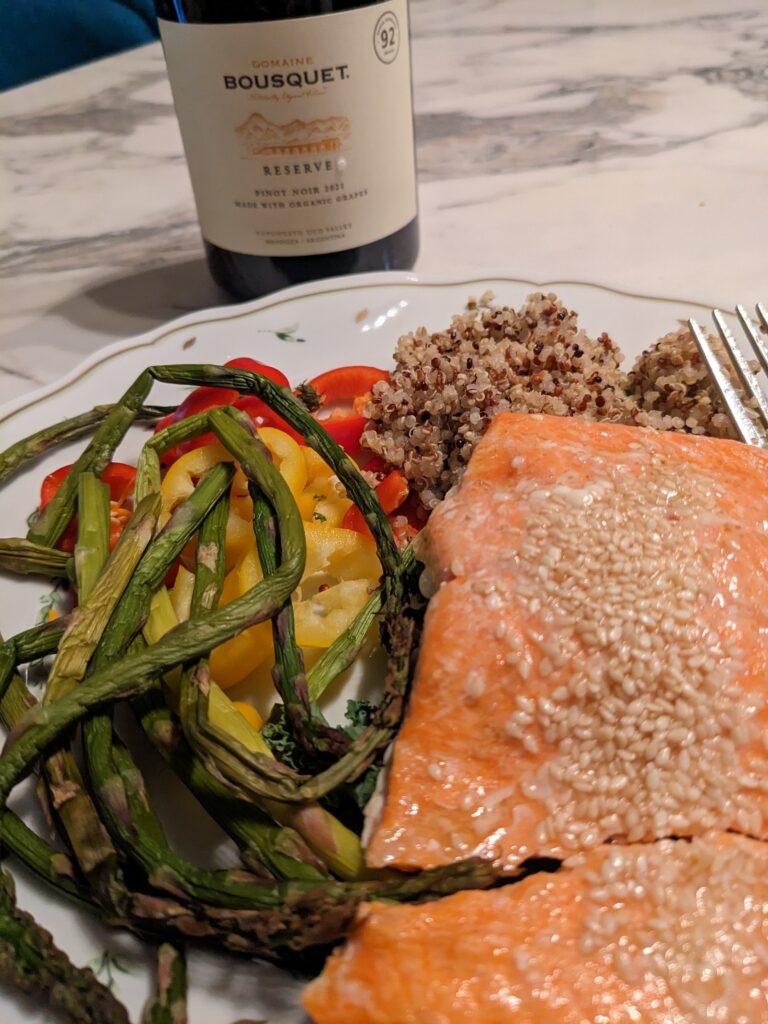
Domaine Bousquet Reserve Pinot Noir 2021, Uco Valley, Argentina, $18.00 Made with certified organic grapes, this wine took many years to perfect since Anne is very particular about her Pinot Noir. The time and effort were worth it with its complex aromas of smoke, tart cherry, and an earthy undertone. It is medium bodied with bright acidity and long length.
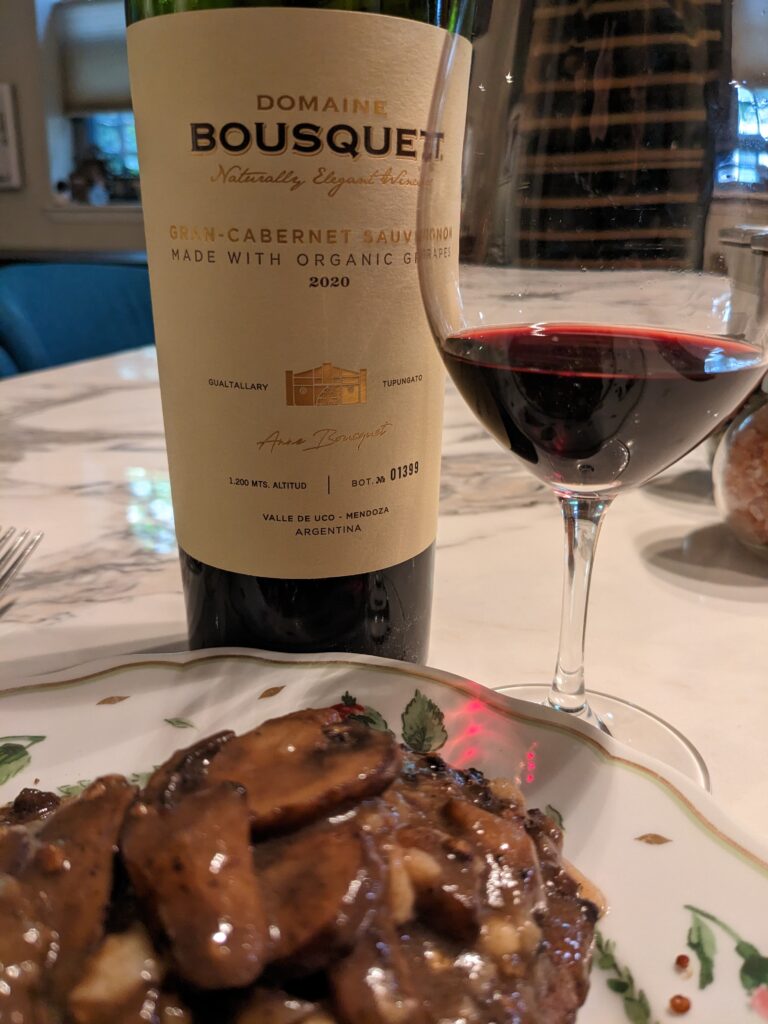
Domaine Bousquet Gran Cabernet Sauvignon 2020, Uco Valley, Argentina, $20.00 A blend of 85% Cabernet Sauvignon and 15% Malbec (both of which are certified organic), this wine presents notes of vanilla, oak, black fruit and a slight leaf character on the nose. With Medium+ body, good acidity, firm ripe tannins, and black and blue fruit, it is ripe yet dry, culminating in long length.
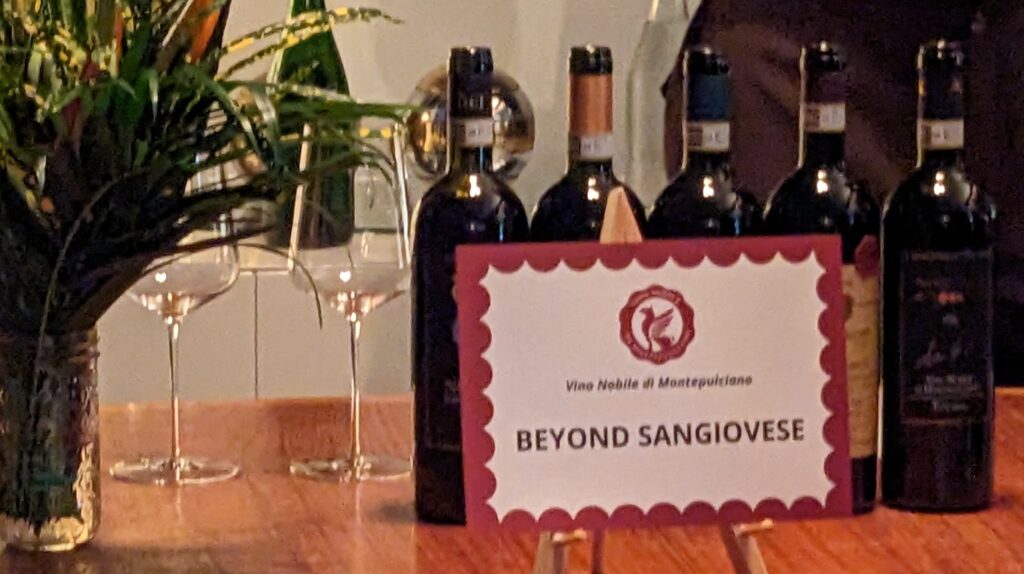
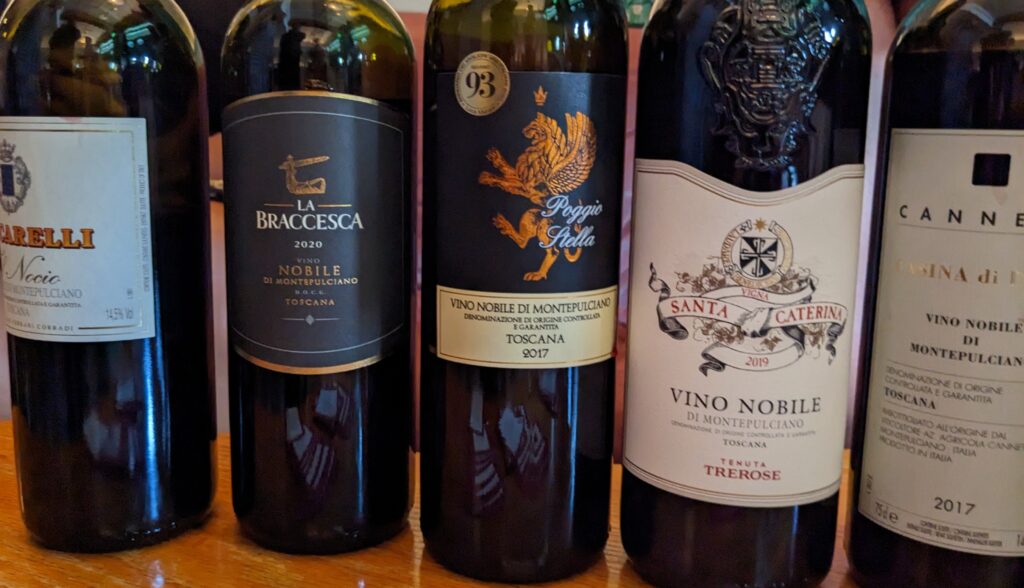
TASTING NOTES: Vino Nobile di Montepulciano
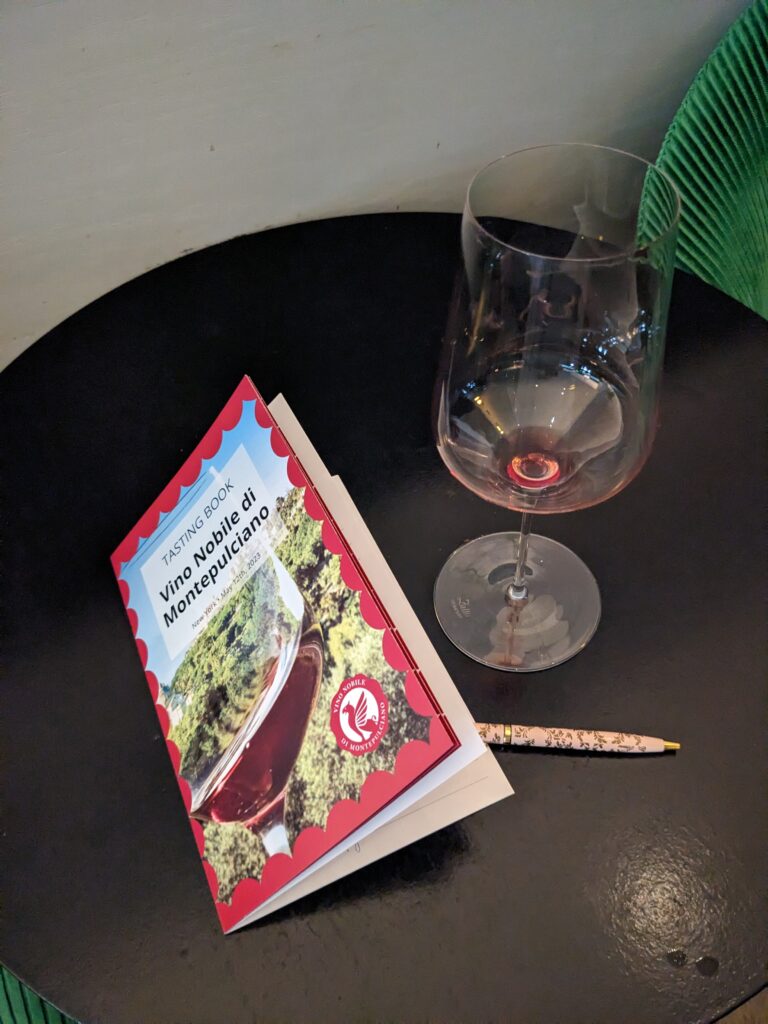
A recent walk-around tasting event provided attendees with the opportunity to taste through a collection of Vino Nobile di Montepulciano wines as well as meet a few of the winery representatives.
Maria Stella Carletti, Winemaker at POLIZIANO Winery
Here are a few of my favorites (notes are limited):
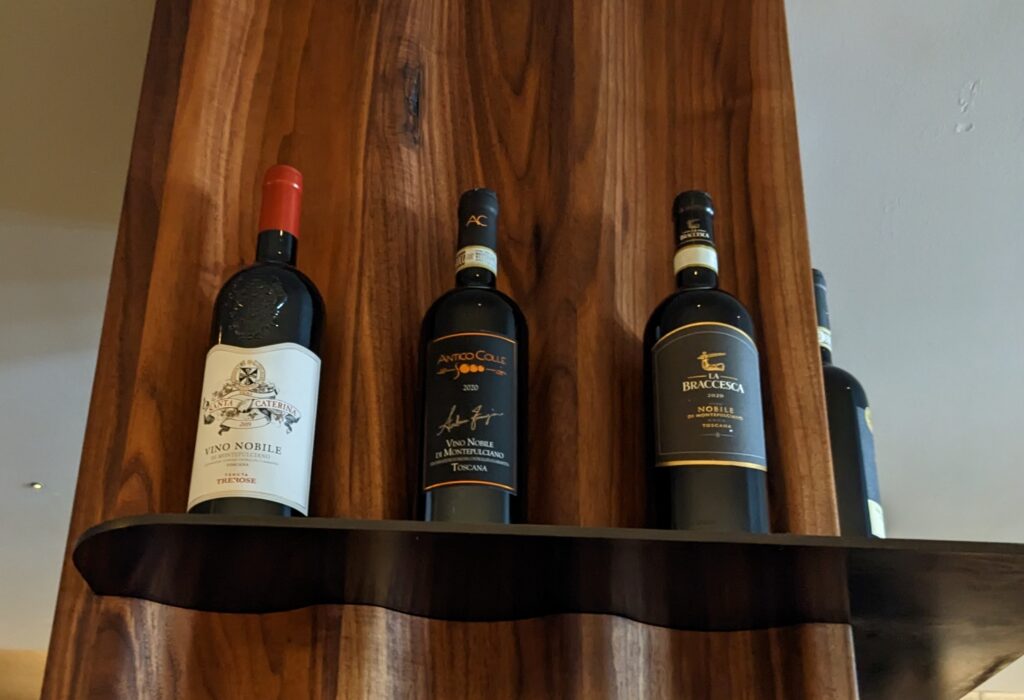
Antico Colle Vino Nobile di Montepulciano 2020, Tuscany, Italy 95% Sangiovese, 5% Merlot Fresh, with decidedly herbal characteristics, firmer tannins and floral notes.
Carpineto Vino Nobile di Montepulciano Riserva 2018, Tuscany, Italy Sangiovese, Canaiolo and other authorized grapes Meatier, with really nice depth and riper fruit.
Dei Vino Nobile di Montepulciano 2019, Tuscany, Italy 70% Sangiovese and other red grape varieties Floral, powerful, with darker fruit, less tannic than some of the other wines.
Icario Vino Nobile di Montepulciano 2019, Tuscany, Italy 90% Sangiovese, 10% Colorino With complex notes of smoke, oak, black fruit, it has a lighter structure and texture, with a distinct cherry and leafy palate.
La Braccesca Vino Nobile di Montepulciano 2020, Tuscany, Italy Sangiovese, Merlot Rich and ripe with dark cherry aromas and flavors, firm tannins.
La Ciarliana Vino Nobile di Montepulciano 2018, Tuscany, Italy Sangiovese, Mammolo Floral with lush, ripe red fruit, soft tannins and long length.
Poliziano Vino Nobile di Montepulciano 2020, Tuscany, Italy 90-95% Sangiovese, 5-10% other grapes, including Canaiolo and Colorino Cherry and plum, with dusty tannins, vibrant acidity, medium body and long length.
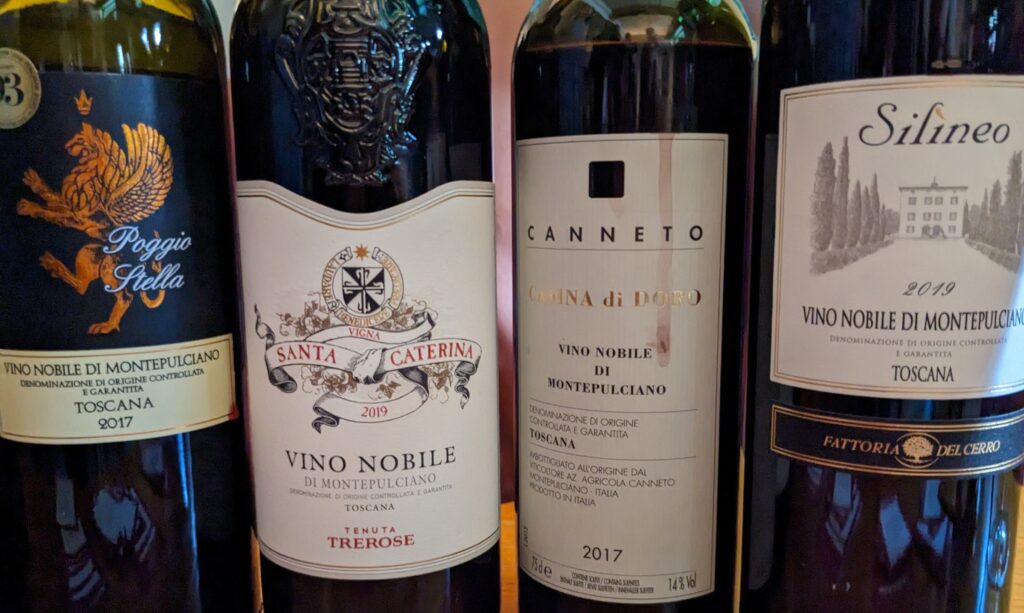
Tenuta Trerose Vino Nobile di Montepulciano S. Caterina 2019, Tuscany, Italy 100% Sangiovese Intense nose and palate, with ripe red fruit and long length.
Vecchia Cantina di Montepulciano Vino Nobile di Montepulciano Poggio Stella 2017, Tuscany, Italy mostly Sangiovese Lovely and soft, with cherries, berries and vanilla.
Spring has been a long time coming this year. While Mother Nature graced us with a beautiful glimpse of picture-perfect weather in early April, the cold, wet weeks that followed left much to be desired. We are now happy to see the sun and feel its warmth, beckoning us outside. In a word (or more precisely two), it’s Picnic Season!
That means a lot of things, but chief among them is what wines to enjoy al fresco this spring and summer. In that regard, I recently had the very pleasant opportunity to taste through a selection of wines from Spanish wine producer, Hammeken Cellars. With Sailé Ramirez at the helm as CEO, the company has launched six new brands and planted over 250,000 trees as part of their sustainability program.
In fact, during that spring preview weekend in April, my husband and I had a picnic date night in Fort Tryon Park, toting along two rosés from their collection: Radio Boka Rosé and Sedosa Rosé.
Outside was no longer an option for a while, so the Radio Boka Verdejo was enjoyed indoors at the dining table, but the Gotas de Mar Albarino was a welcome companion as I introduced my friend, Sharon, to the joys of fancy picnics when we met up in Prospect Park for lunch and a production of Molière’s Tartuffe.
In keeping with the theme of freshness and al fresco dining, I’m including tasting notes from a recent seminar with Domaine Bousquet, since several of its current releases are also perfect picnic pairings, particularly, their sparkling rose and LO CA Chardonnay.
TASTING NOTES
WHITES
Radio Boka Verdejo 2021, VDT Castilla, Spain, $12.00 Aromas of bitter almond, pear, and citrus on both the nose and palate, this complex wine offers up medium body, medium acidity and long length.
Gotas de Mar Albariño 2022, Rias Baixas, Spain, $25.00 Produced from 100% Albariño from 15-25 year old vines, this wine was aged for six months on its lees. Notes of citrus and riper tree fruit are joined by minerality and salinity, with medium body, good acidity and long length.
Domaine Bousquet LO CA Chardonnay 2022, Uco Valley, Argentina, $14.00 LO CA is a local calorie and low alcohol wine, which required numerous attempts to get it right due to ensure a wine that was stable and of the quality they desired. The resulting wine has 9% abv and 2% residual sugar. Green apple, musk and citrus greet the nose and persist on the palate with high acidity, minerality, medium body and long length.
ROSÉS
2021 Radio Boka Rosé, VDT Castilla, Spain, $12.00 Tasted alongside the Sedosa rosé, this wine was less ripe, with slightly higher acidity. It is redolent of fresh raspberries and citrus, with medium body and long length.
Sedosa Organic Rosé 2021, VDT Castilla, Spain, $20.00 Comprised of 100% Bobal from 15 year old vines, this wine is pale salmon in color with aromas of berries, and melon and a hint of floral. The dry palate provides ripe fresh berries, good acidity and long length.
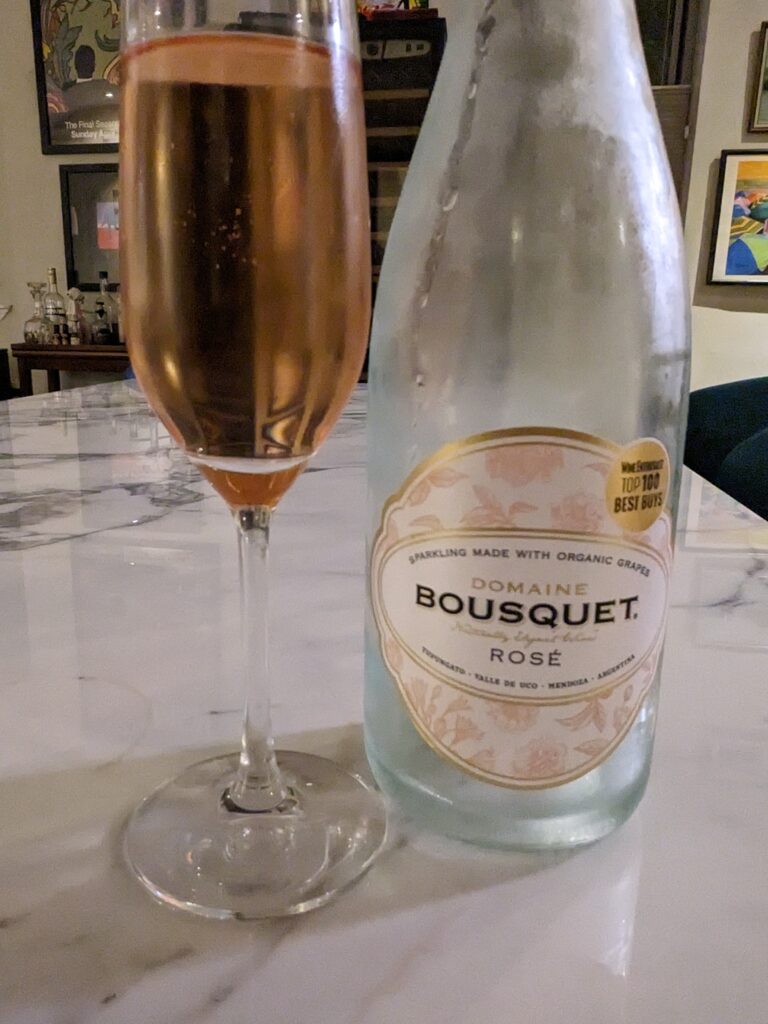
Domaine Bousquet Sparkling Rose NV, Uco Valley, Argentina, $13.00 This sparkling wine is produced using the Charmat Method, bringing together 75% Pinot Noir and 25% Chardonnay. Deep salmon in color, with a persistent bead, it is fresh and lively with tart cherry notes, a lovely mousse and long length.