Drinking Wisely & Well: Holiday 2018
Reply
As the old year draws to a close and the new one lingers on the horizon, the arrival of the Winter Solstice (on or about December 21) brings with it the shortest day – and longest night – of the year. From its Latin roots, we are reminded that on this day, the sun stands still; we can take a moment to reflect and look up at the stars.
Gazing upward, Orion greets us from his perch in this sky. Home to three of the 25 brightest stars, Orion’s gleaming placement among the stars permits him to be seen all over the world, regardless of hemisphere. This winter constellation, named for the myth of Orion, and seen so well amidst the darkness, poetically alludes to the regenerative powers of the sun as Orion’s own eyesight was restored by its healing rays. And, just south of his brilliant belt, Orion’s faithful companion, Sirius, also known as the Dog Star, literally sparkles as brightest star in the sky.
In olden days, this moment in the calendar marked the end of harvest (and all of the hard work it entailed) and signaled instead a time to celebrate. Rome’s festival of Saturnalia took place from December 17 to 25 – those Romans knew how to party!
So, taking a cue from these ancient holidays, now is the perfect time to raise a glass (or two) in celebration of this festive season and all that we have to be thankful for!
Of course, you can toast the holidays with red or white, but why not think pink this season? If you’ve put away your rosé, along with your bathing suits and shorts, it’s time to reconsider your rosé routine. Unfortunately, rosé has become nearly synonymous with the lazy, hazy days of summer and relegated to pool parties and picnics.
But, rosé is much more than that! Yes, rosé is perfect for the hot and humid temperatures of June, July and August, but it is not a pair of white pants and can be drunk after Labor Day. If rosé is here to stay (which it most definitely is), it should stay all year round. In fact, rosé is such a versatile wine that it should be a welcome addition to the table any time of year.
So, it was a pleasure to receive a quartet of rosés from Provence, which itself is nearly synonymous with rosé, to mark this year’s holidays and share with friends at a Solstice celebration. As 2019 looms large and, with it, the sparkle of a brand-new year, fresh with promise, the bright, fresh flavors of rosé, along with their warm pink hues, provide a nice respite from the gloomy grey skies of winter!
TASTING NOTES
Château Coussin La Croix du Prieur Rosé 2017, Côtes de Provence, France, $14.00
Primarily produced from Grenache, this wine presents intense notes of strawberry, spice, perfume and floral.
Château Henri Bonnaud Terre Promise Rosé, 2017, Côtes de Provence, France, $15.00
Comprised of half Grenache and half Syrah, this wine greets the nose with lovely cherry and berry aromas that persist on the medium-bodied palate, along with a hint of floral.
Château Leoube Le Secret de Leoube Rosé 2017, Côtes de Provence, France, $40.00
Bringing together Grenache, Cinsault and Cabernet Sauvignon, this wine presents delicate floral aromas with beautiful minerality on the bright and refreshing palate, culminating in long length.
Mirabeau en Provence Pure Rosé 2017, Côtes de Provence, France, $20.00
A blend of Grenache and Syrah, this wine offers up aromas of strawberry, citrus and musk on the nose, which give way to more peachy notes on the medium-bodied palate with long length.
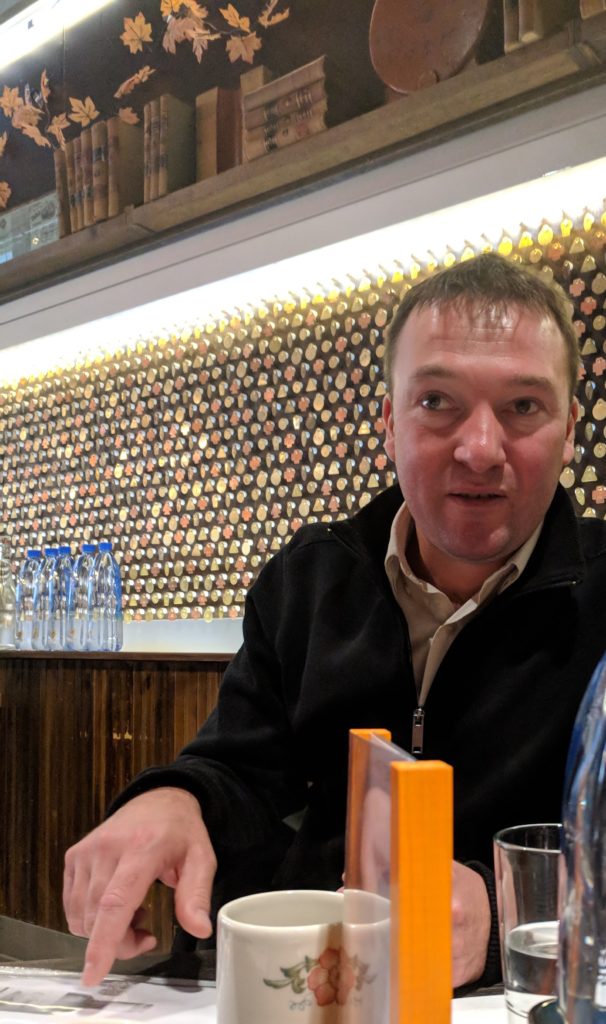 Born, raised and educated in Burgundy, Thibaut Delmotte launched his wine career doing three harvests each in Burgundy and Bordeaux before taking a year off to travel throughout South America. He booked an open ticket, headed to Buenos Aires and visited Argentina, Chile and Brazil, eventually finding himself somewhat settled in Salta teaching French at the local Alliance Française.
When a new acquaintance discovered his background as a winemaker she told him about a high elevation vineyard north of the city. He didn’t believe it was possible to grow vines at such an altitude but was intrigued enough to secure an appointment with the man behind the project: Donald Hess.
Thibaut and Donald arranged to meet at the property at 9:00 AM, which required Thibault to depart Salta at 5:00 AM. By 6:00 AM, the pavement gave way to gravel as he snaked his way up the mountain. By 9:00 AM, there was no sign of life and he was beginning to think that he had been punked. Soon he came to a small village and was assured that he was close to his destination. Another 40 minutes of driving brought him face to face with the tall, Swiss gentleman who promptly laughed at seeing the small, compact rental car in which Thibault had made the journey.
Still disbelieving, Thibaut permitted Donald to give him a tour of the mountainous property, which was barren desert – more suited to cacti than Cabernet. Then, he saw the eight hectares of pre-phylloxera vines and was duly impressed.
Hess spoke about his grand plans for multiple vineyards and a large capacity winery. Thibaut was excited about the opportunity, but readily admitted to his lack of experience to take on such a project. Undeterred, Donald continued with the tour and invited Thibaut to lunch that afternoon. But, before the meal, he was to take part in a blind tasting during which he was asked to taste and rank 10 wines in order of his preference. It was the ultimate job interview! When Thibaut’s least favorite wine was revealed to be the Colome Malbec Reserva he was certain he had blown his chance, but Donald appreciated his feedback as to why the French-born and bred winemaker didn’t find the overt/powerful wine to his liking. Hess offered him the job on the condition that he commit to the post for at least three years. That was fifteen years ago.
In the early years, the emphasis was on building the new winery, developing the vineyards and, equally important, investing in the local village to upgrade its infrastructure, increase its access to education and solve social ills such as alcoholism and teen pregnancy. It was also necessary to create own electricity
Despite its initial rusticity, the Colome property itself dates to 1831, when it was established by the Isasmendi-Dávalos family. It remained in the Dávalos family until 2001, when Hess was finally able to purchase the property. Hess himself was first acquainted with Colome and its potential while visiting his great aunt in Buenos Aires several years prior and had the opportunity to taste an old bottle of its wine.
In addition to the state-of-the-art winery, Colome’s estate is home to the James Turrell Museum. Turrell is a California-based, light and space artist, whose experiential installations defy explanation. To get a better sense of his art, please see: http://www.bodegacolome.com/museo/?lang=en The winery attracts 8,000 visitors each year who usually spend half a day tasting wine and visiting the museum. A nine-room hotel is also available on the estate for those who wish to stay over.
More recently, the focus has been on two special projects: Autentico and Altura Maxima (maximum height). The Autentico project relies on doing things the “old way.” In this regard, the best blocks of 100 year+ vines are still trained using the pergola system, watered with flood (instead of drip) irrigation, treated without chemicals and generally approached with a low intervention philosophy. This approach continues in the winery, where the use of oak is eschewed in favor of showing the true (authentic) wine in the glass, uncovered by wood aromas and flavors.
At a height of 3,111 meters (10,200 feet) in altitude, Altura Maxima is the highest vineyard in the world (although a recently planted plot in Tibet threatens to take this title away). It was initially planted in 2007 to Pinot Noir and Sauvignon Blanc, as well as Malbec. Given the elevation, the vines receive more ultraviolet light, forcing them to develop thicker skins on the grapes. This ultimately produces wines with more structure and concentration, while the 25 degree diurnal difference ensures that the wines retain high levels of acidity and elegance. All of this comes at a price; the very extreme conditions mean that wasps, donkeys and frost are all threats to the fruit. Thus, the vineyard only yields a small production of grapes (4 kilos per hectare compared to 7 kilos per hectare).
TASTING NOTES
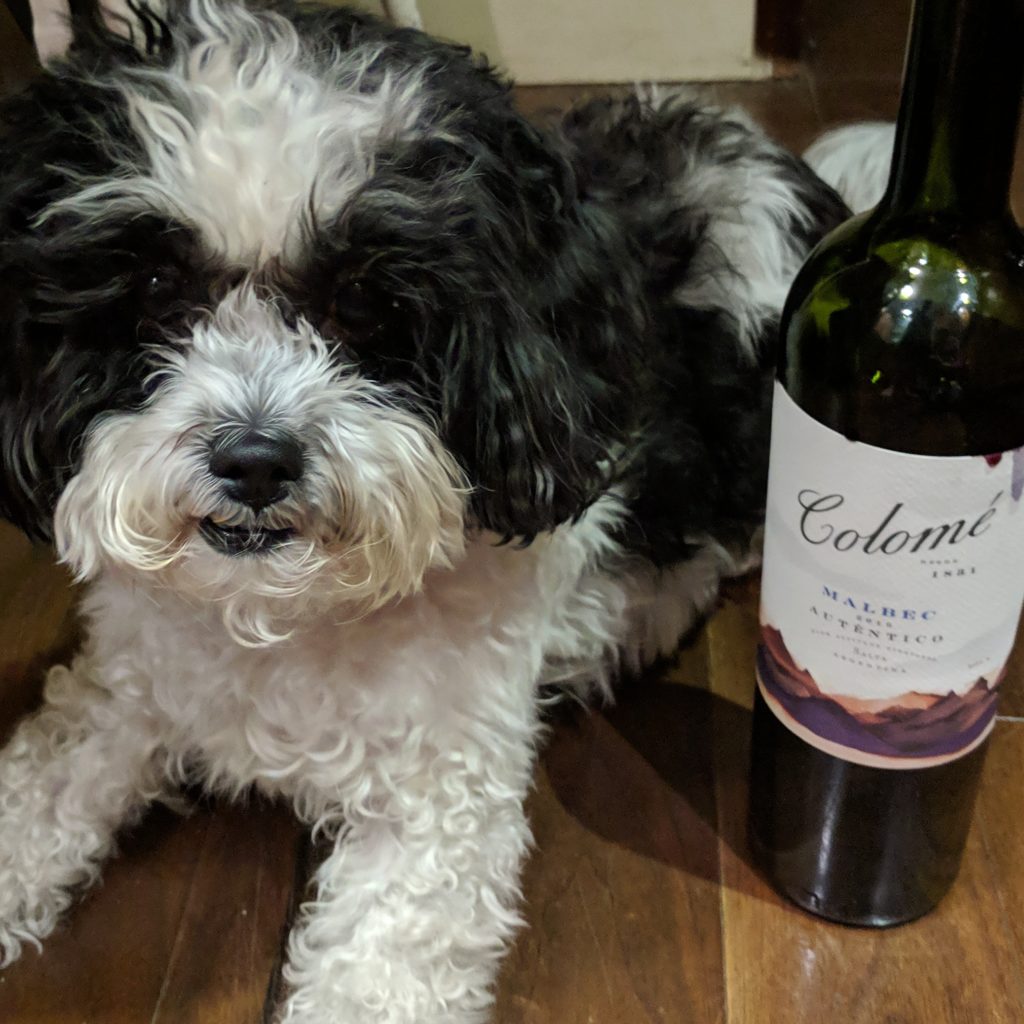 Colome Autentico 2017, Salta, Argentina, $on-premise only
This 100% Malbec is deep purple in color with intense aromas of wood, plum, black fruit. The dry palate displays very ripe blackberry and blueberry joined by floral and spice, with firm, ripe tannins, full body and medium+ length. It is released young, but can age five to seven years.
Colome Altura Maxima 2014, Salta, Argentina, $125.00
Also 100% Malbec, this wine spends 23 months in old oak and one year in bottle before release. It is a very floral Malbec with fine grained tannins.
Regardless of which winter holidays you do or don’t celebrate, who doesn’t want to be on the receiving end of presents? So, with that in mind, I am starting a list just in case anyone wants to know what to get me. Next up, a fabulous dress from Marta Scarampi!
 Thanks to a holiday invite from my friend Susannah Gold of Vigneto Communications, I had the pleasure of meeting the Torino-based designer and browsing her wares while sipping wines from Lugana, a unique DOC that spans two Italian regions – Lombardia and the Veneto. Here, the white grape variety Turbiana, which is closely related to Trebbiano di
  Soave, reigns supreme, finding its way into a wide range of wine styles from still to sparkling and from dry to sweet. [NB: I previously wrote about Lugana’s wines last year.]
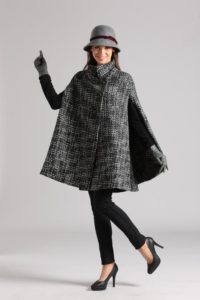 Italian native Marta Scarampi studied at FIT before returning home to launch her fashion line. Her line features a selection of capes and her travel and business collection – dresses and jackets that easily go from the boardroom to the boarding queue.
 These capes are much better to keep a super woman warm on a cold day and can be customized with faux fur collars, rainproof hoods and are available in a range of fabrics and styles. They looked uber chic and sophisticated on my friend, Lisa, who tried on several different options.
Always and forever the dress girl, I was smitten by two styles in Marta’s collection. The first was her Lucca stretch dress (pictured left), while the other was a more celebratory number with metallic threads, worthy of the holiday season. Like the capes, the dress styles can also be made-to-order with the client’s preferred fabric choice.