Sangiovese Spoken Here: Tuscany’s Montecucco

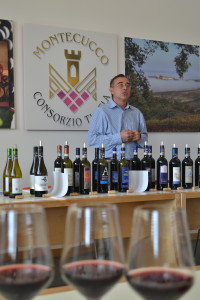
DSC_0513It could be the start of a bad joke: six journalists walk into a Consorzio office… wondering what in the world is Montecucco? But, instead, it was a pleasant journey that revealed another side of Sangiovese, a coterie of winemakers dedicated to their land and people passionate about wine.

Situated within Italy’s Tuscany region, just south of Sienna, Montecucco abuts Morellino di Scansano and looks across the river to Brunello di Montalcino. Here, seven towns sheltered by Mt. Amiata, an extinct volcano, are making wine under the Montecucco designation.

While wine has historically been produced in the region, the denomination is quite young, having obtained recognition in 1998, thanks to the enterprising efforts of six producers. Previously, the area was known more for its polycultural approach to agriculture, with farmers growing not only grapes, but also olive groves and cereals and raising livestock, a practice which continues to this day.

But, despite its relatively recent arrival on the wine scene, Montecucco has seen significant growth in both numbers and quality and has been rewarded for its efforts. Since 2011, the denomination also sports a DOCG level wine and can boast that its yields are among the lowest in Italy at 7 tons per hectare for these top wines.

The DOC rules account for white, rosato and red wines. White wines are produced DSC_0600predominantly from Vermentino, with a minimum of 40% required for Montecucco Bianco DOC[1] and at least 85% of this variety for Montecucco Vermentino DOC.
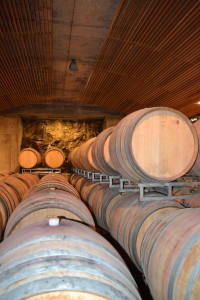
As elsewhere in Tuscany, Sangiovese is the grape of choice for reds. The Montecucco Rosso DOC requires a minimum of 60% Sangiovese, while the Montecucco Sangiovese DOCG must be produced with at least 90% Sangiovese. This latter wine and the Riserva also require 12 months and 24 months in wood, respectively, plus several months in bottle before release.

Given the area’s proximity to Morellino and Brunello, the wines almost beg to be compared and contrasted, in their description — more tannic than Morellino; less intense than Brunello. But, in reality, such an approach is much too limited and doesn’t provide the full picture.

Rather, the wines are truly capable of standing on their own merit and have their own distinct voice. This point was abundantly clear after we tasted through a selection of 24 wines at the consorzio office – our introduction to Montecucco. The wines were robust expressions of Sangiovese with firm tannins, notes of dried red fruit, spice and cherries with structure, complexity and power.

Moreover, as we quickly learned, as a region made up of many small producers (there are presently 70), the stories behind these wines were equally revealing. While there were differences in individual wine styles from producer to producer, a unifying declaration of a fierce devotion to quality and love for the territory was evident during our visits. To wit, 55% of the producers subscribe to organic farming.

Colle Massari: A Gentle Giant
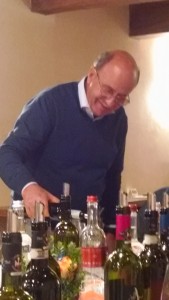
2015-09-25 22.24.52Perhaps the leading voice of the region is that of Claudio Tipa, President of the Montecucco Consorzio and owner of Colle Massari. Named for the hill on which it stands, Colle Massari is by far the largest producer in the region at 500,000 bottles per annum (of the region’s total annual production of 1.8 million bottles).

Tipa, a Tunisian-born Swiss who entered the wine industry after a successful career in telecommunications has built a portfolio of wine properties with his sister, Maria Iris, beginning with the purchase of Colle Massari in 1998.

Now also the owner of Grattamarco (in Bolgheri) and Poggio di Sotto (in Montalcino), Claudio admits that he entered the industry in a backwards manner by starting with a wine that was unknown in the market. Yet, despite this obstacle, and the allure of his other properties, his heart seems wedded to Montecucco.

Further, his commitment to Montecucco appears motivated by passion and not profit; Claudio proclaimed that, “We want to do something else – something smaller; something real. [Montecucco] is little and hidden. If you have Brunello, you can sell it. Montecucco is much harder [to sell].” In spite of Colle Massari’s relatively large size, his maintains a philosophy of staying small while keeping the quality high. His hard work and dedication have paid off, with Colle Massari earning Gambero Rosso’s Winery of the Year distinction in 2014.

Not surprisingly given his tenure and stature in the region, Claudio has served as president of the consorzio three times, but says that he won’t serve in that position again. Instead, he prefers to get the younger generation involved. In fact, he mentioned that he plans to retire at DSC_0607age 70. While I enjoyed the full collection of Colle Massari wines, I was particularly impressed with the Montecucco Riserva 2012, which displayed an impressive array of spice, cinnamon, black cherry, wet leaves, earth and olive notes.
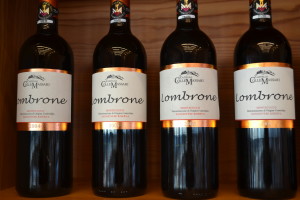

Perazzeta: Preserving the Past DSC_0541
Another of the region’s early pioneers is Perazzeta.  One of the founding members of the DOC, this small family business operates from a building that dates to 1400. The historic cellar was bombed during WWII because the Allies through the Germans were hiding there (they weren’t, but others were).

Similarly, the vineyard had been in the family for generations, providing wines for daily use. But, in 1994, the family was asked to bottle their wine by a Livorno restaurant, encouraging them to pursue a more commercial course for their wines. Today, their annual production runs 60-70,000 bottles.

In another nod to the past, the Bocci family has been working with a professor from Padua to research and identify old vines that have survived. As a result of this work, the winery’s Emma is produced from an extinct Sangiovese clone.DSC_0565
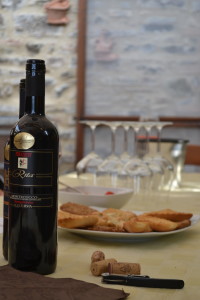
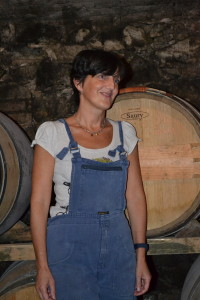
We were greeted at Perazzeta by Rita Bocci, wife of winemaker, Alessandro, who welcomed us dressed in denim overalls, underscoring the hands-on, down-to-earth nature of the people we met. More recently, they have been joined by their daughter, Sara, in the family business. Their Rita Riserva 2009 – named for both Alessandro’s wife and mother – was stunning with its beautiful development of spice, oak and cherry.


Prato al Pozzo: Yielding a Dream
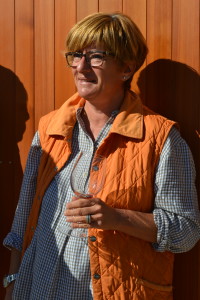
DSC_0630At Prato al Pozzo, we met Francesca Quiriconi, who owns the small estate with her husband, Fabio. The duo purchased the property in 2003 and have been slowly growing the estate. Fabio has served as director of two Antinori estates for many years and has always had a dream to produce his own wine.

After ten years of waiting, they are finally building a real cellar, with construction appearing almost completed during the time of our visit. But, this dream has not come without its costs. Francesca manages the property in Fabio’s absence (he is only home on weekends) and is also responsible for taking care of their two daughters on her own.
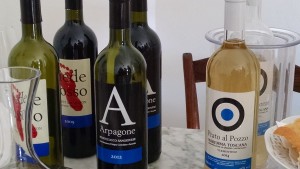
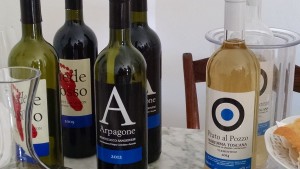
2015-09-26 10.40.21Named for a Molière character who was reluctant to spend money, their flagship wine is sourced from the initial Arpagone vineyard (1.5 hectares), which doesn’t yield very much. Although Francesca referred to this wine as a “poor cousin of Brunello,” it was really quite lovely with fresh cherries, earth, olive and mineral character. As they continue to establish themselves, they plan to grow to a maximum of 2.5 hectares and are in the process of converting to biodynamics.

Poggio Mandorlo: Bringing Friends Together
Another realization of a dream, Poggio Mandorlo brought together four friends – Roberto, Felice, Giuseppe and Fabio – who wished to make their own wine. Accordingly, they came to the region in 2001, planting 30 acres of land under the direction of Consultant viticulturist, Maurizio Saettini, and initially hiring Brunello producer, Roberto Cipresso (of La Fiorita), as their consultant winemaker.
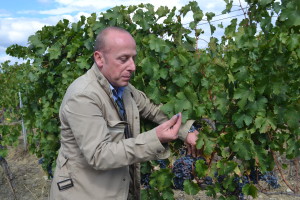
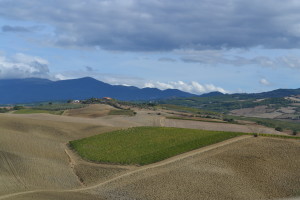
DSC_0528The estate sits 250 meters above sea level. Here, the mountains protect the vineyard from the Sirocco winds and stop the rain, while the good wind from the sea is able to penetrate and benefits the vines. With Sangiovese, Merlot and Cabernet Franc, the vineyard was carefully planted based on soil and exposure. Unlike Montalcino, which has no calcium in its soils, the Poggio Mandorlo estate is home to calcareous Albezza soils, similar to those found in Chianti Ruffina. The first vintage was in 2004. 2015-09-25 14.34.26
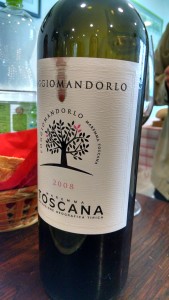
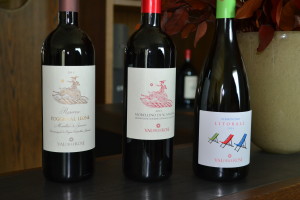
Their top wine, bearing the same name as the estate, is a blend of 70% Merlot and 30% Cabernet Franc, taking its cue from St. Emilion, despite its IGT Maremma Toscana designation. Given their north-facing exposure, the Cabernet Franc vines maintain good acidity and provide elegance to this wine, with its ripe fruit of red and black berries along with wet leaves and spice. Il Guardiano, their entry-level wine, previously qualified for Montecucco Sangiovese status, but with its 85% Sangiovese/15% Merlot blend, as of 2011 (the year of the new DOCG regulations), this wine is now labeled as IGT Toscana.

Poggio al Gello: A Labor of Love
With four hectares of grapes and five hectares of olives, Poggio al Gello DSC_0672is a labor of love for a retired teacher (Alda) and engineer (Giorgio) who claim that they are continuing to work, but without the stress. The two are happy with their small size of 20,000 bottles annually and are proponents of organic agriculture.
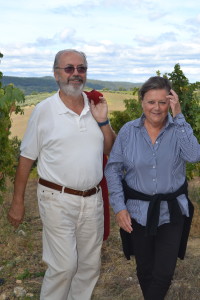
Recognizing that they needed schooling in the ways of wine, the couple hired the director of Col d’Orcia as their “teacher.” They note that he never tells them to do this or do that, but rather, is careful to explain to them why they should or shouldn’t do something. “He is our doctor of wine,” Alda says. Their Rosso del Gello Riserva 2011 spent two years in large oak, resulting in depth and complexity in the balanced and elegant wine.
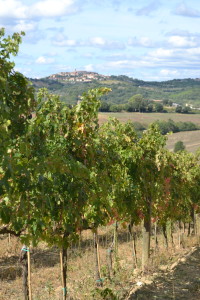
DSC_0670In addition to producing Montecucco wines, the estate makes two wines from ancient varieties – Pugnitello and Fogliatonda  —  as much as to preserve these nearly extinct varieties as because they don’t wish to be boring. Beyond wine, they also make their own olive oil. In fact, Alda seems to come alive in the olive grove, as she stops to admire the budding olives on the tree. In their spare time, he is writing a novel, while she plays the piano and recently wrote a song for their grandson.


Tenuta l’Impostino: A Place to Stop and Rest
On a larger scale, Tenuta l’Impostino takes its name from the impostini — places where couriers would stop and change horses before heading on to their next destination during Medieval times. But, instead of moving on to the next location, the current owners fell in love with the area and decided to stay.
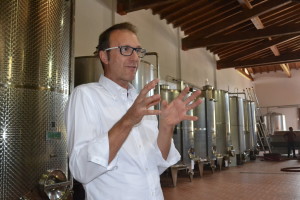
DSC_0696The 52 hectare property has 25 planted to vines, where a natural amphitheater provides excellent exposure. The old homestead’s restored farmhouse and stable presently serve as a restaurant and inn, respectively, providing a wonderful place for tourists to relax and recharge, while enjoying the estate’s wines. DSC_0725
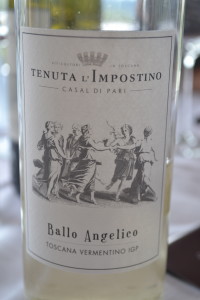
The first harvest was in 2006 and, in spite of the property’s size, the grapes continue to be hand harvested. Tenuta I’Impostino’s Vermentino, Ballo Angelico, was one of my favorite whites, with freshness, minerality and a touch of salinity. Their Montecucco Rosso 2011 was also really lovely, with cherries, earth and spice.

Parmoleto: The Family that Farms Together
As Leonardo Sodi meets us in his parking lot, he glances wistfully across the valley at Castello Banfi and Brunello territory, seemingly only a whisper away. Yet, he is resigned to his Montecucco fate and in keeping the family farm in the family.
DSC_0766The 72 hectare estate consists of five hectares of vineyards, three hectares of olive groves and 65 hectares of cereals, along with 300 pigs and a bed-and-breakfast. The vines were mostly planted in 2000 and include just over 1 acre of Riesling.

The Sodi family’s historic cellar is 100 years old, but his parents only starting bottling wine in 1990 and were among the six founders of the DOC. Today, they produce seven different wines, with a total annual production of 23,000 bottles. The intention is to maintain the current size of production because Leonardo is determined to keep it a family farm. If it becomes too large, it will not be a family farm.DSC_0745
A sparkling wine and full-bodied white round out the predominantly red portfolio, but a rosato is noticeably absent because as Leonardo explains, he doesn’t like rosé. Although it needed more time to resolve its tannins, the Montecucco Sangiovese Riserva 2010 was balanced and elegant with tart cherry, spice and wood. His Sormonno, a blend of 75% Sangiovese and 25% Cabernet Sauvignon, displayed power and structure along with minerality and spice and was fondly dubbed a “Super Cucco” by fellow journalist, Dave Eckert.

Campo Nuovi: Breathing New Life into New Lands
2015-10-27 21.39.13I first met Daniele Rosellini when I visited Chianti Classico in 2011; the agronomist had been instrumental in the Chianti Classico 2000 research in which the best grape varieties, clones and rootstocks were identified as part of Chianti Classico’s commitment to improving quality. During this time, Daniele and his wife, Nadia Riguccini, wished to craft their own wines, but they needed to stay outside the Chianti Classico territory to avoid a conflict of interest with his job.

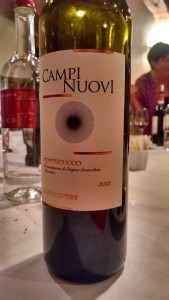
After much consideration, they purchased property 2015-09-25 22.37.55within the budding Montecucco denomination in 2000 with the goal of creating their own venture. Their land was previously referred to in historic documents as “Campi Nuovi” (New Fields), a name they kept as they thought is fitting to begin their “new life.” Today, their property is Certified organic and they are also practicing biodynamics. I didn’t have the opportunity to visit his estate during this trip, but it was a lovely surprise and pleasure to become reacquainted with him and to taste his wonderful wine. His Montecucco Rosso 2012 was powerful, concentrated and full of intense, dark red fruit, with slight notes of spice and vanilla.
In Montecucco, Sangiovese speaks loudly and proudly; those tasting these wines will be rewarded with beautifully balanced, well-made wines. But, it is the voices of the people I met that linger with me still.
DSC_0591 DSC_0558

[1] Alternately, the Montecucco Bianco can contain a minimum of 40% Trebbiano Toscano.
A Harvest Celebration: It’s Never Too Early

2015-11-26 11.50.46The third Thursday of November is Beaujolais Day – the day on which the new vintage of Beaujolais Nouveau is released. Georges Duboeuf, the largest producer, generally hosts a festive affair heralding the wine’s arrival on America’s shores with a bang; from chefs on motorcycles to trapeze artists to graffiti artists. This year, there wasn’t even a whimper. Instead, I received only a single email from retailer, Sherry-Lehmann to mark the occasion. I thought perhaps I had fallen off that invite list, but, in speaking with a colleague, learned that there was no party this year.

While many decry the quality (or rather the lack thereof) of Beaujolais Nouveau, I have always enjoyed the quasi-holiday and, if not the wine itself (which, in fact, I generally do), then what it stood for: a celebration of the arrival and completion of yet another harvest. Another year of toil in the soil and effort in the winery.

We can easily see the bounty of the year’s harvest in the cornucopia of fruits and vegetables in the farmer’s market. But, unlike fresh grapes (and other produce), which provide immediate gratification from vine to vendor, wine takes time to make.

Wines like Beaujolais Nouveau are the exception, going from grape to glass in just a few weeks. It may not be complex and age-worthy, nor is it meant to, rather, it is fresh and fruity and a reminder of what is to come with more time and effort… other wines from this vintage. A time to celebrate the season and give thanks for what Mother Nature has once again provided.

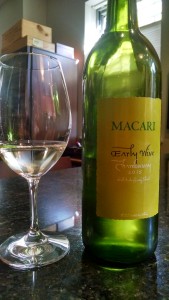
Without the usual Beaujolais Day hoopla, something seemed missing. But, the arrival of Macari’s Early Wine 2015 gave me my much-needed fix. The grapes for this Chardonnay wine were harvested in early September, making their way to bottle by the end of October and released during the first week of November.

On the evening before Thanksgiving, I took a moment to open up this wine and pause and reflect on my deep gratitude in anticipation of the following day’s holiday. I also took time to reflect on what was in the glass – white floral and peach aromas; slightly off-dry palate with vibrant acidity; citrus, peach and floral flavors; and a long finish.

And, more importantly, I took time to notice what the wine reflected back: the remembrance of the freshness of summer as we head into winter; the long days of toil and effort in the vineyard; the gentle care taken by Kelly Urbanik in the winery; and the promise of what is to come from the other fruits of 2015’s labor.

Island Wines: Santorini Edition

There is something special about visiting an island. The discrete borders, the intimate setting and the separation from the mainland all conspire to conjure images of serene beauty. It’s why “Island Getaway” makes a much better headline than “Landlocked Getwaway”!

This summer, I had the pleasure of visiting several different islands, either in body (Long Island) or in spirit (Sicilia and Santorini), succumbing to their charms through the lovely wines that capture their essence.

Admittedly, Greece has been the talk of the town lately – what with a collapsing economy and all that. But, the good news coming out of Greece is the quality and diversity its wines. I presented a session on Greek wines for IWAGY back in the spring, which was a great opportunity to refresh my memory on Greece’s regions and indigenous varieties. Then, in June, I was (virtually) off to the island of Santorini with a tasting featuring the wines of this volcanic island.

The volcanic island of Santorini is exactly what one would expect from a Greek island. Vivid photographs of blindingly white stone buildings juxtaposed against the brilliance of the azure sea, central casting couldn’t have done a better job in creating the perfect setting.

Viticulture on the island dates to 3500 BCE, but the island owes its true viticultural heritage to the volcanic eruptions that took place in 1600 BCE. The resulting caldera, volcanic soils coupled with the climatic winds and limited rainfall, require vines to be grown in a unique, basket-shaped trellis (known as kouloura) nestled close to the ground for protection.

Here, producers rely on a mixture of indigenous varieties, most notably the white grape Assyrtiko, which creates crisp, dry refreshing whites that are mineral driven. Other local grapes include Athiri, Aidani and the reds: Mavrotragano and Mandelaria.

There are three appellations assigned to the small island: Santorini (dry whites, which must include a minimum of 75% Assyrtiko, rounded out with Athiri and Aidani), Vinsanto (sweet wines producead from at least 51% Assyrtiko and made from late harvested grapes, which are dried in the sun for about 2 weeks prior to fermentetaion) and Nykteri (originally named for the now-defunct restriction that the grapes be harvested at night (nikta), these dry whites are also produced with a minimum of 75% Assyrtiko, but with the additional requirement that the wines be aged for at least 3 months in oak barrels). Additionally, the luscious dessert wine, vinsanto, is also produced on the island.

ESTATE ARGYROS
This winery, originally established in 1903 by George Argyros, is now under the leadership of the fourth generation in the guise of Matthew Argyros. With 30 hectares of vineyards, the company’s holdings are among the largest on the island.

Argyros Aidani 2014, PGI Cyclades
This wine has bright fruit aromas with flavors of floral and peach.

Argyros Assyrtiko 2014, PDO Santorini
This wine displays distinct minerality and salinity on both the nose and palate, with good acidity and texture.

Estate Argyros 2014, PDO Santorini
This wine was fuller-bodied and more structured due to the barrel influence than the Assyrtiko.

Estate Argyros Vinsanto 1998, PDO Santorini
Aromas of caramel, honey, with a mineral characteristic. On the palate, it is rich, but not heavy or cloying; bright and fresh with a long finish.

Estate Argyros Vinsanto 1990, PDO Santorini
Darker in color than 1998, this wine offered up an intense nose of dried fruits, with a sweet, viscous palate with caramel, honey and fig, balanced by sufficient acidity.


GAIA

Gaia was established by Leon Karatsalos and Yiannis Paraskevopoulos in 1994 and is considered to be a boutique winery. As an internationally trained winemaker, Yiannis is at the forefront of Santorini’s rebirth.

Gaia Thalassitis 2014, PDO Santorini
This unoaked version is pithy and fresh, with chalk and mineral notes throughout.

Gaia Assyrtiko Wild Ferment 2014, PDO Santorini
A yeasty character pervades the nose and palate most likely a result of the use of natural yeast.

Gaia Thalassitis Oak Fermented 2013, PDO Santorini
This oak-treated wine displays both a fuller body and notes of oak due to the winemaking.


GAVALAS

A true family business, the Gavalas Winery is presently headed by George Gavalas, who fuses his family’s traditions with a modern sensibility in the creation of his wines. In this regard, he has been instrumental in reviving some of the more obscure varieties on the island.

Gavalas Katsano 2014, PGI Cyclades
Floral and almond aromas on the nose give way to floral and pear flavors on the soft palate.

Gavalas Santorini 2014, PDO Santorini
Fresh with citrus and chalk, this is a lovely example of Assyrtiko.

Gavalas Santorini Natural Ferment 2014, PDO Santorini
Yeasty notes are joined by citrus and minerality. Very special.

Gavalas Vinsanto 2006, PDO Santorini
Intense nose with caramel and honey.


HATZIDAKIS
Forced to abandon the family vineyards in the wake of the 1956 earthquake, Haridimos and Konstatina Hadzidakis returned to the island forty years later to rebuild, replant and restore their family’s winemaking legacy.

Hatzidakis Aidani 2014, PGI Cyclades
With floral and peach aromas and flavors, this wine is lively on the palate with good acidity.

Hatzidakis Nykteri 2013, PDO Santorini
Fresh, with just a hint of sweetness on the attack. This wine is big and bold with good acidity.

Hatzidakis Mavrotragano 2013, PGI Cyclades
This wine has a deceptively soft start, giving way to its tannic grip and bright plum fruit.

Hatzidakis Vinsanto 2003, PDO Santorini
This wine is extremely fresh despite its sweetness level. It offers notes of honey, fig and quince.


KOUTSOYANNOPOULOS
The Koutsoyannopoulos family has been making wine since Grigoris and Dimitris Koutsoyannopoulos established Volcan Wines in 1880. Today, the fourth generation continues this tradition, under the family name, while still retaining the old logo.

Koutsoyannopoulos Santorini 2013, PDO Santorini
A bit weightier on the palate compared to some of the other examples, this wine still provides lively acidity and lots of minerality.

Koutsoyannopoulos Santorini 2012, PDO Santorini
With a decidedly mineral nose, the palate is more redolent of fresh fruit, namely pear and citrus. One of my favorites of the event.

Koutsoyannopoulos Nykteri 2012, PDO Santorini
Very floral on the nose, this wine offers up citrus, pith and mineral flavors on its complex palate.


SANTO WINES
Established in 1947, the SantoWines cooperative presently has 2500 members that support its activities in growing grapes and making wine.

Santo Wines Sparkling 2014
Quite lovely and fresh with a creamy mousse and floral notes.

Santo Wines Nykteri 2014, PDO Santorini
Floral and fruit aromas greet the nose and persist on the palate through the long length.


Then, in late June, just as the crisis was really heating up, an unusual event heralded the launch of Agrino.  Promoting the Mediterranean diet, these packaged rice dishes offer flavor and convenience and will, of course, pair well with Greek and other wines. Coming soon to a grocery shelf near you!

Island Wines: Long Island Edition

2015-06-30 16.43.09There is something special about visiting an island. The discrete borders, the intimate setting and the separation from the mainland all conspire to conjure images of a serene paradise. It’s why “Island Getaway” makes a much better headline than “Landlocked Getwaway”!

This summer, I had the pleasure of visiting several different islands, either in body (Long Island) or in spirit (Sicilia and Santorini), open to their charms through the lovely wines that are produced on each.

Close to home (aka New York City), Long Island provides a welcome refuge for city dwellers, with its beaches, farms and vineyards. We returned to the region after a two-year, accidental hiatus, stopping at some of our favorites for a brief refresher and to stock up our cellar, which we were about to deplete as a consequence of hosting our Meet, Meat & Merlot dinner, featuring a selection of aged Long Island Merlots.

The four-course dinner, held at our apartment, was an excellent opportunity to see how Long Island Merlot can develop with time. All of the wines, from the youngest at 12 years old (2003) to the oldest at 23 (1992), proved the point in spades. Between the chaos of cooking an elaborate menu and hosting 11 guests, I admittedly did not take notes on the wines, but the menu and wine selection are listed below.

Tasting notes for the various wines we tasted during our two-day visit to both the North Fork and The Hamptons AVAs are also included below.

Meet, Meat & Merlot Dinner Menu & Wines
Amuse Bouche: Frico Cheese Crisps with Hungarian Paprika

Wild Caught Salmon Sliders with Sage on Crispy Potato “Buns”
Shinn Estate Vineyards Estate Merlot 2003, North Fork of Long Island, USA
Shinn Estate Vineyards Six Barrels Reserve Merlot 2002, North Fork of Long Island, USA

¯
Coq au Vin 8 Hands Farm Organic Chicken Breast with Cipollini Onions & Mushrooms Lenz Estate Selection Merlot 2001, North Fork of Long Island, USA
Lenz Estate Selection Merlot 2000, North Fork of Long Island, USA

¯
Beef Wellington Organic Beef Tenderloin with Mushroom Duxelles and Foie Gras in Puff Pastry served with North Fork Squash and Sugar Snap Peas
Macari Vineyards, Bergen Road 1997, North Fork of Long Island, USA
Rivendell, Merlot 1990, North Fork of Long Island, USA
Rivendell, Merlot 1992, North Fork of Long Island, USA

¯
Dessert
Briermere Farms Raspberry & Peach Pie and
Briermere Farms Gooseberries and Wickham’s Farm Cherries

MACARI VINEYARDS
Macari Sauvignon Blanc 2014, North Fork of Long Island (NY), USA, $23.00
This wine is fresh and bright, with crisp citrus, a hint of green apple and long length.

Macari Dos Aguas Blanc 2013, North Fork of Long Island (NY), USA, $27.00
A blend of Chardonnay, Riesling, Viognier and Sauvignon Blanc. The intense nose displays aromas of lush pear and tropical fruit, both of which persist on the palate.

Macari Sauvignon Blanc No. 1 2013, North Fork of Long Island (NY), USA, $27.00 Macari has been actively experimenting with the use of concrete eggs and 60% of this wine was fermented in one. Compared to the regular Sauvignon Blanc, it was much rounder with lots of orange peel aromas and flavors.

Macari Cabernet Franc Lightforce 2013, North Fork of Long Island (NY), USA, $N/A
This wine was also fermented and aged in a concrete vessel. It was fresher and lighter than regular Cabernet Franc, but still very Cab Franc in its characteristics, with beautiful earth and mushroom notes.

Macari Merlot Reserve 2010, North Fork of Long Island (NY), USA, $36.00
From the near perfect 2010 vintage, this wine is absolutely gorgeous with rich notes of coffee and black cherry, culminating in long length.

2015-07-01 11.13.40LENZ ESTATE
Lenz Estate Blanc de Noir Rosé 2013, North Fork of Long Island (NY), USA, $22.00
A light and pleasing rosé with fresh strawberry and slight herbal notes on the nose and palate.

Lenz Estate Old Vine Gewürztraminer 2010, North Fork of Long Island (NY), USA, $30.00
More floral than spice, this dry Gewurztraminer is quite elegant with nice acidity.

Lenz Estate Malbec 2011, North Fork of Long Island (NY), USA, $35.00
With intense and concentrated aromas of smoke, mulberry and blue fruit, this wine is more restrained on the palate, with elegant flavors of spice and blue fruit.

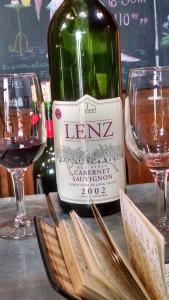
Lenz Estate Old Vines Cabernet Sauvignon 2002 North Fork of Long Island (NY), USA, $NA
This wine was showing some development with complex aromas and aromas of red fruit, black fruit and some meatiness. On the dry palate, it displayed ripe and concentrated flavors of blackberry, coffee and slight cedar; lovely.

McCALL WINES
McCall Pinot Noir 2012, North Fork of Long Island (NY), USA, $28.00
This wine offers fresh, bright fruit with notes of cherries, herbs and earth.

McCall Pinot Noir Hillside 2013, North Fork of Long Island (NY), USA, $39.00
This Pinot Noir is more complex and intense than the entry-level wine, with more meaty and spice notes.

McCall Merlot Reserve 2010, North Fork of Long Island (NY), USA, $30.00
This pretty and elegant wine displays rich black cherry aromas that pervade the palate as well.

McCall Ben’s Blend 2010, North Fork of Long Island (NY), USA, $54.00
Bringing together, Merlot, Petit Verdot, Cabernet Sauvignon and Cabernet Franc, this Bordeaux-style blend provides velvety tannins and nice complexity with gorgeous black fruit aromas and flavors.

CHANNING DAUGHTERS
Channing Daughters Tocai Mudd Vineyard 2012 North Fork of Long Island (NY), USA, 24.00
A combination of minerality and salinity greet the nose, while the palate is rewarded with apple and mineral notes and long length.

Channing Daughters Rosato di Refosco 2014, The Hamptons (NY), USA, $20.00 This rosé is distinctly herbal with sour cherry and a hint of salinity that lingers throughout the finish.

Channing Daughters Envelope 2011, The Hamptons (NY), USA, $42.00
Produced from 62% Chardonnay, 28% Gewurztraminer and 10% Malvasia Bianca, which were co-fermented with ambient yeast on the skins, this wine offers up pronounced aromas of floral and spice. This wine is rich, with concentrated fruit flavors of floral and pear on the palate.

Channing Daughters Ribolla Gialla 2013, The Hamptons (NY), USA, $35.00
This wine displays rich aromas of honey and marzipan. Its palate is dry with flavors of honey and white flowers.

Channing Daughters Sculpture Garden 2011, The Hamptons (NY), USA, $30.00
A blend of Merlot, Teroldego and Blaufrankisch, this wine spent 22 months in oak and 18 months in bottle before release. It has soft tannins, with notes of cherries, cocoa, and spice, which persist through the long finish.

NB: While I don’t have precise tasting notes, we absolutely adored Channing’s range of VerVino Vermouths.

WÖLFFER ESTATE
W
ölffer Estate Noblesse Oblige Extra Brut Sparkling Rosé 2011, The Hamptons (NY), USA, $54.00
This elegant sparkling wine was very yeasty on the nose, with flavors of berries and cream on the palate.

Wölffer Estate Rosé 2014, Long Island (NY), USA, $18.00
Considered among the official rosés of the Hamptons, this fresh, Provencal-style rose is the perfect wine for summer with its purity of melon and berry fruit and refreshing acidity.

Wölffer Estate Summer in a Bottle 2014, Long Island (NY), USA, $24.00
This white blend offered up ripe, lush fruit with flavors of floral, peach and pear.

Grapes of Roth Dry Riesling 2014, Long Island (NY), USA, $26.00
Produced by Wölffer’s winemaker and partner Roman Roth, this is classic Riesling with citrus, slight pith, mineral, just a hint of off-dry sweetness on the attack.

Wölffer Estate Descencia Botrytis Chardonnay 2012, Long Island (NY), USA, $40.00
A late-harvest Chardonnay dessert wine with medium-sweetness, this wine is beautifully balanced by its bright acidity along with notes of honey, spice and Asian pear, culminating in long length.

Drink Wisely and Well – A Fresh Look at France issue

http://issuu.com/tracyellenkamens/docs/drink_wisely_and_well_fresh_look_at

A Re-introduction to Roussillon

I first visited Roussillon in 2001, but it wasn’t until I started studying wine in 2005 that I truly became acquainted with the wines of this region. Several recent tastings re-introduced these wines to me, reminding me that their diversity, quality and appealing price points make them worthy of renewed interest.

Admittedly, a large portion of production is handled by large co-operatives, but co-op is no longer a four letter word around here. In fact, today, many of the cooperatives function more like custom-crush facilities than the typical co-op of yesteryear. Plus, many small family wineries also exist, such as the Nadal family of Château Nadal Hainaut, whom I met at the Wines of Roussillon’s Roussillon Day in New York.

I also had the pleasure of meeting husband and wife team, Dominque and Claude Ortal, at the same walk-around tasting and took an instant liking to the friendly couple who have guided Clos Saint Georges and its related brands (Château de Canterrane, Collections Emotion d’Oc and others) since 1970. Their property is scattered among seven towns within the Aspres area of Languedoc-Roussillon. I also took an instant liking to their wines.

Another immediate “crush” at the tasting was Jean Boucabeille, winemaker for Domaine Boucabeille, a 28-hectare estate, situated due east of Perpignan.  Unfortunately, at the time of the tasting, my new “boyfriend” didn’t have U.S. representation, but I really enjoyed his wines and hope he made a successful match in finding someone to bring them in soon.

While I didn’t get the chance to meet all of the producers whose wines I tasted, I was generally impressed with the region’s refreshing rosés; its eager embrace of indigenous varieties; and its rich and decadent dessert wines. There were also some very interesting dry whites and reds, which were a welcome change. I also had the opportunity to taste a number of these wines with a colleague who works for an importer heavy with this region.

If you are not already familiar with these wines, I urge you to become acquainted. Your palate will thank me!

WHITE WINES
Emotion d’Oc, Cuvée de Paul-Muscat Sec 2012, IGP d’Oc, France, $NA
Made from Muscat grapes usually reserved for the production of fortified whites, this wine offered up exotic fruit aromas yet was dry, with ripe fruit character on the palate. Very pleasing.

Terrassous, Muscat Sec 2014, IGP Cotes Catalanes, France, $14.00
Another dry Muscat, this wine was nice with more limited fruit expression and an interesting waxy texture on the palate.

Domaine Treloar, One Block Muscat 2013, IGP Pays d’Oc, France, $10.00
Rounding out the discussion of dry Muscats, this selection was richly layered with lots of depth and a similar waxy texture.

La Noble Chardonnay 2013, IGP Pays d’Oc, France, $12.00
This brand works with small producers and local co-ops to source fruit from Limoux. The wine is an unoaked version of the ubiquitous grape, which I was hesitant to try, but was duly rewarded with fresh citrus and melon fruit aromas and flavors, medium+ acidity, medium+ body and long length.

Le Cirque Grenache Gris 2012, IGP Cotes Catalanes, France, $18.00
This 100% Grenache Gris is produced solely in stainless steel by a modern cooperative, Les Vignerons de Tautavel Vingrau, which serves more as a custom crush facility than as an old-fashioned co-op. Nicely textural with waxy notes and aromas of pear and melon, the wine is dry on the palate with ripe pear, slight apple and melon, medium acid and medium body.

Chateau de Lancyre, Roussanne 2012, IGP Monferrand, France, $22.00
This wine was one of my favorite discoveries. The Durand and Valentin families purchased the estate in 1970, taking on a 16th century chateau situated on the ruins of a 12th century fortress, with winemaking records that date to 1550. Today, they own 135 acres of vineyards planted to local varieties close to the Pic St. Loup area. The wine is made with 90% Roussanne spiked with some Viognier and Marsanne and displays aromas of flowers and marzipan, which persist on the dry, medium- to full-bodied palate. Just beginning to show some development, this wine can age well, becoming more complex and weighty with time.

Domaine Boucabeille, Terrasses 2014, Cotes du Roussillon, France, €NA
A blend of Grenache Blanc and Macabeo, this wine was fresh, fruity and complex on both the nose and palate, culminating in long length.

Domaine Boucabeille, Les Orris Blanc 2013 Cotes du Roussillon, France, €27.00
Bringing together 60% Grenache Blanc and 40% Rousanne, this wine was distinctly floral and mineral, with some spice and pear notes lingering in the finish.

Mas de Lavail, Terre d’Ardoise Old Vine Carignan Blanc 2014, IGP Cotes Catalanes, France, $14.00
A unique wine given its white color and production from a deeply pigmented red variety. Fresh and clean with white flowers, this is a very food friendly wine.

Domaine Cazes Le Canon du Marechal Blanc 2014, IGP Cotes Catalanes, France, $11.00
Not surprising given the 60% Muscat-40% Viognier blend, this wine is extremely aromatic with floral and exotic fruit aromas. Its dry palate, medium+ body, offered up depth and complexity with floral, melon and mineral flavors and long length.

Domaine Vacquer, Esquisse 2014, IGP Cotes Catalanes, France, $14.00
This blend of 40% Roussane, 40% Macabeo and 20% Grenache Blanc was fresh and clean with melon, pear and spice notes.
ROSÉ WINES
Le Pot du Clos, Rosé 2014, IGP Pays d’Oc, France, $NA
This was very fresh with good acidity, medium body and flavors of melon and berry fruit; really lovely.

Domaine Cazes, Le Canon Rosé 2014, IGP Cotes Catalanes, France, $11.00
Produced from a blend of Syrah and Mourvèdre, this rosé was more Provençal in style than the others I tasted, with slight berry fruit on the nose and palate.

Domaine Vacquer, L’Ephémère Rosé 2014, Cotes du Roussillon, France, $14.00
Produced from a blend of 1/3 each: Carignan, Grenache Noir and Syrah, this wine was subdued, but elegant, with mineral, melon and long length.

Penya, Rosé 2014, IGP Cotes Catalanes, France $11.00
Cooperative Penya is located in the French Catalan area, just north of Spain. The 96% Grenache Noir and 4% Syrah blend, produced from vines with an average age of 25-35 years displays aromas of under-ripe strawberry and slight herbs on the nose. It is dry, but with a hint of sweetness on the attack, with crisp acidity and a clean finish.

RED WINES
Penya, Rouge 2013, IGP Cotes Catalanes, France $10.00
An unoaked blend of 50% Grenache, 30% Syrah, 15% Carignan and 5% Mourvèdre, this wine offers up intense berry aromas on the nose with herbs; dry rich, concentrated berries, dried herbs, good acidy, really nice.

Domaine Vaquer, Cuvée Bernard 2012, IGP Cotes Catalanes, France $20.00
Another one of my top picks! The Vaquer family has owned the property for more than 100 years. Bernard Vaquer, for whom this wine is named, passed away in 2001; the 25-hectare, high altitude property is currently managed by his wife, Frederique, who was born and raised in Burgundy. Bringing together 33% each of Syrah, Grenache and Carignan, aromas of red fruit and herbs greet the nose. On the palate, it is quite elegant, with medium+ body; medium tannins; cherry, berry and herbal flavors; and long length.

Domaine Cabirau Serge & Nicolas 2012, Maury Sec, France $22.00
From one of the newer Roussillon appellations, this wine is a blend of 60% Grenache, 28C% Syrah and 12% Carignan. The 13.5-acre property was purchased by Hand Picked Selections President, Dan Kraitz, with this wine named for the vineyard manager – Serge Soulatge – and winemaker – Nicolas Burger – who are responsible for assisting Dan in crafting this wine. The wine was aged for 5 months in large oak vats yielding intense and concentrated fruit, with notes of smoke and herbs. It is dry with a sweet attack of red fruit, with medium acidity, medium+ body and lovely freshness that pervades the palate.

Domaine de l’Edre, L’Edre 2011, Cotes du Roussillon Villages, France $30.00
A blend of 46% Syrah, 26% Grenache, 19% Carignan and 9% Mourvèdre, this wine is produced at the extremely low yield of only 1.27 tons/acre from a sustainably grown vineyard in Vingrau, jointly farmed by friends Jacques Castany and Pascal Dienunidou. This wine is produced in two versions – unoaked and oaked. Aromas of berries and pomegranate dominate the nose and palate, it is very polished and focused. The dry palate offers medium+ acidity with bramble fruit and juicy berries and ripe, rich tannins.

Domaine de l’Edre, L’Edre 2010, Cotes du Roussillon Villages, France $30.00
A nearly identical production to the wine above, but this time aged in oak (12 months in 2nd use French oak barrels), this wine displays a slight aroma of oak on nose, joined by blackberry and leather. The full-bodied palate shows well-integrated oak, rich black fruit and long length; really beautiful.

FORTIFIED WINES
Clos Saint Georges Muscat de Rivesaltes Cuvée Eva 2014, Rivesaltes, France, $15.00
Offering lovely, floral aromas, this wine is nicely balanced, with slight licorice and anise notes in the finish.

Domaine Treloar Muscat de Rivesaltes 2013, Rivesaltes, France, $14.00
This wine is so beautifully balanced that its sweetness is almost imperceptible at first. Mineral and anise notes linger in the long length.

Domaine Boucabeille Rivesaltes Ambré Hors d’Age, Rivesaltes, France, €27.00
A vin doux rancio wine, it is showing some initial development, with lots of spice on the nose and palate.

Domaine Cazes Rivesaltes Ambré 1997, Rivesaltes, France $30.00
Produced from Grenache Blanc, this wine spent considerable time in cask before being bottled in 2013. It is complex and rich with dried fruit and spice and would pair beautifully with pumpkin pie.

Terrassous Rivesaltes Ambré 1992, Rivesaltes, France, $50.00
This wine was almost Cognac-like in its aromas and flavors, displaying complex and developing notes on both the nose and palate.

Terrassous Rivesaltes Ambré 1981, Rivesaltes, France, $66.00
Spicy, stunning and simply amazing; my favorite of the three Terrassous Rivesaltes Ambré selections listed here.

Terrassous Rivesaltes Ambré 1974, Rivesaltes, France, $83.00
Intense aromas and flavors; quite lovely, with lots of life still remaining.

Southern Burgundy and Beaujolais offer great wine options with good value

Julienas-2

Image of Julienas, courtesy of DiscoverBeaujolais.com

Georges Dubouef Chateau des Capitans 2011 Juliénas, France, $19.00 Beaujolais bashers need not apply. We typically think of Beaujolais in the fall when Beaujolais Nouveau est arrivé – the third Thursday of November. But, Beaujolais is much more than Nouveau and, as a lighter-bodied red, it’s perfect for summer sipping. Produced from the thin skinned Gamay grape, Beaujolais is generally low in tannins, high in acidity, with bright cherry fruit and capable of taking a slight chill.

Nouveau aside, the Beaujolais hierarchy starts at the base with Beaujolais, while wines produced with grapes sourced from the better vineyards (located in 39 well regarded villages) are a step above and labeled as Beaujolais-Villages. Even more rarified as those wines designated as crus, which are named and labeled for one of the ten villages their grapes respectively come from.

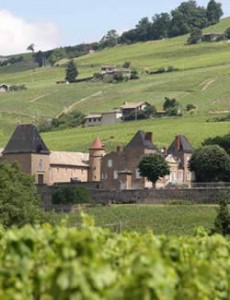
Belying its Roman origin having been named for Julius Cesar, Juliénas is located quite northerly in the Beaujolais region where the more granitic soils are found. Situated within the heart of Juliénas, the Chateau des Capitans estate is home to a 19th century castle. Since the site is thought to have been a headquarters for military staff during the Gallo-Roman period, the castle’s name pays homage to the captains who presumably lived there once upon a time.

Tasting note: Aromas of fresh cherries, cinnamon and wet leaves persist on the palate with high acidity, light body and low tannins; nice round mouthfeel and good length.

Georges Duboeuf Domaine les Chenevières 2011, Mâcon-Villages, France, $14.00 Just north of Beaujolais, the Mâconnais district is part of the Burgundy region and is known for its Chardonnay. The district is structured similarly to Beaujolais in that wines feature either the basic appellation of Mâcon, the higher appellation of Mâcon-Villages or the more prized appellations of Pouilly-Fuissé, Pouilly-Loché, Pouilly-Vinzelles, Saint-Véran and Viré-Clessé. However, the district also permits village level wines to append the name of specific villages or communes, as in the case of Mâcon-Lugny.

With a warmer climate than that found in the Cote d’Or district, Mâconnais Chardonnays generally offer up riper and more tropical fruit notes as well as lower price points. Domaine les Chenevières has been the setting for five generations of winemaking for the family that owns it, with portions of the family’s residence built over 300 years ago.

Tasting note: On the nose, this wine displays damp earth, butter and apple notes. The dry palate offers bright acidity, medium-full body and an elegant richness; unwooded with 100% malolactic fermentation.

Rose Revolution: Better Dead than Red

World winemakers unite! Admittedly I have Communism and Leon Trotsky on the brain thanks to having just finished Barbara Kingsolver’s novel, The Lacuna. However, the notion that winemakers are globally uniting to produce rosé wines is not that far-fetched, at least not in terms of the depth and breadth of these wines now being produced.

While drinking pink wine (at least publically) was previously relegated to newbies quaffing White Zinfandel and other sweet blush wines, today’s rosés run the gamut in hue and are primarily dry in style. With a decade of growth in the U.S. market, rosé continues to be one of the U.S.’s fastest growing wine categories in retail sales; the message is clear: Rosé is here to stay. Tweet that!

A recent “Pink Party” hosted by Winebow showcased the importer’s vast portfolio of rosés, which not only ranged in style (from still to sparkling and pale salmons to deep pinks), but also in origin of production.

As the number one producer of rosé worldwide, it is not surprising that the line-up was heavy in French samples, with appellations that specialize in the pink stuff such as Provence and Tavel well represented. Italian specimens were similarly prevalent, most of which hailed from the southern portion of the boot: Sicily, Sardinia, Campania and Calabria.

But, Winebow’s rosé collection is much more widespread than the wine world’s two top producers. In addition to a reasonable showing of wines from the U.S.’ east and west coasts, more unique appearances came from Croatia, Greece, Lebanon and the Republic of Macedonia.

Adding to the diversity, the sparklers were not only comprised of the usual suspects such as Rosé Champagne and a beautiful rose Cava, but also on hand were lovely bubbles from Austria and Tasmania.

And, vying for most unusual wine of the day was a “100% pure rosé sake” produced from heirloom purple rice.

With such a plethora of rosé wines in the market, it can be quite confusing to the consumer to make sense of it all. But, the easiest way to understand rosé is to think about something with which most people are familiar – tie-dyeing. Tweet this!

Such childhood arts-and-crafts projects provide a simple, but effective tool, for learning about rosé production. Armed with white t-shirts, rubber bands and RIT dye, we saw that leaving the t-shirt in the dye bath for just a few minutes resulted in a pale hue, while soaking it for the full hour delivered the deepest color. Moreover, the instructions advised that higher temperatures and agitation further added to the color saturation.

Apply these same principles to winemaking, substituting grape skins for RIT dye and grape juice/must for t-shirts (no rubber bands required) and, by George, you’ve got it. Now you are ready to join the revolution!

Looking for some rosés to sip this summer (yes, I promise it will be summer one of these days)? Here are some of my favorites from the Pink Party tasting:

SPARKLING WINES
Jansz Sparkling Rose NV, Tasmania, Australia
A blend of Pinot Noir, Chardonnay and Pinot Meunier with just a hint of color. Citrus, mineral and peach notes.

Juvé y Camps Rosé Brut Pinot Noir NV, Cava, Spain
100% Pinot Noir and medium-deep pink in color. Floral and fruit on the nose with red fruit and herbs on the palate.

Lanson Brut Rosé Champagne NV, Champagne, France
A blend of Pinot Noir, Chardonnay and Pinot Meunier. Rich and intense with typical yeasty character along with citrus and a hint of red fruit.

STILL WINES
Adelsheim Rosé 2013, Willamette Valley (OR), USA, $25.00
100% Pinot Noir. Herbs with some depth and slight grip on the palate. Fresh strawberries and melon.

Chateau Mercouri Lampadias Rosé 2013, Ilia, Greece
A 50-50 blend of Avgoustiatis and Agiorgitiko. Simply lovely with good fruit and acidity.

Les Vignobles Gueissard Côtes de Provence Rosé “Les Papilles” 2013, Provence, France
Mourvèdre, Syrah, Cinsault, Grenache, Cabernet Sauvignon and Rolle. Berries and cherries with body and good length.

Zenato Bardolino Chiaretto 2013, Veneto, Italy
Corvina, Rondinella and Merlot. Very fruity with strawberry, raspberry and dried herb aromas and flavors.

Buying German Wine – Understanding the Label

Sprechen Sie Deutsch (Do you speak German)? Looking at the text on German wine labels, it is leichter gesagt als getan (easier said than done), or, more correctly, easier said than understood. And, for that matter, it isn’t even very easy to say.

If wine labels are generally intimidating to the uninitiated, German wine labels are among the most intimidating of all – unfamiliar names; lengthy, unpronounceable terms; and just an all around use of a lot of words could scare off even the most avid wine drinker.

But, in truth, German wine labels actually provide the consumer with a wealth of information about the wine in question. You don’t need a secret decoder ring, but learning some basic German wine vocabulary will assist you in understanding what you are looking at on the wine store shelf.

To begin, there are two levels of German quality wine – Qualitätswein bestimmter Anbaugebiete(QbA) and Qualitätswein mit Prädikat (QmP).  The first category designates wines that come from one of Germany’s 13 wine regions and account for the majority of German wine production. The latter (QmP) are more complicated because, in addition to coming from a particular wine region, they also indicate wines produced from grapes that have achieved certain levels of ripeness at harvest. These are considered to be higher in quality than QbA because Germany’s cool climate makes it more challenging to reach full ripeness, thereby placing a premium on riper grapes.

Prädikat Levels

Once one has worked out the two quality levels, they may encounter some confusion with regard to the grape varieties themselves. Spätburgunder? Grauburgunder? Weissburgunder? Sure, they sound exotic, but actually, these are just the German names for Pinot Noir, Pinot Gris and Chardonnay, respectively. Other grapes likely to be seen include Müller-Thurgau (white), Silvaner (white) — particularly prized when it hails from Franken, Portugieser (red) and the more respected Dornfelder (red). Also of note is Lemberger (elsewhere known as Blaufränkisch) which offers red fruit, spice and nice tannin structure. Above all else, there’s Riesling; this vaunted white grape accounts for over one-quarter of all German plantings.

Dry or sweet? Although many people associate Germany with sweet wines, the majority of German wines produced today are dry. Admittedly, a lot of the drier style wines never make it to our shores (the Germans keep much of it at home for themselves), but consumers can find dry style German wines on U.S. shelves. Some of these wines are distinctly labeled as being dry – if you know how to decipher the label. The specific words to look for are trocken (dry) and halbtrocken (off-dry).

Charta logoIn addition, the label terms “Classic” and “Selection” may also be used to indicate a dry (or high-acid, off-dry) wine.  Similarly, wines bearing the double Romanesque arch of the Charta Association, created in 1983, are dry to off-dry QbA- or prädikat-level Rieslings from the Rheingau region that meet the organization’s strict quality regulations.

In general, wines that have no indication of their sweetness level can usually be expected to be somewhat sweet. Another hint is to check the alcohol level since lower alcohol levels (9% abv and lower) generally mean that at least some of the grape’s sugar content hasn’t been converted into alcohol and, thus, remains in the wine as detectable sweetness.

As with many other wine producing countries, Germany’s wine regions can be further broken down into smaller areas – bereiche, grosslagen and einzellagen. A bereich is a regional or district designation, while a grosslage is a group of vineyards and an einzellage is, theoretically, a single vineyard.  Unfortunately, it is these last two territories that cause the most confusion since it is often difficult to ascertain whether the label refers to a grosslage or einzellage.

However, this uncertainty can be overcome by either memorizing a list of the top sites, limiting purchases to wines from well-known/well-respected producers or simply giving up and taking a chance on the bottle in hand, despite its murky label (well, not really).

Thankfully, an additional classification system was launched in 2002 by the Association of German Prädikat Wine Estates (Verband Deutscher Prädikatsweingüter, can boost one’s confidence in choosing a wine. VDP LogoEstablished in 1910 and abbreviated as VDP, this association represents Germany’s leading wine estates, with a dual focus on quality wine production and classified vineyard sites. All of these wines sport the association’s eagle logo, making them easily identifiable to the consumer.

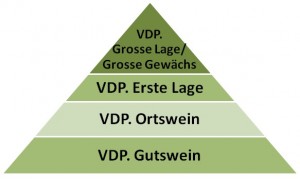
In 2012, this classification system was further refined, closely modeled on Burgundy’s regional and vineyard hierarchy. Accordingly, the top category, VDP. Grosse Lage (translating as Great Site) is awarded to the best vineyard sites, equivalent to Burgundy’s Grand Cru vineyards. Dry wines in this upper echelon are further designated as VDP. Grosses Gewächs “Great Growth” and labeled “Qualitätswein trocken” while naturally sweet wines are labeled with the appropriate traditional Prädikat term.

VDP LevelsAnalogous to Burgundy’s Premier Cru vineyards is the VDP. Erste Lage (First Site), while VDP. Ortswein (Classified Site) is akin to Burgundy’s Village-level wines. The lowest tier of this system is the VDP. Gutswein (Estate Wine), which is similar to the regional designation in Burgundy (i.e. AOC Bourgogne). Dry wines in these categories are also labeled “Qualitätswein trocken” while the sweet wines retain the Prädikat designation on their labels.

Bearing all of these clues in mind, the careful consumer can more readily choose among the selection of German wines on the shelf of their neighborhood wine retailer and find the bottle that best meets their preferences.

silvaner

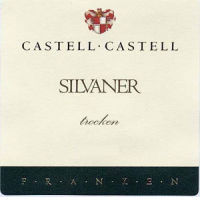
Castell-Castell Silvaner 2012, Franken, Germany, $18.00 
With aromas of pear, wax and white flowers, this dry wine offers medium acidity and medium body on the palate with flavors of almond, wax and pear and medium+ length.

Grafen Neipperg Lemberger
Trocken 2011, Württemberg, Germany, $20.00 (not pictured)
Medium aromas of cinnamon, berry and wood are joined on the (clearly stated –trocken) dry palate with flavors of cranberry, mulberry and a hint of earth in the finish.

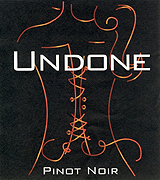
Undone PNUndone Pinot Noir
2012, Rheinhessen, Germany, $11.00
A Pinot Noir from Germany isn’t so surprising these days (Germany is #3 in PN production), but this wine’s origin from Rheinhessen (as opposed to Ahr or Baden) makes it somewhat unusual as does its great quality at this price. With cherry, herbal and wet leaves on the nose, this dry wine has lively acidity on the palate. Medium+ length.


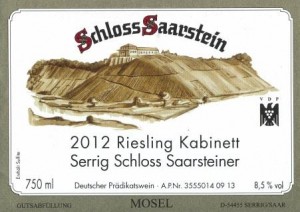
Schloss Saarstein Riesling Kabinett 2012, Serrig Schloss Saarsteiner, Mosel, Germany, $25.00Schloss Saarstein
Located within the municipality of Serrig, the Schloss Saarsteiner property, so named for the large castle (schloss) that sits amidst the vines, above the Saar River (a tributary of the Mosel) is an Erste Lage site. The wine offers peach, floral and wet stone aromas on the nose. Its palate is off-dry with high acidity and flavors of lime zest, peach and wet stone, culminating in long length.

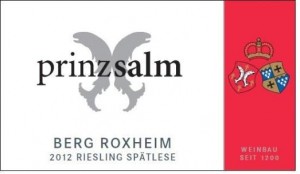
Prinz SalmPrinz Salm Roxheimer
Berg Spätlese 2012, Nahe, Germany, $28.00
With an alcohol level of 7.5% abv and a designation of spätlese, there was no question that this wine (from a Grosse Lage site) would have some sweetness. However, its sweetness is beautifully balanced by its high acidity, so it is perceived as off-dry on the palate, with lemon zest, lime, peach, honey and minerality aromas and flavors.

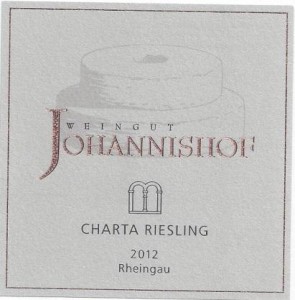
Johannishof Charta Riesling 2012, Rheingau, Germany, $25.00Johannishof

A pronounced nose provides aromas of floral, straw, wet stone and Asian pear. The dry palate displays high acidity with notes of granny smith apple, lime, stone, pith, blossom and minerality. Long Length.


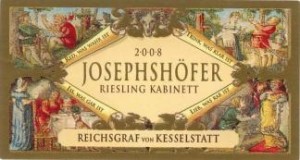
Kesselstatt Josephshöfer Riesling Kabinett 2012, Mosel, Germany, $30.00thumb
First documented 1,100 years ago, the Josephshöfer Grosse Lage site has been wholly owned by Kesselstatt since 1858. Citrus, floral, apricot and slight honey aromas greet the nose and persist on the dry, but ripe, palate. Long length.

Drink Wisely and Well – Holiday issue