This continues to be a challenging time for everyone as we still must deal with limited opportunities for interaction and celebration in an effort to stay safe and socially distant. Yet, when there are milestones to be celebrated, we very much want to share these experiences with friends, family and other important people.
I am all too aware of this dilemma having reached the age of 50 back in October. For years, I had been planning a big birthday party with a big wheel of Parmesan Reggiano and lots of cake. But, the universe had other plans and so I maneuvered the vagaries of a pandemic party, respecting people’s various comfort levels and hosted two mini-parties at rooftop (read outdoor) venues in New York City. Thanks to the generosity of my husband and dear friends, it never felt like a Plan B, despite being just that.
So, with this in mind, I was delighted to receive an invitation to join Sokol Blosser winery in recognition of their 50th anniversary. I am sure that the Sokol Blosser family had been planning this momentous occasion for some time and that hosting a “party” on Zoom was never on their dream list, but it was what was available to them this month.
I was particularly eager to attend since in the Before Times I had had the distinct pleasure of meeting Alison Sokol Blosser on two occasions. The first was an intimate dinner at Morimoto in April 2015 and the other was in April 2019 at Astor Wines for the debut of Second Generation 2GV Pinot Noir Cuvée, an event she attended with her brother, Alex. Plus, I have always been a fan of their wines and their pioneering spirit, with them having been the among the founding families to grow grapes and make wine in Oregon.

My enthusiasm was well rewarded. Despite the e-nature of the event, it was filled with warmth, funny stories, light-hearted jabs and an overall sense of love and passion for each other and for the winery that has come to mean so much to the Sokol Blosser family.
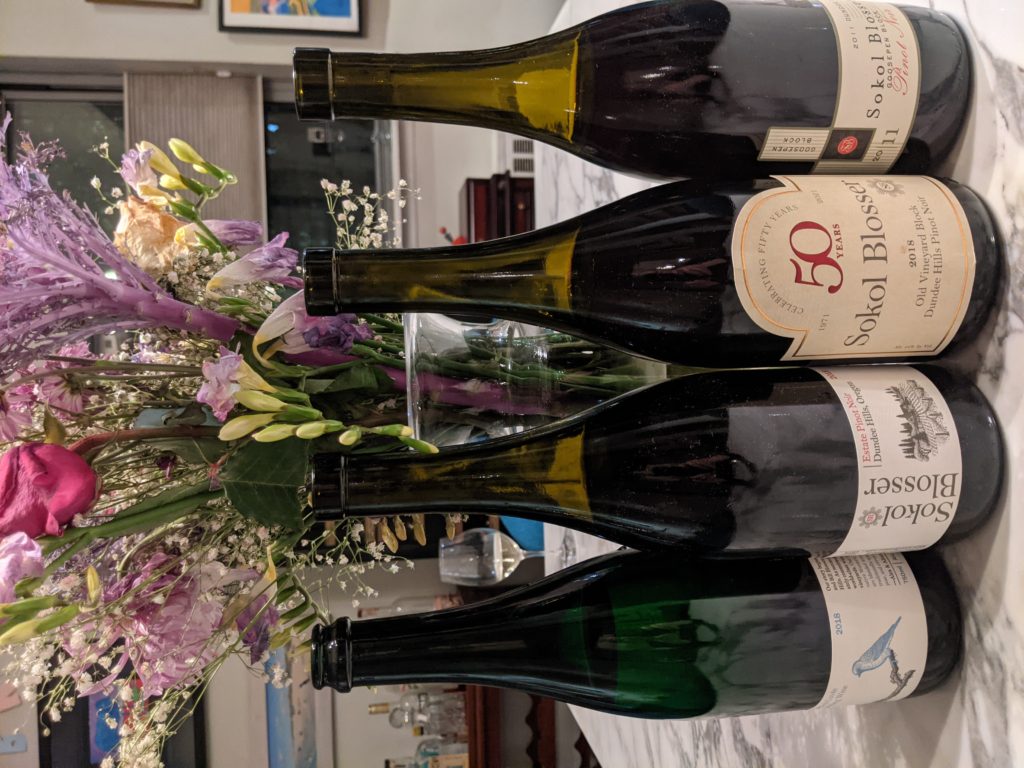
In the true spirit of celebration, the event kicked off with a toast to the family and winery with a glass of their Bluebird Cuvée sparkling wine.
Bluebird Cuvée Sparkling 2018, Oregon/Washington (US), SRP $32
This blend of Pinot Noir, Chardonnay, Muscat, Muller-Thurgau and Riesling is comprised of fruit sourced from both Washington state and Oregon (45%-55% split). It has a lovely, creamy mouthfeel, persistent perlage, with fresh fruit aromas, a hint of peach and peach pit, with long length.
Then, we turned our attention to hearing from Bill, Susan, Alison and Alex. Starting at the very beginning, Bill shared that since he had been a young kid, he had always wanted to be a farmer and grow things. After college, he travelled to France, gaining exposure to wine and vineyards, which opened up his eyes. “It was a whole new thing,” he explained, which instilled a budding interest in wine.
This newly acquired passion dovetailed perfectly with U.S. history as the mid-60s found the whole wine industry coming alive amidst the post-prohibition era. By accident (although some may say there are no accidents in life), Bill met some guys who had studied at UC Davis and had made the decision that the best place to grow Pinot Noir in the U.S. was the Willamette Valley in Oregon since it was the closest to Burgundy as they could find. He noted that, “It’s way warmer today, but still has a good climate.”
Of course, this wasn’t just any group of guys, but David Lett, Dick Erath and Charles Coury, all of whom “got the whole thing going with their pioneer, crazy attitude.”
“Let’s do it!” said Bill. And the rest, as they say, is history.
Alison questioned her mom’s reaction to such a plan and Susan explained that “I should be a good wife and I didn’t have better ideas…” so she agreed to the plan. Interestingly, once assembled, the group consisted entirely of couples, but as Susan revealed, while the guys took the front-facing roles, the women were really important too. For her part, she describes herself as more a vineyard person than a winemaker.
As Susan and Bill shared various stories of their early days, they advised that one of the first challenges was understanding how to grow grapes in Oregon. All of the available books were written for the Central Valley (in California), which has a considerably different climate and topography than Willamette. Instead, they looked to European publications for guidance and thankfully had enough foreign language skills among their pioneering group to translate this much needed knowledge. As Bill acknowledged, “It was a classic bootstrap operation.” In the end, they chose to import Dijon Pinot Noir clones to get started and planted their first vines in 1972.
Then, as Susan related, “We had to sell it.” Yet, the world was not ready for Oregon Pinot Noir in the 1970s. Among their various efforts, they brought a map to show potential customers where Oregon was located. It took decades (2000s) before top restaurants sought out Oregon Pinots for their wine lists. Moreover, Susan recognized that the Drouhin family’s arrival in the Valley was very key in gaining much needed support and a seal of approval.
Another important visitor to Willamette was Madame Bize-Leroy of Domaine Romanée-Conti, who did a tasting with Bill during his first vintage (1977). She pronounced “There is potential here.” But even she shared that making wine and selling it is never easy, despite being from such a vaunted estate, noting that, “Every year throws a new curve.” That visit has stayed with him.
But, in spirt of the difficulties they faced, both Bill and Susan were quick to assert that they have no regrets.
In 2008, Susan and Bill handed the baton to Alex and Alison as the second generation. The two became Co-Presidents. As the conversation shifted from the winery’s founding, Alex and Alison regaled the attendees with tales from their childhood. As Alex explained, growing up, he received no allowance. Rather, he had to work in the winery and vineyard to get pocket money. He started at about age 11, learning very early on that “making wine is primarily cleaning.”
When taking over the reins from their parents, Alex and Alison thought hard about what they wanted for the winery in its next chapter. They set their sights on continuing to raise the quality and also on becoming known as a sparkling wine house. While Bill agreed that Oregon is good for sparkling due to the climate, he further reflected that despite this recognition, he didn’t have the nerve to do sparkling wine since any little flaw shows up. So, it was up to the next generation to take on this challenge. Alison added that their first promise to each other was that they were not going to kill each other.
Susan’s memory is slightly different from that of her offspring. She recalls that they had such wonderful, grandiose plans for expansion and then the financial market had other plans. In the wake of the Lehman Brothers collapse and the recession, Alison and Alex were forced to sell wine just to keep in the business. But, Susan feels that this was a good lesson for the two to learn early on in their leadership.
In keeping with their desire to produce sparkling wine, they started with a Brut Rosé in 2010, a cool vintage, which is conducive to the production of sparkling wine. In 2015, they decided to make a Brut Cuvée, which was inspired by their Evolution White blend. It is deliberately produced with a short tirage of less than one year, which keeps the autolysis from imparting too strong of a yeasty, bread character to the wine. Rather, the goal is a purity of fresh fruit. Today, with this goal achieved, Alex describes Sokol Blosser as a reductionist house as opposed to one with an oxidative style.
Beyond his role as Co-President, Alex has been the winemaker since 2012, which was a good vintage. However, he believes that “It’s the vintages that try you, push you that are the ones that you from the most and are most connected to.”
That being said, Alex boasted of their good planning in having their anniversary coincident with a great vintage. 2018 was that vintage replete with ripeness, tannins and acidity as well as that unique combination of both quality and quantity (one usually gets one or the other).
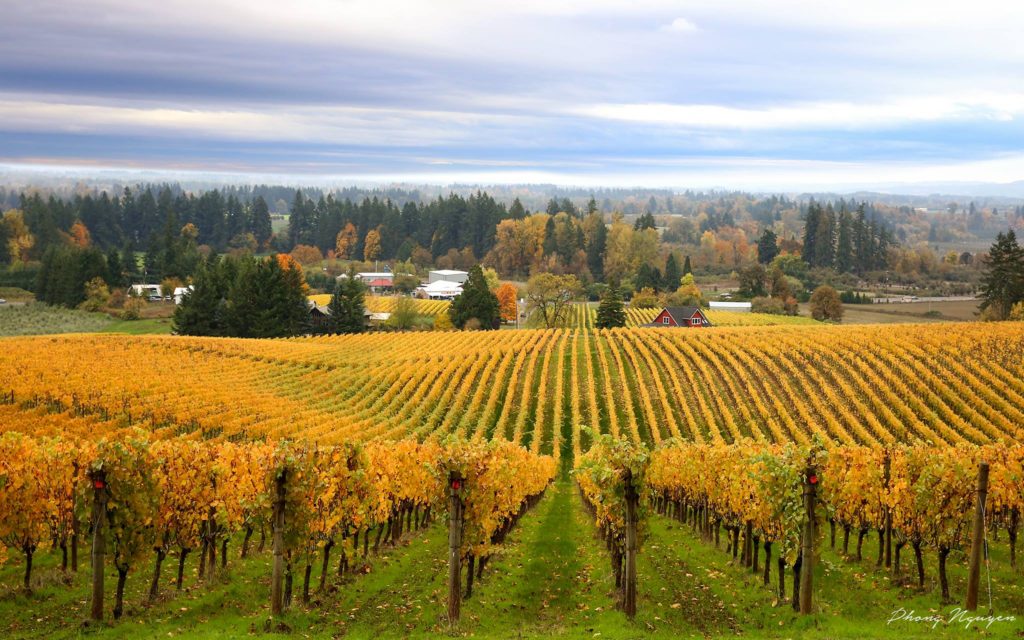
As we tasted the other wines, Alex explained that all of their wines are made the same; the difference is in where the grapes come from. Located in the Dundee Hills AVA, today Sokol Blosser owns 88 acres, which are certified organic. They lease an additional 18 acres in the Eola-Amity Hills AVA (which are also certified organic).

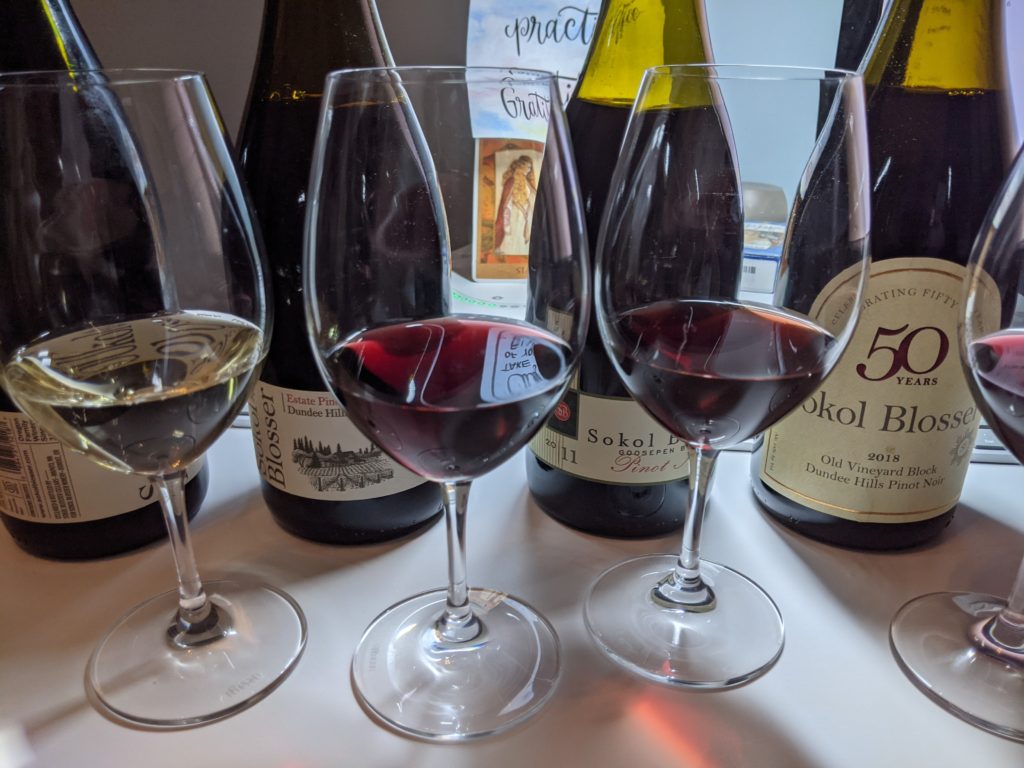
Dundee Hills 2018 Estate Pinot Noir, SRP $42
As their entry level Pinot Noir, this is a blend of all of their various blocks. It offers up a beautiful nose of cherries, with a dry palate, medium+ to high acidity, medium body, dusty tannins, ripe cherries, slight oak, and an earthy undercurrent, culminating in long length.
Old Vineyard Block Estate Pinot Noir 2018, Dundee Hills (OR), USA, SRP $60
Produced as a tribute to Mom and Dad, this wine sports a special, retro label from the 1970s. The original wines in this vineyard block are gone due to phylloxera, but they were replanted in the 1990s, maintaining the original composition. This wine has more density than the Dundee Hills Pinot, with medium+ to full body, slight spice, less earthy notes and more pronounced cherry and berry flavors. It needs time to develop.
Goosepen Block Estate Pinot Noir 2011, Dundee Hills (OR), USA, $110 (current); $80 upon release, 200 cases produced
This wine is redolent of floral, cherry and herbal aromas. The elegant palate provides bright acidity, medium body, lovely tannins, cherries, slight oak and herbs, with very long length.
The winery was generous in sharing this library wine with the event participants and apparently there had been much debate on what to send. Finally, it was agreed that this wine, hailing from the cool 2011 vintage would be a good choice thanks to its bracing acidity, which provided both structure and the ability to keep the wine together with age.
With grapes sourced from one of the estate’s top blocks, these approximately three acres got their name when Susan decided to fence off a few acres of Riesling and have some geese do the weeding. Unfortunately, it turned out that these geese weren’t interested in the job. Accordingly, the family kept one pair of geese and the others found themselves in the Sokol Blosser freezer, while the feathers found their way into some very fluffy pillows.
Looking ahead to the next 50 years, Alison and Alex are focused on a continued commitment to quality along with a focus on innovation. The winery has begun to offer box wines and has made a substantial investment in a mechanical harvester, noting that the technology has come so far; there is no loss of quality despite the mechanization. Further, as a Certified B Corporation since 2015, they also maintain a deft balance between purpose and profit.
Of course, more immediately, they are simply excited to open the tasting room again as we shift to a post-vaccine world.
Finally, there are eight members of the third generation, so watch this space…
As Alison reflected, they have succeeded through a combination of miracles and hard work, which has been an astounding experience. And, as Alex quipped at the end, “Mom and Dad, you done good!”