Beaujolais Nouveau 2010 arrives with Molly Sims, Franck Duboeuf and Peter Deutsch

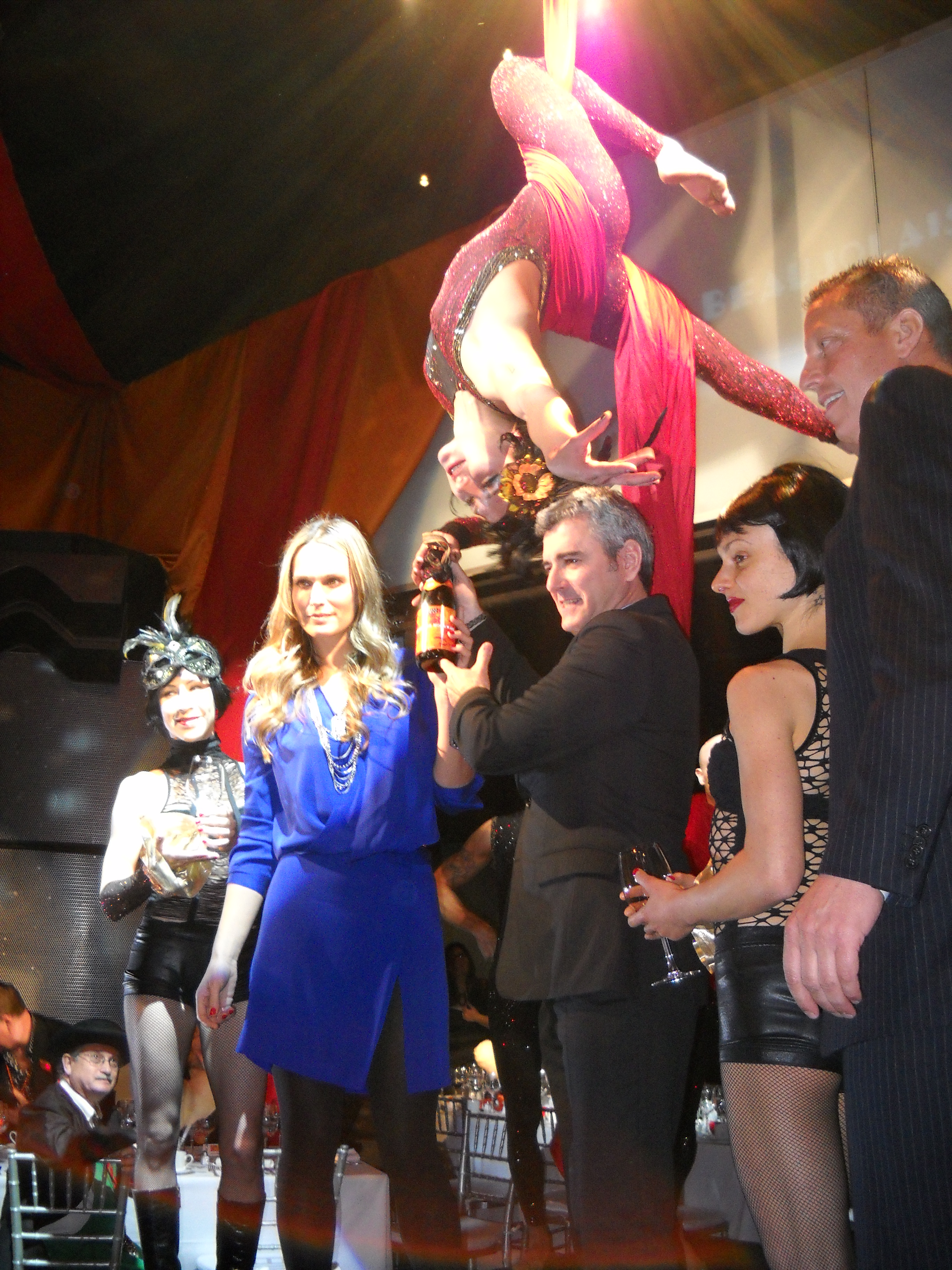
Molly Sims, Franck Duboeuf and Peter Deutsch welcome the Georges Duboeuf Beaujolais Nouveau 2010...cirque style.

Like clockwork, the Beuajolais Nouveau arrived on the third Thursday of November, attended by a circus-style celebration for the 2010 harvest. Actress, model and jewelry designer, Molly Sims, was on hand to toast the first glass from Georges Duboeuf, with George’s son, Franck, serving as Master of Ceremonies under the big top at District 36. The luncheon, prepared by chef Marc Murphy (of Landmarc and now also Benchmarc catering), was accompanied by the Beaujolais Nouveau 2010 and the Morgon Jean Descombes 2009. Other Beaujolais crus were available at the self-pour bar during the initial reception. Overhead, attendees were treated to aerialists dangling from silks, while jugglers, magicians and contortionists dazzled at eye-level.

Beaujolais, whether Nouveau or not, is a wine made in the southernmost part of Burgundy from the Gamay grape. While Gamay is not most people’s favorite grape variety — often associated with prejorative aromas of bubble gum and banana, this year’s wine showed none of these characteristics and was simply pleasing with its ripe cherry fruit and soft tannins. And, it went nicely with the meal.

As a wine, Beaujolais Nouveau has both its share of proponents and detractors, but for me, it is more about the symbolism than the wine itself. Here we are in November, only a few weeks after the harvest and we have much to be thankful for and much to celebrate. Along comes Beaujolais Nouveau, ready to honor the year’s work. Most wines are still preparing for the party (and may take years to do so as they dress in layers of oak, vanilla and toast), but Beaujolais Nouveau and other wines produced in a nouveau-style are not only fully dressed, they are prepared to dance until dawn.

No, it is not a wine on which to meditate, but sometimes all you need is a simple glass of wine, good food and good friends in order to sit back and enjoy the good life. Salut!

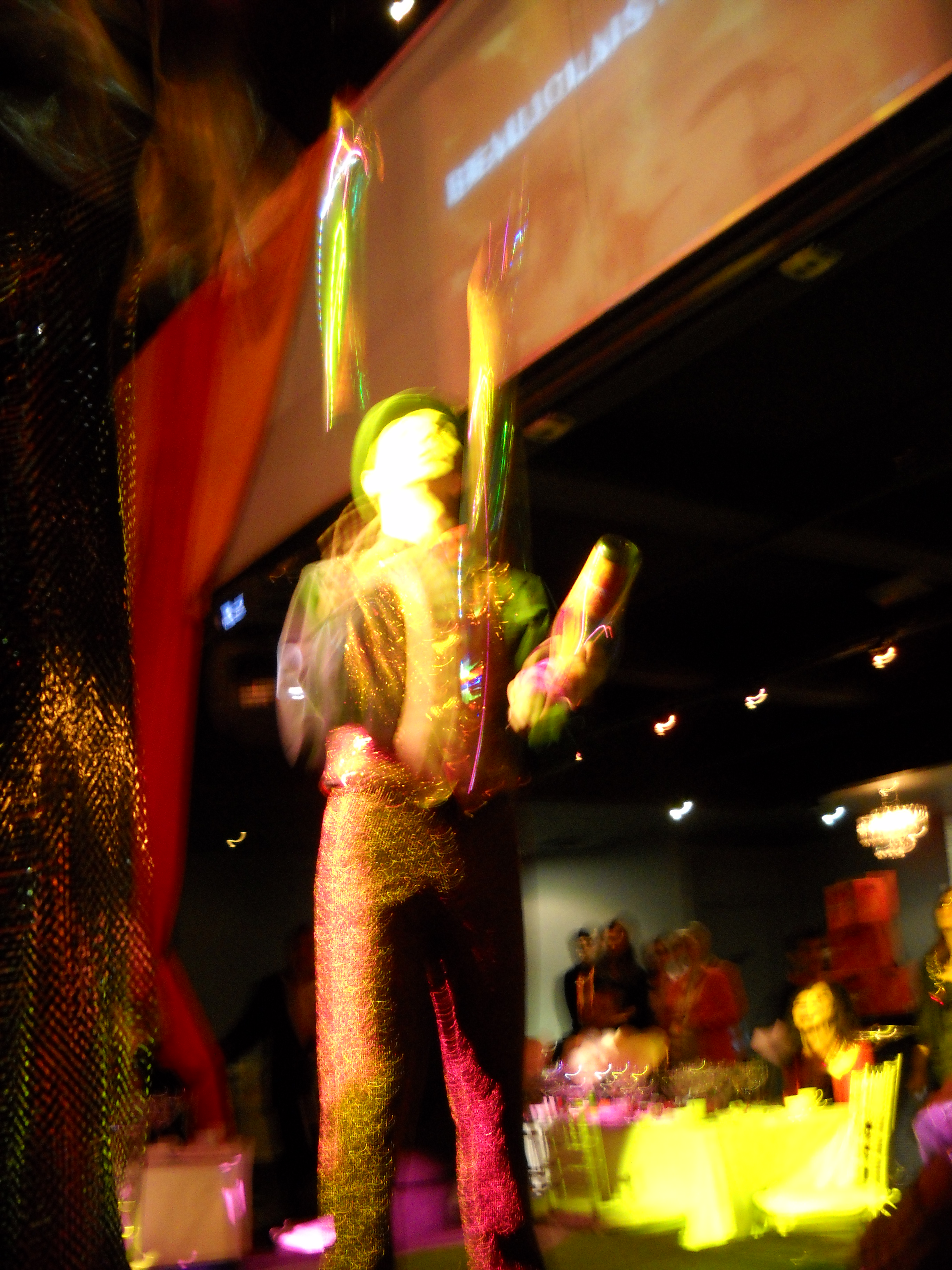
Juggler at Beaujolais Nouveau celebration.

Grand Cru Grapevine: Bubbles Born in the USA: American Sparklers (October 2010)

We have had a busy, but productive, fall season thus far. Our wine salon, From Mystery to Mastery, conducted as part of the East End’s first HARVEST Wine Auction & Celebration was met with great success as was Tracy’s Sex, Wine & Chocolate event with certified sexuality educator, Amy Levine, held at the beautiful Coco de Mer erotica and lingerie store.

Tracy will be teaching at the International Wine Center later this month and at NYU for three classes in November. Her session on Italian Sparkling wines, to be presented at the American Wine Society’s (AWS) annual conference is sold out with 90 registrants and only a few seats remain for her session on South African Wines.

In honor of the AWS’ conference location in Cincinnati, OH – what we’ve dubbed, “the other Cin city” and birthplace of America’s first sparkling wine – we bring you the history of Nicholas Longworth this month.

Drink wisely and well,

Tracy Ellen Kamens, Ed.D., DWS, CWE
CEO: Chief Education Officer 

       and 

Jared Michael Skolnick
COO: Cork Opening Officer 

Bubbles Born in the USA: America Sparkles

America has long had a love affair with sparkling wine, yet, while many Americans would be quick to identify Dom Perignon as an iconic figure of the Champagne region, few would know that they owe a debt of sparkling gratitude to Nicholas Longworth who created the first American sparkling wine – a Sparkling Catawba, in 1842.

Born in Newark, New Jersey, in 1783, this “crazy Jerseyman” stood somewhere between 5′-1″ and 5′-3″ and arrived in Cincinnati in 1804 (one year after Ohio had attained statehood), at the age of 21. After studying law for six months (there were apparently a lot fewer laws back then), he established a law practice.
 

Concurrent with his legal work, Longworth made shrewd investments in land, beginning in 1820. These real estate investments permitted Longworth to indulge in a new passion for horticulture and viticulture, pursuing the latter as a hobby as he began to plant vines along the Ohio River. 

His first attempts were with vitis vinifera, which, having been planted prior to the discovery of phylloxera, not surprisingly died shortly thereafter. Longworth then tried his hand at the American species, vitis labrusca. Specifically, he became interested in the Catawba grape (native to North Carolina), which was hearty enough to withstand the harsh winters of Ohio, planting these vines in 1825. He produced his first wine three years later, declared himself satisfied and subsequently quit his law practice, eventually crafting a sparkling version of his beloved Catawba.

But fortunately, Nicholas wasn’t the only one who admired his slightly sweet, sparkling wines. His wine was enjoyed not only throughout the United States, but also abroad in England and France. It was further lauded by poet Henry Wadsworth Longfellow who immortalized Longworth’s wine in his, “Ode to Catawba” published during the 1850s.

Longworth’s success eventually established him as the “wealthiest man in Ohio.” In fact, “…in 1850 his taxes rated higher than any other man in the United States except William B. Astor…” at an annual bill of $17,000 and, at his death, his wealth was estimated to be $15 million. (Harper’s Weekly)

In addition to being an accomplished wine producer, Longworth was a generous person and used his wealth to help others in his community. He provided work for those in need; built housing above his wine cellars for indigent laborers; and distributed bread to the hungry from his home every Monday morning.

Longworth’s efforts also helped to cement Ohio as a key winegrowing area in the United States. By 1860, Longworth had 3,000 acres of vines and was producing 570,000 gallons of wine, annually bottling 150,000 bottles. During this period, Ohio led the nation in the production of wine, supplying one-third of the nation’s wine and out-producing California by two to one. However, this boom was short-lived as Ohio wine production declined in both the wake of viticultural disease and a loss of labor as Ohioans left to fight in the Civil War.

Yet Ohio was not alone in its pursuit of bubbles. In 1855, Benjamin Davis Wilson, who was to become the first mayor of Los Angeles, was the first to produce a sparkling wine in California. And, across the country, a “champagne” industry was started in Hammondsport in New York’s Finger Lakes region in 1860. Crafting sparklers from Delaware, Iona, Elvira and Catawba grapes, the Pleasant Valley and Taylor Wine Companies set about to establish “American champagne [as] the leading wine of the region.” (Reichl, 14) 

While most of this early success with sparkling wine was brought to an end in the 1920s as America pursued Prohibition, by 1933, “[t]he few surviving Eastern wineries, principally sparkling-wine producers of New York State [namely Great Western and Gold Seal], soon found their bearings again.” (Wagner, 61)

And, only a few decades later, a renaissance would take place, with Jack and Jamie Davies re-establishing a winery at the old Schramsburg estate in Napa Valley, CA. With a focus on quality, not quantity, the Davies’ produced a Blanc de Blancs, which they released in 1967, becoming “America’s first commercially produced Chardonnay-based brut sparkling wine.” (Sawyer) Schramsburg’s reputation was assured when, in 1972, their sparkling wine was poured at the “Toast to Peace” dinner with President Nixon and Premier Chou En-lai in Bejing, China. Their wines have been poured in the White House ever since.

Today, sparkling wine is produced in all fifty states, and, while many of these producers are local in scope, leading American sparklers are found in California, Oregon, New York, Virginia, New Mexico, Pennsylvania, Delaware and Massachusetts, and are often national and even international in their reach. Here, many serious winemakers are crafting world-class wines utilizing the Traditional Method of production, with ultra-premium producers focused on estate-grown grapes and the production of vintage-dated wines.


Harper’s Weekly Journal of Civilization, Nicholas Longworth Obituary, published 3/7/1863.

Reichel, Ruth ed., History in a Glass: Sixty Years of Wine Writing from Gourmet. Random House: New York, 2006 [Frank Schoonmaker, Return to the Native, p. 14]

Sawyer, Christopher. “The Best of Both Worlds.” The tasting panel, December 2009.

Wagner, Philip M.  Grapes Into Wine, Knopf Press, 1976


Producer Profiles

Biltmore Estate
Biltmore Estate in Asheville, North Carolina is “the most visited winery in the United States,” seeing one million visitors annually. The 125,000 acre estate is the site of George Vanderbilt (grandson of Cornelius)’s dream home designed by noted architect Richard Morris Hunt. The Château Reserve Blanc de Blancs is 100% Chardonnay from fruit sourced throughout North Carolina and is aged 24-30 months before disgorging.

Chateau Frank
In 1962, Dr. Konstantin Frank established Vinifera Wine Cellars in Hammondsport, New York and earned a reputation for his Rieslings and “champagnes.” The 1999 Prestige Cuvee is made with 100% estate-grown fruit, a blend of 50% Chardonnay, 45% Pinot Noir and 5% Pinot Meunier and then aged for more than five years. 

Gruet Winery
The Gruet family of Champagne, France established their Albuquerque, NM winery in 1984. The 2004 Blanc de Blancs remained en tirage for a minimum of four years with the last bottles reaching anywhere up to five years.

Iron Horse Vineyards

When Iron Horse’s founding partners, Audrey and Barry Sterling, first saw the 300 acre property in 1976, it was the most westerly vineyard in Sonoma, but the Sterlings knew they wanted to grow Chardonnay and Pinot Noir and that this was the perfect climate in which to do so. The 2005 Classic Vintage Brut is among the most traditional of their sparklers, made from 25% Chardonnay and 75% Pinot Noir and aged for three years. 

Kluge Estate
Kluge Estate was established in 1999 in Carter’s Mountain on the edge of Blue Ridge Mountains in Charlottesville, VA by Patricia Kluge whose dream was to build a wine region. The 2007 SP Rosé, made from 95% Chardonnay and 5% Pinot Noir, was aged for 21-24 months and won at the Monticello Cup in 2010 and took home Silver medals at both the San Diego Wine & Spirits National Women’s Wine Competitions.
 

L. Mawby
Larry Mawby planted vines on Michigan’s Leelanau Peninsula in 1973, with his first harvest in 1978. His Talismon is made from estate grown fruit picked as a field blend of Vignoles, Pinot Noir, Pinot Gris, and Chardonnay.

Soter Vineyards
Although he is more known for his Pinot Noirs, Tony Soter chose to make a sparkler because he is a “sucker for a winegrowing challenge.” Produced from 100% estate grown fruit, the Soter Rosé is a 50-50% blend of Chardonnay and Pinot Noir and spent at least three years on the lees.


Troutman Vineyards
Building on Ohio’s wine legacy, Deanna and Andy Troutman established Troutman Vineyards in 1997. Their Cuveé D, a brut style sparkler made from hybrid variety, Vidal Blanc, won a Bronze Medal at the 2009 Ohio Wine Competition in the Hybrid Sparkling Wine category.
 

Chenin Shines Brightly

AWS Tasting at Grand Cru Classes ~ October 2010

The tasting featured a collection of Chenin Blancs from South Africa and ranged in price from $5.00/bottle to $55.00/bottle. The majority of the wines were dry, but the final wine was a noble late harvest Chenin Blanc

The crowd favorites, based on the AWS evaluation and scoring (20 point scale) were as follows:

Mulderbosch Chenin Blanc 2008, Stellenbosch, South Africa – coming in with an average score of 15.5; I had it at 16
At $13.00, this was a lot of wine for the money – complex aromas of tropical fruit, botrytis and lanolin, richness on the palate, medium+ length

At 16.2, Ken Forrester’s FMC 2007, Stellenbosch, South Africa neared the top of the list, but, at $55.00, the group was less inclined to purchase it. Aromas of nuts, yeast, botrytis and spice; lush tropical fruit, oak, spice, with a caramelized note in the long length.

The highest scoring wine of the night was the Darling Cellars Onyx (Noble Late Harvest) 2008, with an average 16.4. $20.00 for a 375 ml bottle – not too bad for a dessert wine, especially one with the complexity and balance that this one showed. Aromas of honey, licorice, spice and apricot; medium sweet on the palate with honey and tangerine; long length.

Grand Cru Grapevine: All in the Family (September 2010)

September 2010

Summer has not yet quite finished out its tenure, but the 2010 harvest is already in full swing. Having been spared from the potentially devastating Hurricane Earl, many of the white grapes have begun to be picked and brought into the winery, while the red grapes will remain to finish ripening for a few more weeks.

Right on cue, the East End’s first HARVEST Wine Auction & Celebration will take place on September 24-25, 2010. As a reminder, Grand Cru Classes will offer its “From Mystery to Mastery” class through the Wine Salon as part of this two-day event.

The HARVEST event and the actual harvest signal autumn’s impending return, which also finds children returning to school this month and answering the age old question of what they did on their summer vacations. With family stories in mind, this month we look at the Concannon Family and its history.

And, we encourage you to return to school this fall as well…wine school that is. Tracy will reprise her Sex, Wine & Chocolate event on October 5, 2010 with nationally recognized sex coach and certified sexuality educator, Amy Levine, at the amazing Coco de Mer erotica and lingerie store. Savor every sip, taste and touch more fully through this decadent tasting of wine paired with Bond Street chocolates, which integrates a unique look at the intersection of these three joys in life. Call the store at 212-966-9069 to reserve your spot.

For tamer, but equally wine savvy, classes, turn to Tracy’s classes, which will be offered NYU’s School of Continuing & Professional Studies. She is also teaching the WSET Intermediate Certificate at the International Wine Center on Mondays, starting October 18, 2010.

Drink wisely and well,
Tracy Ellen Kamens, Ed.D., DWS, CWE
CEO: Chief Education Officer
and
Jared Michael Skolnick
COO: Cork Opening Officer

All in the Family

Two Generations of the Concannon Family

I first met the Concannon family in a grocery store in California. No, I didn’t have the pleasure of meeting a member of the family, that came later, but yes, you can actually buy wine at the same time that you stock up on those other staples in life – milk, bread, cereal and ice cream – at the supermarket in some states. Rather, a family vacation had brought by parents, sister and I to San Diego and we were browsing the wine aisle in search of an inexpensive wine to enjoy with dinner. I’m not sure what drew us to the Concannons, but we picked up the bottle, placed it in the cart along with a rotisserie chicken and sides and headed back to our studio room at the hotel. We were not disappointed.

This past summer, I actually had the opportunity to meet John Concannon, the fourth generation of Concannons to run his family business, for dinner at Brasserie Ruhlmann, with his wines poured throughout the meal. I was very impressed with John and the wines, both of which were (food)-friendly and approachable. Over the course of dinner, John shared his family’s history with me, further adding to my appreciation of Concannon.

In addition to having wine in their blood, the Concannon family is also proud of its Irish heritage, with founder James Concannon becoming the first Irish immigrant to establish a winery in the U.S. John owes his family’s legacy to Great Grandmother Ellen who devised to keep her husband closer to home. Born on St. Patrick’s Day, James initially moved to the U.S. and found work in the rubber stamp business, but his wife, Ellen, insisted he stay in the area and make wine for the church instead. Following his wife’s advice, James bought 47 acres of land in California’s Livermore Valley and planted vines in 1883.

Building on their lengthy history, in the 1950s, the family was the first to hire a female winemaker. And, in 1961, the Concannons celebrated both the arrival of John and the launch of America’s first varietally-labeled Petite Sirah. Today, Concannon is the oldest, continuing operating U.S. winery under the same family and heralds its 127th harvest this year. John’s niece, Shannon, is already eagerly asking her dad questions about the wine business, ready to take the helm of her family’s venture, although it is expected that she will at least complete grammar school before doing so.

While Concannon’s Reserve and Heritage wines are only available at the winery, two other tiers of Concannon wines are widely available:

  • Concannon Selected Vineyards – grapes sourced from California’s Central Coast; $10.00 and under
  • Concannon Limited Release – comparable to the winery’s Reserve wines; includes the Conservancy wines, which are sourced from Livermore Valley vineyards that have been preserved as agricultural land in perpetuity; $15.00

Tasting Notes

Concannon Vineyard, Sauvignon Blanc 2008, Livermore Valley (CA), USA, $10.00
Mildly aromatic with aromas of grapefruit and lime, this wine is dry, with restrained fruit flavors of grapefruit, lime, citrus pith and stone, anchored with vibrant acidity.

Concannon Vineyard, Conservancy Chardonnay 2008, Livermore Valley (CA), USA, $15.00
Aged in French and American oak barrels, the nose is greeted with slight toast and nut notes, along with melon. The dry palate presents with medium+ acidity and flavors of melon, citrus, mineral and noticeable, but well-integrated oak. It paired beautifully with a blue crab salad.

Concannon Vineyard, Conservancy Merlot 2007, Livermore Valley (CA), USA, $15.00
Sourced from a cool area, this Merlot is bright and fruity with aromas of plum, cherry and herbs. Medium acidity and medium tannins join the dry palate, which offers black cherry and leafy notes.

Concannon Vineyard, Conservancy Cabernet Sauvignon 2007, Livermore Valley (CA), USA, $15.00
Produced from 93% Cabernet Sauvignon and 7% Syrah, this wine is dry, with medium acid, full body and medium, ripe tannins. Aromas and flavors of blueberry and spice are joined with a hint of dark cocoa.

Concannon Vineyard, Conservancy Petite Sirah 2007, Livermore Valley (CA), USA, $15.00
Deep aromas of blackberry, smoke herald this dry wine, which has medium acidity, a full body, and notes of blackberry, smoke and oak wrapped around finely-grained tannins.

When in doubt, drink Tequila

The view from the balcony was breathtaking – the sand, the sea and the sun all conspired to produce an amazing tableau. Sitting on the balcony every day, we never grew bored with the sight.

Situated in the heart of Cancun, Mexico, we settled into a rhythm for our vacation, foreswearing our usual wine for a week filled with Margaritas. Our visit to the downtown Walmart had yielded an inexpensive, but reasonably nice quality, bottle of Tequila, along with the ubiquitous Jose Cuervo Margarita mix. It wasn’t fancy, but the duo did the trick and kept us awash in cocktails for the week.

Admittedly, a true Margarita should be made with Triple Sec and lime juice (instead of the mix), but we took the lazy journey to Margaritaville.

During our trip, we had the pleasure of visiting the Hacienda Tequila where we were given a brief tutorial on how tequila is made and were reminded on just what it is that makes tequila, well, tequila.

Tequila is part of the larger class of spirits called Mezcal, which are produced from the agave plant. Tequila hails from a delimited area within Mexico, centered around the state of Jalisco, but with differences in aromas and flavors stemming from the various terroirs. In addition, it must be made with 100% blue agave, which is considered to be a superior variety of agave. While these plants resemble cacti, they are actually related to the Amaryllis family.

Jimadors (field workers) harvest the core of the blue agave when the plant is between 6 and 8 years of age. The cores are cooked with direct heat for 36-48 hours and then left in the ovens with residual heat for an additional 24-36 hours. This cooking process is necessary in order to convert the starchy core into a fermentatble sugar. After cooking, the cores are milled to extract the  sugary liquid and remove the extensive fiber. This liquid is fermented into an alcoholic liquid, which is then distilled in pot stills, generally with two distillations.

Depending upon the maturation and ageing, tequilas are labeled as follows:
*Gold or Joven – unaged, with the addition of coloring agents (mostly caramel)
*White or Blanco – unaged or rested a maximum of two months
*Reposado – minimum of two months aging in wood
*Anejo – minimum of one year aging in wood
*Extra Anejo – minimum of three years aging in wood

We tasted through a number of tequilas at Hacienda Tequila, most of which were sipping tequilas — too good to be adultered with margarita mix. One of our favorites was the Casa Azul Reposado, which we purchased in the airport’s duty free shop on the way home. We also loved the Casa Azul Anejo, but it was pricier than we preferred to spend. Now, all we need to do is pour some tequila, close our eyes and be transported back to our Cancun balcony.

Captain, My Captain

Each year, the American Wine Society (AWS) sponsors two wine competitions recognizing both amateur and commercial winemaking. The wines are judged in Pittsburgh with extra bottles of wine sent to be informally evaluated at the annual conference in a mock competition. At conference, tables are staffed by volunteers who are wine judges, graduates of the Wine Judging Training Program (WJTP) and/or those currently in the program. These table captains are to lead their table members in an evaluation of the wines. Since I had just began the WJTP, I volunteered to be a table captain.

Called up to the front of the room, each table captain had to grab an unmarked box of wine and returned to his/her table. Mine was a flight of Chardonnays. After carefully reading the instructions, and opening the wines, I waited until the participants entered the room and my table was filled. In all, there were five of us at my table, representing one of about 20 tables altogether.

I welcomed the group and explained how a wine competition was run and what they should do this afternoon. Once everyone was fully briefed, we began to pour samples of the first five wines into our glasses, passing each bottle onto the next person. The next step was to begin tasting/evaluating and scoring using the AWS 20-point format. After everyone had completed this process, I asked each person for the total score on each wine, before we discussed each wine on its own. The first wine’s scores ranged from 10 to 16. One person continued to be an outlier at the low end throughout the scoring process. The following bottle seemed to be flawed and our scores reflected it. We continued to taste through bottles 3, 4 and 5 in the same manner. Dumping out wines 1 through 5 (we only had 5 glasses each), we then poured and tasted wines 6 and 7, following the same procedures. We agreed that our bottle of wine 6 was faulted and chose not to score it. At the end, the official scores were unearthed from the envelope and we compared our average scores with the judges.

Here is how our scores compared:
Wine 1 – 13.7 (Us) vs. 14.0 (official judges)
Wine 2 – 10.3 vs. 14.17
Wine 3 – 11.7 vs.12.0
Wine 4 – 12.3 vs.11.83
Wine 5 – 14.2 vs.12.67
Wine 6 – Not scored vs. 8.67
Wine 7 – 14.7 vs.16.0

As evidenced from the above comparison, while our scores didn’t fully match the official judging, we were relatively close with the exception of Wine 2, for which there may have been a problem with our bottle since we felt it was flawed. 

All in all, I thought it was a very interesting and instructive exercise and look forward to volunteering again in November 2010.

Building my strengths in the American Wine Society Wine Judging Training Program

As an educator, it is important to recognize your strengths and weaknesses. While strong on wine knowledge, my blind tasting skills are my weakest area. Therefore, I enrolled in the American Wine Society (AWS)’s Wine Judging Training Program (WJTP) as a way to discipline myself to keep my skills sharp. Presently, this three- year program is only offered in conjunction with the society’s annual conference, held in various locales. I began the program in November 2009, with the conference held at the Grand Sandestin Resort in Destin, Florida.

In advance of the conference, program participants are provided with a required reading list, syllabus and learning objectives and are instructed to arrive prepared for an exam – written and practical. As to be expected, all instructors in the program are graduates of it themselves.

We spent the morning reviewing important aspects of a wine’s appearance, paying attention to clarity, color and depth, led by Ken Brewer. Ken also spent considerable time discussing wine judging in general and the characteristics of being a good wine judge. Above all is the need to be objective in your evaluation, regardless of whether you absolutely adore a wine or positively hate it. 

Next, Richard Ulsh, a chemistry professor at the University of Pittsburgh, spent considerable time explaining the nuts and bolts of our sense of smell. Given that evaluation of a wine is heavily focused on its nose for both aromas and flavors, understanding this process was especially helpful. Rich then shifted from how to what by explaining all of the various faults one might find in a given wine and the reason for their presence. Participants also had an opportunity to smell through a line up of wine glasses, each of which contained one of the aroma faults we had just reviewed.

For the last presentation of the morning, Betty Nettles led us through an insightful set of tasting exercises where we experienced various components both separate and then in tandem to see how they interacted with one another. More specifically, we tasted through multiple component flights — ethanol on its own in varying proportions; synergy of alcohol and sugar; synergy of alcohol and acidity; synergy of sugar and acidity; and the eynergy of sugar and tannin. The final flight illustrated how alcohol, acid, sugar and tannin can come together to create a balanced wine.

At the conclusion of the day, we were presented with five samples wines for which we were to write an evaluative note and assign a score based on the AWS 20-point scoring system. Our last assignment was to identify which, if any, faults or imbalances were present in 10 samples. After which, we were done with Year 1. The results were posted the next day (5 Passes, 1 Conditional and 6 Fails — this is not an easy program) and I was pleased to find that I had passed, ensuring my promotion to the second year.

I am now preparing for Year 2 of the program, which will be offered in Cincinnati this November. I will also present two sessions at the conference — one on Italian sparkling wines and another on South African wines.

Wine Shopping in NYC: Behind the scenes at Wine Portfolio

Television show, Wine Portfolio, hosted by Owner/Executive Chef of Wild Fire Steakhouse and wine enthusiast, Jody Ness, takes people around the worlds of wine and food and around the world. As Jody says, “Life is my passion, people my inspiration, and wine my muse…Life is meant to be enjoyed, a great glass of wine is made to be shared, so we created Wine Portfiolio: The world of wine uncorked.”

Among Jody’s travels, an upcoming episode will feature the wide range of wine shopping choices available to shoppers in New York City, along with tips and tricks for all wine lovers on how to shop for wine. I was asked to join Jody and his team (Kevin Fox, Michelle Lin and Norm Ness), with segments filmed at three very different retail stores in Manhattan.

The first stop was Sherry-Lehmann, a 76-year-old store launched in the months just after that experiment gone wrong (aka Prohibition) was lifted. With nearly 7,000 different wines available, the store has both breadth and depth in its selection. Long-time strengths continue to be France, especially Bordeaux, Burgundy and Champagne. Our visit to Sherry-Lehmann was hosted by long-time friend and colleague, Robin Kelley-O’Connor, Sherry-Lehmann’s Director of Sales and Education. Robin shared a bottle of the Lafite Reserve Speciale 2006 (Medoc) from Baron Eric de Rothschild with us while we toured the store, a great bargain at under $20.00/bottle.

Heading downtown and a bit west, we arrived at Tom Geniesse’s Bottle Rocket. Tom was out of town on a much-deserved vacation and he left us in the capable hands of manager, Gary Itkin. Bottle Rocket’s unique approach to wine sales groups their carefully curated collection (365 bottles) by type (whites, reds, dessert), food categories (seafood, meat, take-out) and gifts (boss, friend, date), making it easy for a novice to pick out a wine with confidence. Jody was intrigued by Jam Jar Shiraz with its bottle designed to mimic a jar of jam, and treated us to a taste of this fruity, off-dry red before we departed for our third location.

To beat the heat, we took a taxi the few blocks necessary to get to Chelsea Market where we visited with David Hunter, general manager and wine buyer for Chelsea Wine Vault. A pioneer of the Market, Chelsea Wine Vault has been there since 1997. The store caters to a collection of tourists and locals alike, with wines arranged by country and region. All of the wines are selected by David who tastes hundreds of wines each month, in his search for the best set of wines for the store. Below the retail floor, a temperature-controlled storage facility, run as a separate venture, is available for customers to correctly store their wines.

After filming at all three stores, the team stopped for some lunch and then proceeded to the High Line for some final shots, including an interview with Jody and me.

All photos courtesy of Michelle Lin, Re:Source Media


Women in Winemaking: Simi & Franciscan

When you were little, what did you want to be when you grew up? Not surprisingly, winemaker was probably not on your list. Similarly, while Janet Myers and Susan Lueker are now both successful Napa Valley winemakers, they each came to their craft by a circuitous route.

Janet grew up in Southern Illinois with a family fruit orchard and maternal grandparents from Italy, but her interest in grapes didn’t come until later. She studied biology in college and initially pursued anthropology. Janet eventually moved to London and, while waiting tables there, developed a love of wine. As her passion strengthened, she chose to study enology at UC Davis. 

Meanwhile, Susan studied chemistry when she first went away to school, but then changed her mind and majored in child development. After working with hospitalized children, which she found quite depressing, she decided to switch careers. Susan had always liked wine and her parents had met at UC Davis, so it seemed like a natural place to investigate. After a great meeting with one of Davis’ professors, Susan enrolled at the university. 

Arriving at the same decision around the same time, Susan and Janet found themselves as lab partners and became friends. Today, Janet is the head winemaker at Franciscan, a post she has held since 2005, while Susan is at Simi, where she has been for the past 10 years.

A recent “Women in Winemaking” dinner featured both winemakers and their wines at the Crosby Hotel in New York. During the reception, guests had the opportunity to taste Simi’s Sauvignon Blanc and Franciscan’s Napa Valley Chardonnay as well as two red wines. Moving to the dining room, additional wines were paired with dinner.

Simi Chardonnay 2007, Russian River Valley, CA
This wine was made from 20-year old vines planted by Zelma Long. It showed butter, apple and citrus aromas on the nose owing to partial malolactic fermentation and ageing in G. Ferrer barrels. Dry and full-bodied on the palate, its flavors included apple, oak, nuts and vanilla.

Franciscan Cuvée Sauvage Chardonnay 2007, Carneros, CA
Named for the use of ambient/wild yeast used, this wine takes twice as long to ferment and Franciscan was the first producer in Napa to bottle a wild ferment wine. This wine has aromas and flavors of oak, yeast and green apple and spice, which can be attributed to the wild yeast, barrel fermentation and lees stirring.

Simi Landslide Vineyard 2006, Alexander Valley, CA
The 290 acre (180 of which are planted) Landslide Vineyard was planted in the mid1980s by Zelma Long and has three different elevations, each of which delivers a unique quality to the grapes. The lowest elevation results in ripe character and softer tannins, while the highest provides vibrant, vivacious fruit. A blend of 85% Cabernet Sauvignon, the remainder made up of the other four Bordeaux varieties, floral, blackberry smoke and cherry aromas greet the nose. A full-bodied palate shows notes of blackcherry, spice, vanilla, oak and smoke. 

Franciscan Magnificat Red Wine 2006, Napa Valley, CA
One of the first Meritage blends, Magnificat was named for Bach’s piece, which was written for five voices. Franciscan has been making this wine since 1984, varying the blend each vintage. Janet noted that, “By varying the blend, we can be more true to the personality of the blend.” The 2006 is produced from 56% Cabernet Sauvignon, 40% Merlot, 3% Malbec and 1% Petit Verdot, with meat, bacon, cherry and smoke aromas. Medium+ tannins, fruit, spice and vanilla linger in the long length.

What’s your Conundrum?

I was asked to serve as the judge for a special event celebrating Caymus’ Conundrum, which was paired with a range of take-out cuisine in search of the best match. This wine is a “proprietarily secretive blend of California white grapes”, drawing from Sauvignon Blanc, Muscat Canelli, Chardonnay and Viognier, and a combination of stainless steel and barrel fermentation that results in an unusual, but wonderful wine.

Pamela Wittman, owner of Millissime PR & Marketing Services, graciously opened up her home to a group of wine and food journalists, inviting them to each bring a dish of ethnic food, which they felt would pair well with the Conundrum wine. The stakes? A jeroboam of Conundrum.

Guests arrived, bearing their dishes, which Pamela and her team (Patricia, Erin and Matthew) plated, carefully protecting each person’s the identity until the big reveal later in the evening. After everyone had settled in, Pamela offered a brief welcome and explained the origin of the evening’s event. When she first tasted this wine, she felt strongly that it would pair well with a variety of foods and thus, she sought to confirm her suspicions that night. Guests were then invited to dig into the wonderful array of food.

Having been asked to serve as the arbiter for the evening, I took my job seriously and made sure to take a bite of each dish and taste it alongside the wine, keeping careful notes of my impressions. I tasted the food on its own and then took some wine into my mouth, while the food was still in it, to further probe the pairing. It was a fun, but challenging task, as I sought to rank my preferences from 1 (favorite pairing) to 11 (least favorite). Certainly, it was not a scientific experiment, but I did come to some conclusions and submitted my ranking to the Millissime team.

My first choice was a Chicken Tagine with Apricots, prepared by Jamal Rayyis (technically he cheated as it wasn’t take-out, but he did take it out of his kitchen and it was quite tasty, so there were no arguments). I found the dish to be full-flavored and well-spiced with its fruit flavors — fruity, but not sweet — matching nicely with the fruit in the wine. My second favorite selection was Chicken Tikka Masala, the flavors and creamy texture serving as a nice foil for the wine. Sweeter dishes such as General Tso’s Chicken were less preferred by me as their sweetness dimmed the fruit in the wine and made it appear overly dry. Dishes with excessive heat overpowered the wine and were similarly less successful. I also have to mention the Grand Marnier Shrimp, brought by my friend, Lisa Carley, which thankfully made it into my Top 5, otherwise she claimed that she would have had to stop speaking to me.

A popular vote was also taken, and, while there wasn’t perfect consensus, the #1 and #11 spots were the same — Jamal taking home the prize for the evening and my dear husband, Jared, falling short on both lists (and confirming my impartiality as judge). Actually, everyone really enjoyed the Thai pasta dish he had selected, but its heat (and mind you, he ordered it as medium, not hot) would be better suited to a beer or lassi.

So, that was our Conundrum for the evening, easily solved with great wine, great food and great company. What’s yours?

All images courtesy of Pamela Wittman.