JBF Chefs and Champagne – Out of the kitchen, but still in the heat

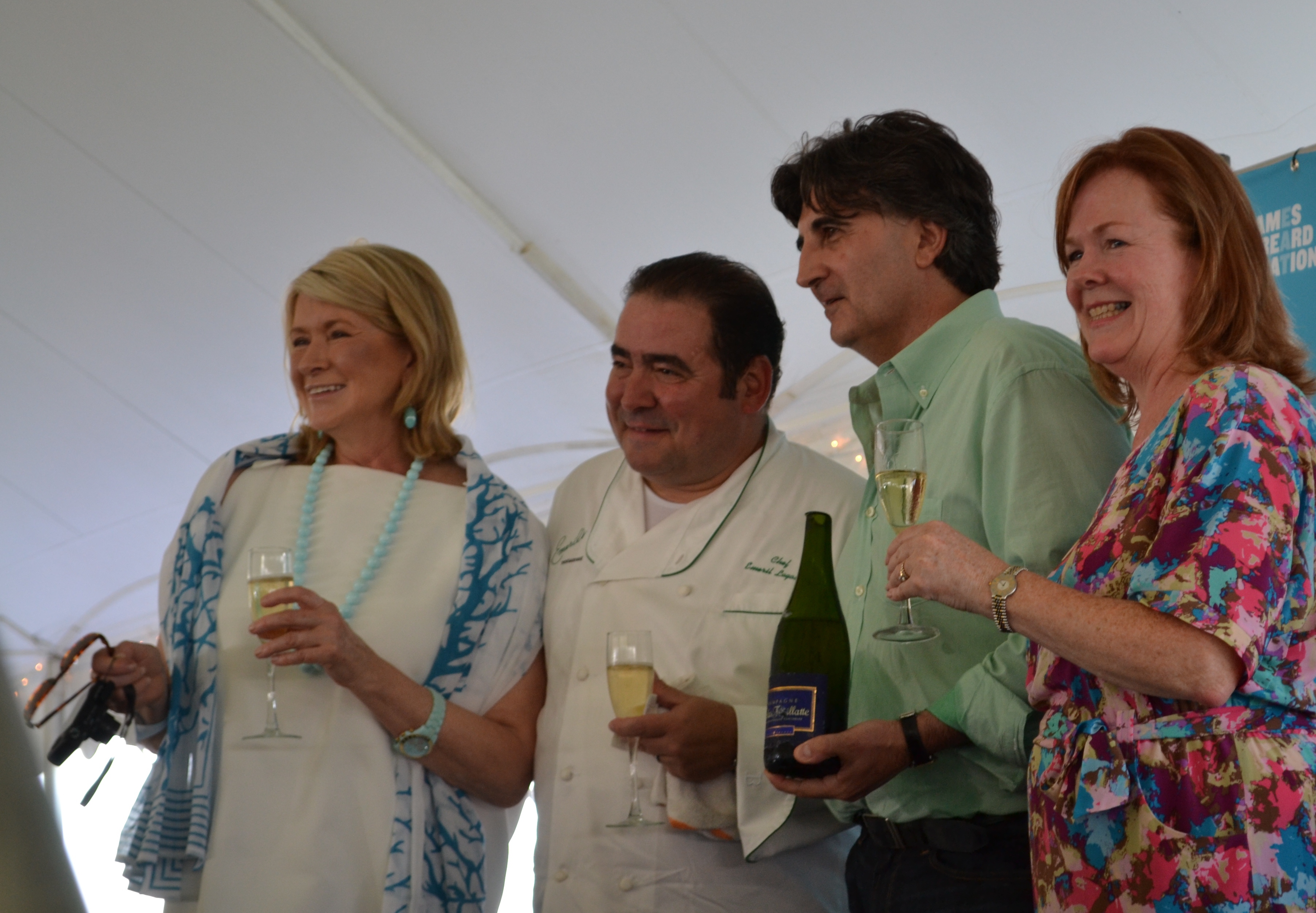
Martha Stewart, Emeril Lagasse, Pascal and Susan Ungaro

It was hot or, perhaps more accurately, as Matthew Broderick quipped in Biloxi Blues, “It was Africa hot.” Of course, that would be acceptable if we were in Africa, but as we were in The Hamptons, it was less so. Much less so. But despite the record-breaking heat index, chefs and event goers soldiered on and had a wonderful time at The James Beard Foundation (JBF)’s annual Chefs & Champagne event.

Arriving early, we availed ourselves of the Nicolas Feuillatte Palmes d’Or 1999 and, glass in hand, set off in search of the best bites. We kicked it off with Richard Grenamyer of Jacksonville, FL’s The Blue Fish Restaurant and Oyster Bar. His soy and ginger-glazed tuna with wakame and wasabi cream provided a touch of heat, which went beautifully with the Champagne as did Marc Forgione’s Chile lobster with local corn and lemon verbena.

Among the notable chefs and their corresponding cuisine was Shea Gallante of Ciano with his yellow Basinga tomato gazpacho soup with Maine lobster, watermelon and basil. This dish was amazingly tasty and refreshing, providing welcome respite in the heat. I asked him if he had consulted the Farmer’s Almanac before submitting his menu, but he explained that previous experiences with these types of events had taught him to stick to cold food.

Perhaps braver for braving the heat, John Doherty, formerly with the Waldorf=Astoria and now ambassador for Certified Angus Beef, offered prime steak and eggs, but didn’t seem too wilted at the grill.

Pitching in to help colleague Spencer Minch (Emeril’s Delmonico), event honoree Emeril Lagasse himself handed me a plate of gulf white shrimp with traditional rémoulade.

Another JBF Award Winner, Marcus Samuelsson (Blue Parrot and Red Rooster) doled out chilled corn soup with marinated bass and tomatillo-cilantro purée, which was a definite crowd pleaser.

A few pastry chefs were also on hand, including Jennifer McCoy of Craft, whose olive oil cake with raspberry-lavender jam was the perfect ending to the evening, with its lightness and combination of savory and sweet.

As part of The James Beard Foundation’s scholarship fundraising event, three scholarships were awarded to local students, including the Christian Wölffer Scholarship, particularly poignant since the event was held at the eponymous winery in Sagaponak, NY. Next year, the JBF will offer a $5,000 scholarship in Emeril’s name.

The Torrontés Project

Argentina has distinguished itself with not just one, but two signature grape varieties – Malbec and Torrontés. The latter is primarily grown in northern Argentina, with the Cafayate appellation, within the province of Salta, being among the most highly regarded area for production. Generally planted at high altitudes in the Andes Mountains, the grapes receive full sun during the day, while the cooler nights permit the grapes to retain vibrant acidity. Highly aromatic, these fresh, unoaked whites offer floral and fruit aromas that pair well with lightly-spiced Asian cuisine, summer salads and fish.

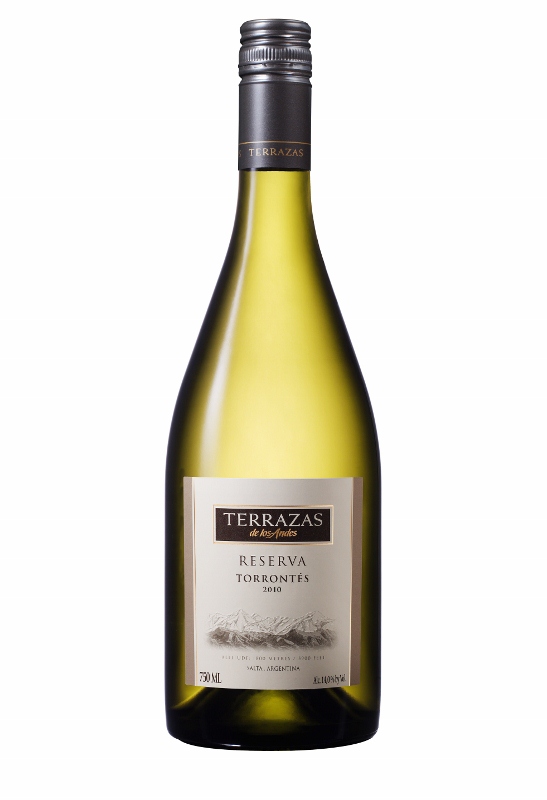
A blind tasting, affectionately referred to as the Torrontés Project, placed the Terrazas de los Andes Reserva Torrontés 2010 (SRP $15.00) in the company of Xavier Flouret Flaca 2009 (SRP $16.00). Despite being from the same appellation and having been produced in a similar method (stainless steel fermentation), the two wines displayed marked differences.

The Flaca had pronounced floral, spice and tropical fruit notes on the nose, which persisted on the palate. With its medium+ acidity and medium+ body, the wine was bold, but balanced.

The Terrazas wine was paler in color, with less overt aromas consisting of floral and peach, coupled with candied citrus on the palate. Higher in acidity and slightly lighter in body, this wine was more restrained.

Aromatically Yours

Viognier – pronounced Vee-own-yay – is primarily associated with France’s northern Rhône Valley and to a lesser extent with Rhône-style wines of Australia. However, this grape is starting to get around.

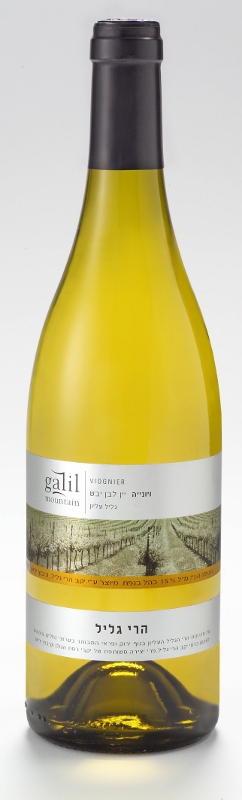
Case in point, the Galil Mountain Winery Viognier 2009 (SRP: $15.00) from Israel’s Upper Galilee, situated at one of the country’s highest elevations – 3,280 feet above sea level. Located in northern Israel, near the borders of Lebanon and Syria, the Gaililee area, which also includes the Golan Heights, is generally regarded as Israel’s best wine producing region. Galil Mountain Winery was established in 2000 and is the sister winery to Golan Heights Winery, which was named best wine producer of the year at VinItaly in 2011.

Galil Mountain’s Viognier was classic in nature, showing floral, apricot and tangerine. While dry on the palate, it had rich fruit flavors of apricot, peach pit and spice. Not surprisingly, it was fuller-bodied than the Sauvignon Blanc. Although 40% of the wine had been barrel fermented in new French oak, the oak was not prominent on the nose or palate.

The Viognier was tasted with another equally aromatic grape, Sauvignon Blanc, from the North Fork of Long Island, representing interests closer to home. Sauvignon Blanc is probably most closely associated with New Zealand, but it is actually from France’s Bordeaux and Loire Valley regions, the former of which has a climate very similar to Long Island.

Produced from fruit from Long Island’s vaunted 2010 vintage, the Katherine’s Field Sauvignon Blanc from Macari Vineyards (SRP $23.00) possessed citrus, pith and mineral notes on the nose. The ripe vintage displayed itself on the palate with pineapple and continued minerality, along with vibrant acidity. The wine was released in early May with only 883 cases produced.

Both were welcome guests at the table when brought to a friend’s Hampton’s house in early July.

A Fresh Look at Frascati

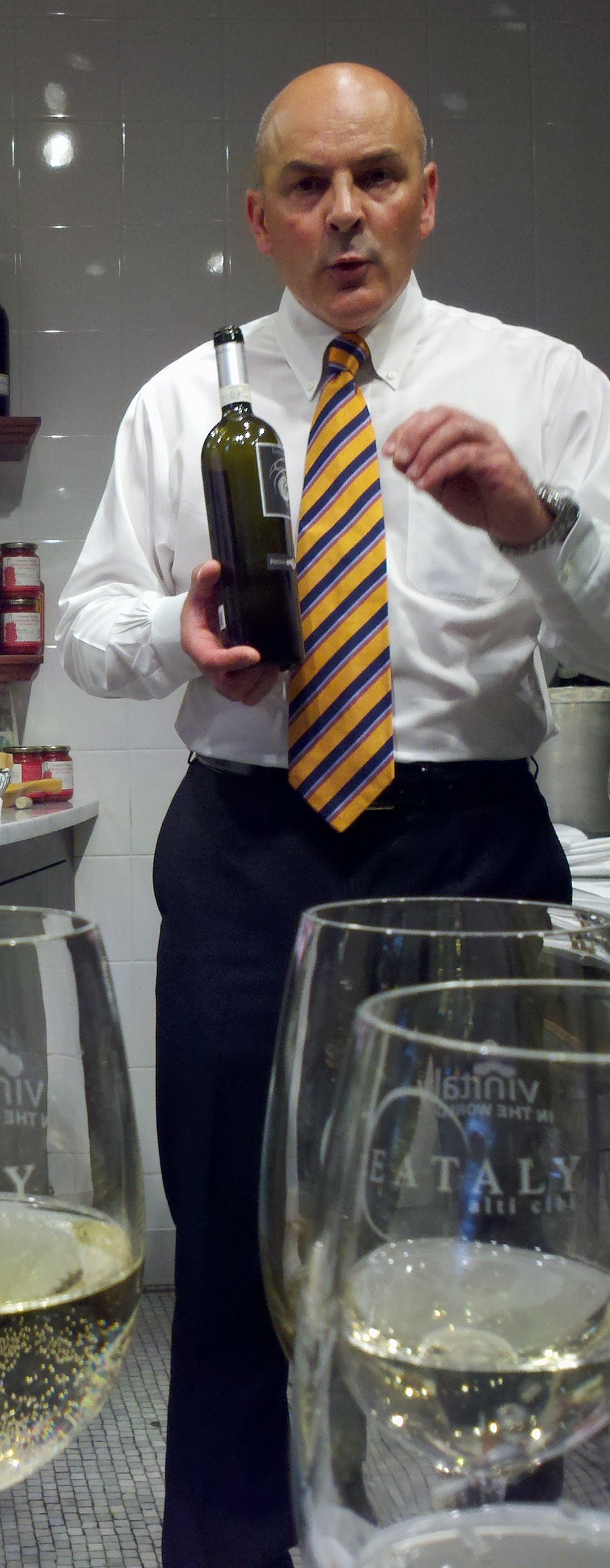
Fontana Candida's winemaker, Mauro Merz

Long the ambassador for Italian wines, Frascati adopted a low profile as a light-bodied quaffer – easy to drink, but just as easily dismissed. However, when the focus shifts to providing a product that is, above and beyond, authentic and of the highest quality, this is a wine that can also offer a refreshing surprise.

Named for the town of Frascati within Lazio and proximate to Rome, the Frascati DOC was the first one established back in 1966. This traditional wine is a white blend comprised primarily of Malvasia de Lazio and/or Malvasia di Candia, along with Trebbiano Toscano, Trebbiano Gialla, Greco, Bombino (and somewhat more controversial, up to 10% of aromatic, international varieties, ie. Riesling, Sauvignon Blanc).

The leader in this region, Fontana Candida, believes that wine must bring joy; be made naturally; and be an expression of its place. With this philosophy in mind, the company continues to work on improving brand Frascati for both itself and the region at large. To that end, they hired an agronomist and offered his services free of charge to the local growers – small, family farms.

While the motive was admittedly selfish — they wanted to source better fruit — growers who bought into these changes have reaped the rewards of Fontana Candida’s largesse. Not only did they receive the free consultation, but now also earn significantly more for their grapes when selling to Fontana Candida. Moreover, at a time when the delimited area is shrinking due to Rome’s urbanization projects and an overall decline in grape prices, Fontana Candida has committed to maintaining its higher prices, paying up to 40% over the base in incentives.

The resulting wines show off the quality of vineyard work coupled with the true expression of tradition and terroir. The flagship Fontana Candida Frascati Superiore DOC (SRP $10.00) is fresh and fruity, but with the weight to stand up to food. And, of particular interest, they are capable of aging.

No really. A mini-vertical of their Vigneto Santa Teresa Frascati Superiore 1997, 2001 and 2004 wines proved the point in spades. Winemaker Mauro Merz stresses that the wines will not necessarily improve with time, they will evolve and last. With a certain gravitas, these wines displayed both elegance and depth. Whereas the young wine displayed fresher notes of green apple and a slightly savory aspect, the older wines showed honey, bruised fruit (pear and apple) and dried herbs. The most mature (1997) showed signs of age with a slightly oxidative character on the nose, but was still enjoyable with its palate cleaner than its nose.

Equally delightful were the producer’s Luna Mater wines (SRP $23.00). First produced in 2008 in celebration of Fontana Candida’s 50th anniversary, the wine is made with select lots from older vines averaging 50 years and aged in large Acacia wood casks (which was selected for its ability to bring out the best characteristics of Malvasia grape). However, the intention is not to dominate the wine with wood. Rather, the aging extracts the wood tannins, lending structure and longevity to the finished wines, the former of which was evident upon tasting these wines as were aromas and flavors of pear and almond.

With its motto “Quality above all,” it is clear that Fontana Candida is producing wines of depth, elegance and richness that can be enjoyed in their youth as well as their more golden years. Either way, the wines offered a fresh look at old faithful Frascati.

Navarra: Ancient Kingdom of Modern Wines

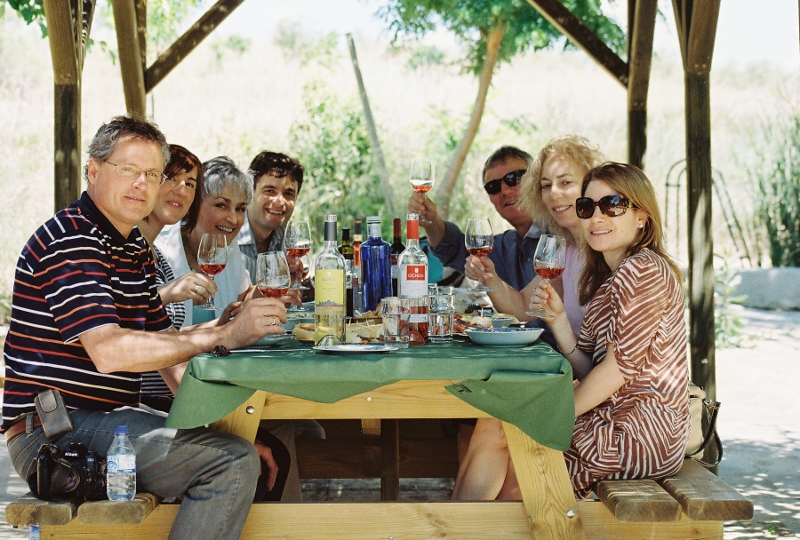
Our mother made the pimentos, she tells us. Seemingly in the middle of nowhere, we sit outside under the shade of an arbor on a sun-filled summer’s day. An enormous feast is suddenly set before us – salad, sausages, tortillas, jamon, pimentos, cheese, while bottles of wine, tasted earlier at the Ochoa winery, stand at attention, ready to poured. We are joined by Adrianna, Beatriz and Pablo and are treated like dear old friends of the family.

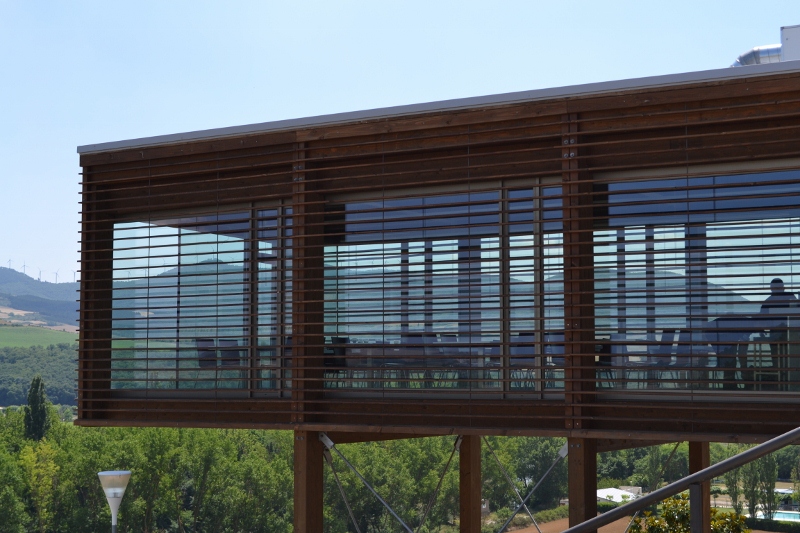
A few days later, a modern box suspended high above the vineyards serves as the site for lunch. Javier points out the Otazu winery and other buildings on the estate from this vantage point. Juxtaposed, the two scenes seem unlinked, but, in fact, they are indicative of Navarra’s dichotomy of old and new co-existing throughout the region.

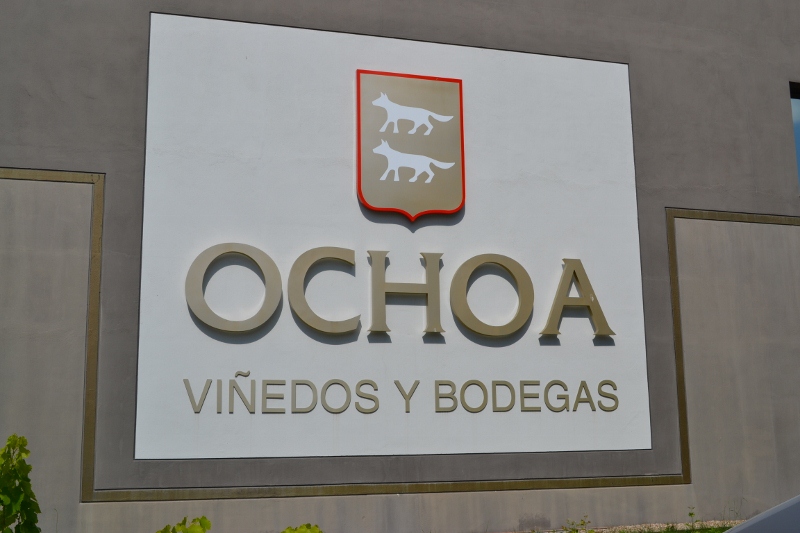
Two wolves adorn the Ochoa crest, the Basque word for which is ochoa. The family can trace its winemaking roots to a document dated 1370 in which Queen Juana (Carlos II’s wife) orders payment to wine merchant, Ochoa de Ayanz. Several towns away, in Ujué, a mural in a Romanesque church features a similar crest, almost as further evidence of the Ochoa heritage. Stretching back farther to the Romans, Navarra has been at the crossroads of many cultures for centuries. At Villa Romana de Arellano, the dolias unearthed by a farmer show that wine was an important product from the very beginning.

More currently, Ochoa has played a pivotal role in Navarra’s wine industry with Javier Ochoa’s role in establishing EVENA (Navarra Viticulture and Oenology Station). Continuing the family’s winemaking legacy, daughter Adriana recently took over as head winemaker and sister, Beatriz, handles marketing and sales. Reflective of Navarra’s international outlook, Adriana studied viticulture and enology in Bordeaux, France and worked the harvest in Australia before taking the reins from dad.

This duality of tradition and modernity can be seen over and over again in different forms. When we arrive, the town of Puente la Reina is bustling with activity – people sit outside in cafes and bars enjoying tapas and other treats in the summer’s afternoon. A veritable tower of Babel, a mix of languages and accents are heard as we catch snippets of conversations when we pass by. The year is 2011, but we would have found a nearly identical scene had it been 1211. Situated along the Camino de Santiago, Puente la Reina, in the heart of Navarra, is just one of the many towns that were built to provide the pilgrims with food and shelter as they made their way to Santiago de Campostela, bringing their customs and cultures as they passed through.

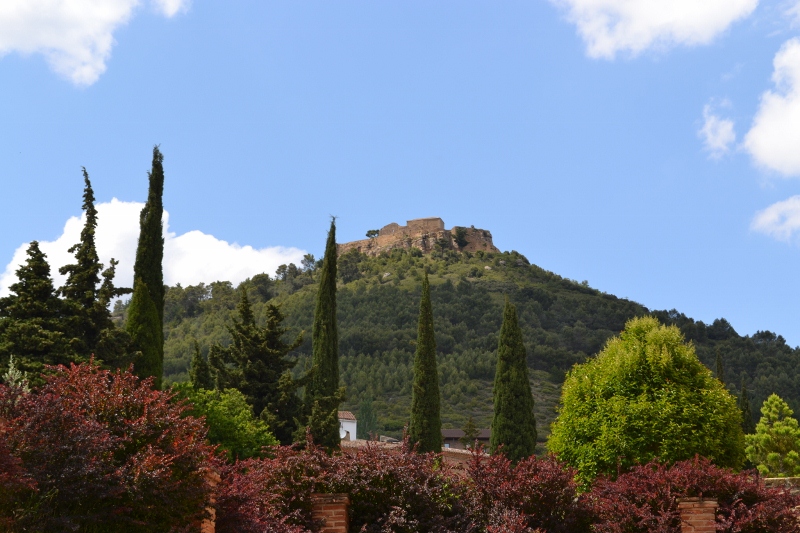
Further down the road, the well-worn and well-signed path snakes its way past a medieval castle at Castillo Monjardin. The castle and its eponymous winery are presided over by Sonia and her husband, Victor. While not part of Spain’s monarchy, there is a royal air about the place, which recalls Navarra’s history as a separate kingdom (maintaining its independence until it succumbed to the Castilian empire in 1512).  Planted to Chardonnay, Tempranillo, Cabernet Sauvignon and Merlot, their vineyards underscore Navarra’s link to France. In fact, the Compte de Champagne, Theobald, also held the title of King of Navarra.

Similarly, at Otazu, Javier leads us through the ancient cellars, stopping to point out an alter that dates to the 14th century. After walking the long corridor, we turn to our right and are confronted by a set of glass doors that serve as the entrance to the new barrel room. Though just steps away, we are suddenly transported seven centuries to what is best described as a modern temple truly dedicated to Bacchus, with 1,000+ French oak barrels resting under the vaulted ceiling.

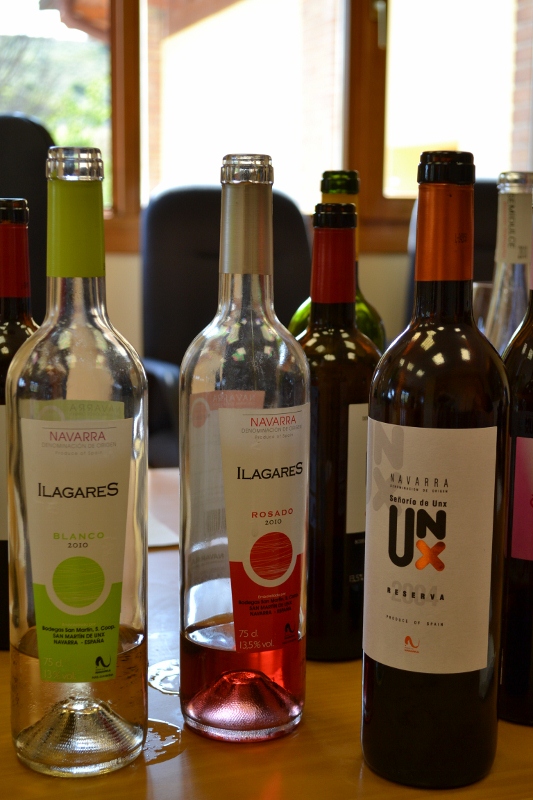
Nearby, St. Martin de Unx’s winemaker proudly professes the winery’s commitment to Spanish varieties: Garnacha, Tempranillo and Viura. While the co-op sticks to traditional grapes, it is experimenting with Navarran oak, grown in local forests, and, as he is quick to point out, are the only ones to be conducting such trials, another point of pride. In a nod to the future, the winery also created a semi-sweet rosé to appeal to the younger generation of Spaniards who crave Coke® instead of wine.

Testing is also alive and well at Inurrieta, which planted Sauvignon Blanc before it became an authorized grape for the DO. Now, its two Sauvignon Blancs garner critical acclaim.

Produced from both native and international grape varieties, Navarra’s wines speak to the history and tradition of the region, while making room for what is to come. However, what is most striking about these wines is their quality. In tasting one after another, there was concentration, complexity and beautiful balance. Even more amazing, when inquiring about retail prices, most wines fall under $20.00, with quite a few under $15.00.

With its long tenure of winemaking, international influences and openness to trying new things, Navarra’s wineries remain true to this heritage. What the future holds for Navarra is anyone’s guess, but it is sure to be focused on innovation, while being strongly anchored in the region’s culturally diverse past.


Tasting Notes

Inurrieta Orchidea Sauvignon Blanc 2010, Navarra, Spain, $10.00
While Sauvignon Blanc is newly authorized for the region, Inurrieta produces two, with the Orchidea its unwooded venture with this grape. Aromas of citrus and tropical fruit give way to high acidity, citrus, especially grapefruit, with a slight floral note. The sur lie treatment adds some roundness to the palate, which culminates in medium+ length.

Castillo de Monjardin Chardonnay Reserva 2007, Navarra, Spain, $19.00
Castillo de Monjardin is the only one producing a Reserva-level Chardonnay. Having been barrel fermented and aged in French oak, this wine provides notes of apple, spice, butterscotch and vanilla on the nose. Its palate is full-bodied with apple, lime, spice and slight oak flavors. Overall, this wine is complex, bright and creamy, with long length.

Ochoa Rosado Lágrima 2010, Navarra, Spain, $11.00
Navarra is well-known for its rosés (aka rosados) and with good reason. The more “serious” of Ochoa’s rosés, the Lágrima is comprised of 50% each of Garnacha and Cabernet Sauvignon, with deep pink hue. Floral and berry aromas persist on the palate, along with depth and structure due to the wine’s slight tannic grip, herbal character and long length.

Senorio de Unx Reserva 2004, Navarra, Spain, $20.00
Produced from 90% Tempranillo and 10% Garnarcha, the Reserva spent 15 months in a combination of French and American oak. The nose offers dried herbs, floral, spice and raisin, while the palate emphasizes dried figs, red fruit and sweet spice. With its medium+ tannins, full body and long length, this wine could continue to age and develop with time.

Otazu Pago de Otazu 2006, Navarra, Spain, $32.00
The Pago designation, which supersedes the DOCa level, was added to Spain’s wine laws in 2006 and is only awarded to very best estates (to date, there are only 10 Vinos de Pago throughout all of Spain). A blend of 90% Cabernet Sauvignon and 10% Tempranillo, this wine displays wet earth, dried herbs, red fruit and cinnamon on the nose. The full-bodied palate has medium+ acidity, medium tannins with notes of red fruit and earth, which linger in the long length.

Grand Cru Grapevine: Navarra – Ancient Kingdom of Modern Wines (July 2011)

With summer in full swing, we hope you are taking advantage of the great weather and having fun!

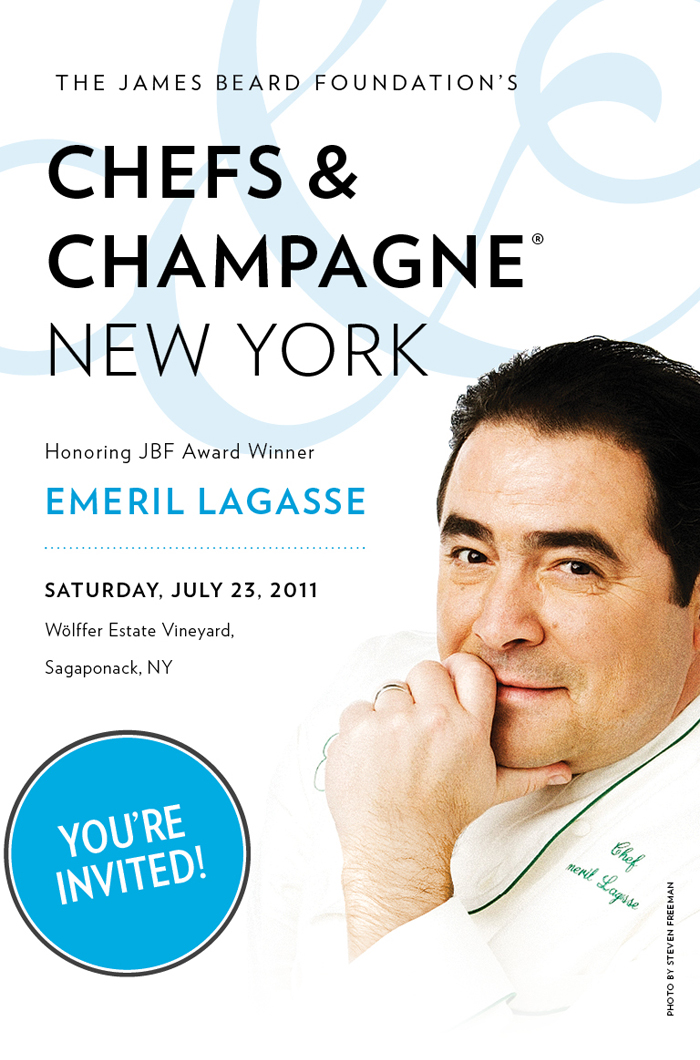
While there are many fun activities taking place on the East End this season, consider attending the James Beard Foundation’s annual Chefs and Champagne. This star-studded event raises money for the foundation’s scholarships and will honor Emeril Lagasse. Featuring food from top toques (the chefs) and Nicolas Feuillatte Champagne, this gala celebration takes place at Wölffer Estate on Saturday, July 23, 2011. For more information, see the James Beard website.

Also, mark your calendar for the second annual HARVEST: Wine Auction and Celebration of Long Island’s East End, which will take place on September 17, 2011. Leading up to the big event, wine salons will be offered on September 3, 10 and 17, with Grand Cru Classes presenting a special Mad about Merlot session on September 10 at 11:00 AM.

Do chocolate and wine pair well together? Some say yes, some say no way! Settle the debate with our wine and chocolate tasting event on August 14. Roxanne Browning of Exotic Chocolate Tasting will share the world of artisanal chocolate from bean to bar, while Tracy will focus on the world of wine, with a delicious line-up of wines carefully selected to pair with Roxanne’s chocolates. Visit our website to sign up for this and all other classes.

Finally, we are also pleased to announce the Grand Cru Classes was featured in the first edition of CRAVE New York City – The Urban Girl’s Manifesto, which profiles local, women-owned businesses.

Drink wisely and well,

Tracy Ellen Kamens, Ed.D., DWS, CWE
CEO: Chief Education Officer

and

Jared Michael Skolnick
COO: Cork Opening Officer

Navarra: Ancient Kingdom of Modern Wines

Our mother made the pimentos, she tells us. Seemingly in the middle of nowhere, we sit outside under the shade of an arbor on a sun-filled summer’s day. An enormous feast is suddenly set before us – salad, sausages, tortillas, jamon, pimentos, cheese, while bottles of wine, tasted earlier at the Ochoa winery, stand at attention, ready to poured. We are joined by Adrianna, Beatriz and Pablo and are treated like dear old friends of the family.

A few days later, a modern box suspended high above the vineyards serves as the site for lunch. Javier points out the Otazu winery and other buildings on the estate from this vantage point. Juxtaposed, the two scenes seem unlinked, but, in fact, they are indicative of Navarra’s dichotomy of old and new co-existing throughout the region.

Two wolves adorn the Ochoa crest, the Basque word for which is ochoa. The family can trace its winemaking roots to a document dated 1370 in which Queen Juana (Carlos II’s wife) orders payment to wine merchant, Ochoa de Ayanz. Several towns away, in Ujué, a mural in a Romanesque church features a similar crest, almost as further evidence of the Ochoa heritage. Stretching back farther to the Romans, Navarra has been at the crossroads of many cultures for centuries. At Villa Romana de Arellano, the dolias unearthed by a farmer show that wine was an important product from the very beginning.

More currently, Ochoa has played a pivotal role in Navarra’s wine industry with Javier Ochoa’s role in establishing EVENA (Navarra Viticulture and Oenology Station). Continuing the family’s winemaking legacy, daughter Adriana recently took over as head winemaker and sister, Beatriz, handles marketing and sales. Reflective of Navarra’s international outlook, Adriana studied viticulture and enology in Bordeaux, France and worked the harvest in Australia before taking the reins from dad.

This duality of tradition and modernity can be seen over and over again in different forms. When we arrive, the town of Puente la Reina is bustling with activity – people sit outside in cafes and bars enjoying tapas and other treats in the summer’s afternoon. A veritable tower of Babel, a mix of languages and accents are heard as we catch snippets of conversations when we pass by. The year is 2011, but we would have found a nearly identical scene had it been 1211. Situated along the Camino de Santiago, Puente la Reina, in the heart of Navarra, is just one of the many towns that were built to provide the pilgrims with food and shelter as they made their way to Santiago de Campostela, bringing their customs and cultures as they passed through.

Further down the road, the well-worn and well-signed path snakes its way past a medieval castle at Castillo Monjardin. The castle and its eponymous winery are presided over by Sonia and her husband, Victor. While not part of Spain’s monarchy, there is a royal air about the place, which recalls Navarra’s history as a separate kingdom (maintaining its independence until it succumbed to the Castilian empire in 1512). Planted to Chardonnay, Tempranillo, Cabernet Sauvignon and Merlot, their vineyards underscore Navarra’s link to France. In fact, the Compte de Champagne, Theobald, also held the title of King of Navarra.

Similarly, at Otazu, Javier leads us through the ancient cellars, stopping to point out an alter that dates to the 14th century. After walking the long corridor, we turn to our right and are confronted by a set of glass doors that serve as the entrance to the new barrel room. Though just steps away, we are suddenly transported seven centuries to what is best described as a modern temple truly dedicated to Bacchus, with 1,000+ French oak barrels resting under the vaulted ceiling.

Nearby, St. Martin de Unx’s winemaker proudly professes the winery’s commitment to Spanish varieties: Garnacha, Tempranillo and Viura. While the co-op sticks to traditional grapes, it is experimenting with Navarran oak, grown in local forests, and, as he is quick to point out, are the only ones to be conducting such trials, another point of pride. Testing is also alive and well at Inurrieta, which planted Sauvignon Blanc before it became an authorized grape for the DO. Now, its two Sauvignon Blancs garner critical acclaim.

Produced from both native and international grape varieties, Navarra’s wines speak to the history and tradition of the region, while making room for what is to come. However, what is most striking about these wines is their quality. In tasting one after another, there was concentration, complexity and beautiful balance. Even more amazing, when inquiring about retail prices, most wines fall under $20.00, with quite a few under $15.00.

With its long tenure of winemaking, international influences and openness to trying new things, Navarra’s wineries remain true to this heritage. What the future holds for Navarra is anyone’s guess, but it is sure to be focused on innovation, while being strongly anchored in the region’s culturally diverse past.


Tasting Notes

Inurrieta Orchidea Sauvignon Blanc 2010, Navarra, Spain, $10.00
While Sauvignon Blanc is newly authorized for the region, Inurrieta produces two, with the Orchidea its unwooded venture with this grape. Aromas of citrus and tropical fruit give way to high acidity, citrus, especially grapefruit, with a slight floral note. The sur lie treatment adds some roundness to the palate, which culminates in medium+ length.

Castillo de Monjardin Chardonnay Reserva 2007, Navarra, Spain, $19.00
Castillo de Monjardin is the only one producing a Reserva-level Chardonnay. Having been barrel fermented and aged in French oak, this wine provides notes of apple, spice, butterscotch and vanilla on the nose. Its palate is full-bodied with apple, lime, spice and slight oak flavors. Overall, this wine is complex, bright and creamy, with long length.

Ochoa Rosado Lágrima 2010, Navarra, Spain, $11.00
Navarra is well-known for its rosés (aka rosados) and with good reason. The more “serious” of Ochoa’s rosés, the Lágrima is comprised of 50% each of Garnacha and Cabernet Sauvignon, with deep pink hue. Floral and berry aromas persist on the palate, along with depth and structure due to the wine’s slight tannic grip, herbal character and long length.

Senorio de Unx Reserva 2004, Navarra, Spain, $20.00
Produced from 90% Tempranillo and 10% Garnarcha, the Reserva spent 15 months in a combination of French and American oak. The nose offers dried herbs, floral, spice and raisin, while the palate emphasizes dried figs, red fruit and sweet spice. With its medium+ tannins, full body and long length, this wine could continue to age and develop with time.

Otazu Pago de Otazu 2006, Navarra, Spain, $32.00
The Pago designation, which supersedes the DOCa level, was added to Spain’s wine laws in 2006 and is only awarded to very best estates (to date, there are only 10 Vinos de Pago throughout all of Spain). A blend of 90% Cabernet Sauvignon and 10% Tempranillo, this wine displays wet earth, dried herbs, red fruit and cinnamon on the nose. The full-bodied palate has medium+ acidity, medium tannins with notes of red fruit and earth, which linger in the long length.

Avoid regret, attend JBF’s Chefs and Champagne

On his deathbed, John Maynard Keynes, English economist, uttered these last words, “My only regret in life is that I did not drink more Champagne.” Such regret can easily be avoided.

The James Beard Foundation’s Chefs and Champagne returns to Wölffer Estate Vineyard in Sagaponack, NY on Saturday, June 23, 2011. This star-studded event brings together top toques to showcase their haute cuisine in a truly grand tasting. Culinary luminaries include Matteo Bergamini of SD26; JBF Award Winner Daniel Boulud of Daniel; Marc Forgione of Marc Forgione; George Mendes of Aldea; JBF Award Winner Marcus Samuelsson of The Blue Parrot and Red Rooster; and many more. Chefs from Long Island, New Jersey, Washington, D.C. and the British West Indies will also be present.

Wash it all down with Nicolas Feuillatte, the only Champagne sponsor of this year’s gala and the #1 best-selling Champagne in France and #3 in the world.

Emeril Lagasse will be honored at the event, which raises money for the Beard Foundation’s scholarship fund. Accordingly, the 2011 recipient of the Christian Wölffer Scholarship for wine and food studies will be announced that evening.

Tickets for the event may be purchased online and are as follows:

• 4:30–10:30 P.M.: VIP Experience* – JBF members and General Public $375; VIP tables of 10: $3,500

• 5:30–8:00 P.M.: General Admission – JBF Members $200, General Public $275

*The VIP Experience includes an exclusive, one-hour access to all tastings; advanced silent auction bidding; reserved seating; VIP after-party access; and a gift bag.

Can’t get to the event? Make a donation to the James Beard Foundation and stop by your local retailer to pick up the Nicolas Feuillatte Brut, reading available at Astor, Garnet, Heights Chateau and Sherry-Lehmann among others). Or, treat yourself to its prestige cuvée, Palmes d’Or, in its signature cut-crystal bottle.

Either way, you’ll have no regrets.

Everything’s Coming Up (Sparkling) Rosés

In a bold move (and equally bold attire – a pink shirt and gold tie), Hugh Davies, owner of Napa’s Schramsberg Vineyards, challenged some sharp palates to blind taste his J. Schram Rosé 2000 (SRP $130.00) against some of the best rosé Champagnes. The J. Schram Rosé 2000 is a blend of 75% Chardonnay and 25% Pinot Noir, with grapes sourced from Napa, Mendocino, Sonoma, Monterey and Marin Counties and aged on its lees for seven years.

Confident that his wine would show well, tasters were given six flutes filled with varying shades of pink bubbles and asked to rank the wines from 1 to 6 (with 1 being their favorite). None of the tasters knew the identity of the other wines as they set off on their tasting journey.

Once the wines had been tasted and scored, the scores were tallied before the identities were revealed. The verdict? Collectively, the group chose the J. Scram 2000 as their favorite, with the Louis Roederer Cristal 2002 in 2nd place, followed by Perrier-Jouet 2002. My personal picks varied a bit, placing the Cristal first, the Perrier-Jouet second and the J. Schram in third place. I found the former two to be lighter and more delicate, but did still enjoy the J. Schram a lot.

The second flight of wines permitted attendees to taste through the J. Schram in various stages and from different vintages. More specifically, the 2009 pre-bottled, base blend of 85% Chardonnay and 15% Pinot Noir was compared with the post-bottle version. The wine has nicer qualities, but appeared young and disjointed given its incomplete stage. A 2006 J. Schram showed how, in time, the wine would become more integrated, while a comparison of the 2003 J. Schram – a natural sparkling version vs. the finished wine – provided a glimpse into the wine’s further development, with less fruit on the nose and more complexity on the palate. To finish off the flight, the 1993 J. Schram offered a sample of the aging potential of this wine.

The final flight of the day paired several different Schramsberg wines with a delicious lunch, showing the food friendly nature of these wines.

~Blanc de Blancs 2006 – Salmon crepe
~Blanc de Noirs 2006 – Wild mushroom and rice cake
~Reserve 2001 – Lobster Choux
~J. Davies 2006 (a still wine blended from 79% Cabernet Sauvignon, 15% Malbec, 6% Petit Verdot) – Lamb Skewers
~Crémant Demi-Sec 2005 (produced from 88% Flora, a cross between Gewurztraminer and Semillon) – Ham

Two from the Clos

The vineyards of Clos de los Siete in Mendoza, Argentina, are the brainchild of Michel Rolland, flying winemaker, closely associated with Bordeaux. The ambitious project seeks to bring five owners together to create their own wines as well as a collaborative wine.

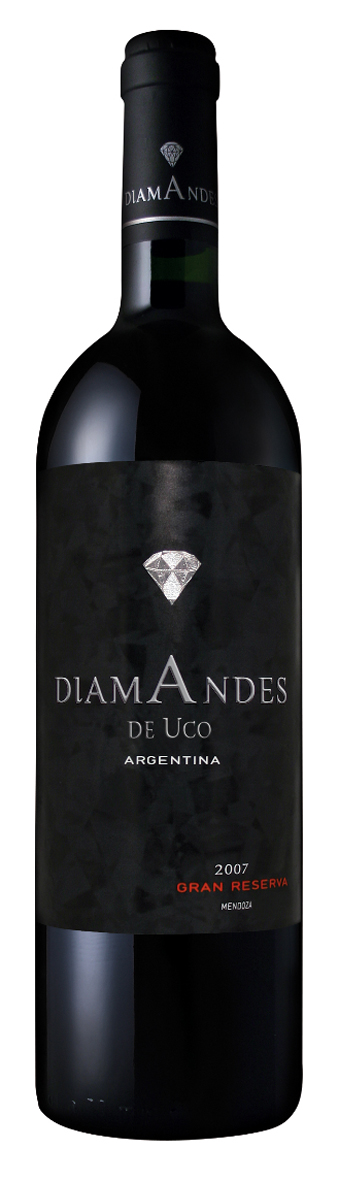
Although the project was launched in 1998 and the Clos de los Siete by Michel Rolland wine has been available since 2002, a new wine from the property recently made its debut—DiamAndes Gran Reserva. Owned by the Bonnie family of Bordeaux, France (and proprietors of Château Malartic Lagravière), the vineyards for Bodega DiamAndes were planted in 2005.

While the wines are produced from vines grown in close proximity, the foci of the winemakers are different. Whereas the Clos de los Siete by Michel Rolland is produced from a blend of Malbec, Merlot, Cabernet Sauvignon and Syrah, with actual percentages varying from vintage to vintage, the DiamAndes is heavily comprised of Malbec, seasoned with Cabernet Sauvignon.

I tasted these two wines side by side from the same vintage, 2007, as a way to compare and contrast the different blends from the same terroir.

The Clos de los Siete (48% Malbec, 28% Merlot, 12% Cabernet Sauvignon and 12% Syrah) was fruit forward in style with youthful notes of blueberries, vanilla, plum and slight wood. The full-bodied wine had medium+, but ripe, tannins and an overall ripe fruit/jammy appeal.

In comparison, the DiamAndes Gran Reserva, comprised of 70% Malbec, 30% Cabernet Sauvignon and aged in French oak (presumably new since the winery is new itself), was more elegant and austere. This wine showed some slight development on the nose along with more overt oak/wood aromas. Similarly full-bodied, but with dustier tannins, this wine offered flavors of dark plum, oak and vanilla. Despite the more obvious use of oak, this wine was beautifully balanced.

Although one style may appeal to someone’s palate more so than the other, I enjoyed them both for their differences.

In Support of Pinot

Winemaker David Rossi co-founded Fulcrum Wines with Christine Rossi. With a sharp focus on balance, David seeks to create wines that maintain a harmony among acidity, tannin and alcohol levels, use of oak and the expression of the fruit. Working out of a facility in Napa, CA, Pinot Noir grapes are sourced from the cooler climate AVAs of the state. Accordingly, the winery produces a range of Pinots, including several single vineyard wines.

The 2008 vintage offered a diversity of four wines, which were tasted in pairs, providing an opportunity to compare and contrast the different origins.


Fulcrum On Point Pinot Noir 2008, Santa Lucia Highlands, CA
Aromas: Blackcherry, cedar, earth/soil and cherry pie
Flavors: Deep blackcherry, earth and cloves
Structure: Medium+ acidity, medium+ body, very long length
An excellent wine, with aging potential.

Fulcrum Pinot Noir 2008, Anderson Valley, CA
Aromas: Plum, cherry, cinnamon, vanilla
Flavors: Cherry, cinnamon
Structure: Medium+ acidity, medium-bodied, long length.

The wines from Santa Lucia Highlands and Anderson Valley were tasted together. While both were very good wines, our preference was for the Santa Lucia Highlands wine (On Point Pinot Noir).


Fulcrum Caps Crown Vineyard Pinot Noir 2008, Sonoma Coast, CA
Aromas: Plum, earthy
Flavors: Raspberry and earth, the latter of which persists throughout the finish
Structure: Medium+ acidity, medium body, long length

Fulcrum Tina Marie Vineyard Pinot Noir 2008, Russian River Valley, CA
Aromas: Floral, berry
Flavors: Raspberry and herbal
Structure: Medium acidity, medium+ body, medium+ alcohol, long length

The Caps Crown and Tina Marie single vineyard wines were tasted together. The Caps Crown was more earthy and masculine while the Tina Marie was more floral and herbal and a bit more elegant despite its fuller body. However, both were wonderful wines.