Que Syrah, Shiraz and Shiraz

A trio of Syrahs crossed by table this fall (9/22/2010), providing me with the opportunity to explore the similarities and differences among wines from Australia and South Africa.

90+ Cellars Lot 4: Shiraz Viognier 2007, McLaren Vale, Australia, $17.00
92% Shiraz, 8% Viogner; Co-fermented and aged for 14 months in new French oak.
Co-fermented as is done with Côte-Rôtie, this wine displayed aromas of medium+ intensity that included blueberry black cherry, oak, earth and dried herbs. Of the three wines, it had the deepest nose. On the palate, it was full-bodied with medium+/high tannins, medium acidity and flavors of blackberry, cherry, oak, earth and spice, culminating in medium+ length. Overall, the wine showed good fruit concentration along with complexity and elegance.

Rudi Schultz Syrah 2007, Stellenbosch, South Africa, $30.00
100% Syrah; Aged for 20 months in French oak barrels (30% new; 70% second and third fill).
Winemaker and proprietor Rudi Schultz was prompted to go into winemaking after tasting great Northern Rhone wines. Thus, it is no surprise that his wines are crafted in a similar style. Notes of blackberry, earth, rubber, leafyness and meatiness were present on the nose, which was the most savory of the three wines. Another full-bodied wine with medium+ tannins, the palate showed blackberry, blueberry, leather, rubber and meatiness, all of which lingered in the wine’s long length. Overall, the wine was both powerful and aromatic.

Xavier Flouret Waroo Shiraz 2009. Pemberton – Western Australia, $18.00
100% Shiraz; Aged for 8 months in oak barrels (75% French, 25% American oak).
From the cooler area of Western Australia, this wine had blackcherry, vanilla, floral and dried/jammy fruit aromas. Similarly full-bodied to the others, this wine provided medium+ acidity and medium tannins on the palate. Its flavors included blackcherry, herbaceousness, leather, and a tart cherry note in the undercurrent. An earthiness remained throughout the wine’s long length. This wine  had the brightest acidity of the three, most likely due to its origins in a cooler climate.

This was an interesting exercise, showing the influence (and confluence) of grape variety, climate and production on the finished wine.

Battle of the California Cabs

What is the difference between one California Cabernet Sauvignon and another (besides the marketing hype)? Sometimes the best way to find out is to taste a number of wines side by side. Even better, if you can taste them blindly, you will be less influenced by what you think is in the glass and more by what your nose and palate actually tell you about the wine.

With this in mind, I decided to have some fun this past summer and open four different Cabernet Sauvignons I had received as samples. All of the wines were varietally labeled as Cabernet Sauvignons, so at a minimum they were 75% of the named grape. Moreover, they all hailed from the great state of California, but from different AVAs within it. To add to the pleasure, I invited our friends who were visiting for the weekend to join in. All were game, so we lined up four glasses each and poured a taste from each of the bagged and numbered bottles. I asked everyone to remain quiet while they tasted so that each person could develop his or her own opinion of each wine. However, once we had all tasted through everything at least once, comments and critiques were fairgame.

-The Crusher Wilson Vineyards Cabernet Sauvignon 2008, Clarksburg (CA), USA, $11.00
100% Cabernet Sauvignon.
Plum and blackberry aromas. Dry, medium acidity, full body, medium tannins, spice and berry flavors. Some oxidative notes on the nose and palate — possibly a faulted bottle.

-Emblem Cabernet Sauvignon 2006, Rutherford (CA), USA, $50.00
100% Cabernet Sauvignon; Aged for 22 months in French oak barrels (66% of which was new).
Medium floral, blackcherry, mint and a hint of bacon on the nose. Fry, medium acidity, full body, medium+ tannins, black berry, spice.

-Emblem Oso Vineyard Cabernet Sauvignon 2006, Rutherford (CA), USA, $50.00
100% Cabernet Sauvignon; Aged for 22 months in French oak barrels (45% of which was new).
Notes of blackberry, blackcherry and euclyptus on the nose. Dry, medium acidity, full body, high tannins, blackcherry, blackberry and peppery flavors.

-Josh Cellars Amber Knolls Vineyard Cabernet Sauvignon 2006, Red Hills (CA), USA, $15.00

100% Cabernet Sauvignon; Barrel aged for 16 months in new American oak and 1-2 year French oak.
Dried floral, herbal notes. Dry, medium acidity, full body, medium+ tannins, blackberry, blackcherry and herbal flavors.

Before the wines were revealed, the consensus was that the Oso Emblem Cabernet Sauvignon wine was the favorite (known as Glass #3 at the time) edging out the other three wines.  The Oso Vineyard wine had longer-lasting appeal with the group, showing a less-fruit forward style and some complex spice notes on the palate, while the non-named vineyard Emblem wine was more fruit forward. The Josh Cellars wine was also well liked by the group, coming in second place.

However, after the wines (and their prices) were identified, the preferences changed somewhat. While the group continued to acknowledge how much it liked the Oso Vineyard Emblem wine, it didn’t feel that they liked it $35.00 more. Accordingly, the Josh Cellars wine seemed to win out in the end, at least in terms of its price to quality ratio.

It was an interesting experience to see that the quality of the higher priced wine was appreciated by the group  — both novices and more experienced tasters alike, but that the lower-priced Josh Cellars wine delivered sufficient quality to make the group happy.

Flights of whites

In preparation for my AWS Wine Judging Training Program exam, which was held in early November 2010, I spent the summer blind tasting through different flights of wine. It was both a challenge to see which wines I could identify by either the grape variety or the appellation as well as to determine how several wines tasted in comparison to one another. NB: Tasting notes appear below the description of the two blind tasting exercises.

Flight 1: June 5, 2010
This flight included four white wines (all samples).
While I knew the identity of the four wines, I did not know which wine was in which glass. I sat down, began to taste and take notes and made some initial observations. The first glass showed notes of citrus, stone and a hint of butter, which repeated on the palate. The aromas in the second glass were quite pronounced and I detected citrus (specifically, pink grapefruit) and minerality on the nose and the palate. I suspected that this might be the New Zealand Sauvignon Blanc, but as I hadn’t tasted through all four wines yet, I wanted to reserve final judgement until the end. I was glad that I did because the very next glass made it evident that I would have been wrong. Yes, glass # 2 was very concentrated with its citrus notes, but glass #3 had unmistakable herbaceous notes of green pepper. The fourth glass exhibited notes of oak and other barrel-derived aromas and flavors (cinnamon and toasted nuts). Knowing that there was a California Chardonnay in the mix, I attributed this wine, with its oak influence, to be the Chardonnay. Wrong again! Unbeknownst to me, one of the Rueda wines had been produced in a wooded style. The wine was not a Chardonnay, but rather a Verdejo. All in all, it was a very educational experience, helping me to see how my methology was working even if I sometimes arrived at the wrong conclusion. In any case, the wines were all quite enjoyable.

Flight 2: July 24, 2010
This flight included four white wines (all samples).
Again, the identity of the four white wines (all samples) were known to me, but the order in which I tasted them was a mystery. We had another houseful of guests, so they were also invited to participate. They declined the rigor of blind tasting, but enjoyed tasting a few different wines separately. With a pair of Rueda wines and a pair of Gruner Veltliners, I was curious as to whether I would be able to determine which two wines were produced from the same grape variety, even if I wasn’t sure which grape variety that was. The first glass had melon and citrus notes, while the second glass was more complex with earth and herbal aromas and flavors. Glass #3 was again aromatically citrus with lemon and lime, but also showing some minerality. It seemed more similar to glass #1 than to glass #2. The fourth glass offered earth and citrus on the nose and palate and appeared to be showing some development, while the other three glasses were all youthful. While I wasn’t sure if glass #4 was a Verdejo or Gruner Veltliner, I was fairly certain it was the same as glass #2. Upon revealing the wines’ identities, I had correctly identified the pairs, even though I had been unsure as to the actual grape variety.

TASTING NOTES

Flight 1
-Bodega Matarromera Emina Verdejo 2009, Rueda, Spain, $9.00
100% Verdejo; Stainless steel fermentation.
Medium+ aromas of pink grapefruit. Dry, medium acidity, medium body, grapefruit, mineral, pith; good concentration, long length.

-Bodega Matarromera Seleccion Personal Carlos Moro Emina Verdejo 2008, Rueda, Spain, $36.00
100% Verdejo; Fermented and aged for four months in French oak barrels.
Medium notes of toasted nuts, green apple, cinnamon. Dry, medium acidity, full body, apple, pear and an undercurrent of wood/toothpick, nuts; long length.

-Bouchaine Estate Chardonnay 2008, Napa Valley and Carneros (CA), USA, $25.00
100% Chardonnay; 70% barrel-fermented and aged (1-4 year old wood); 30% fermented and aged in stainless steel.
Medium aromas of citrus, stone and a hint of butter. Dry, medium acidity, medium+ body, citrus, stone, pith and medium+ alcohol; long length.

-90+ Cellars Lot 2 Sauvignon Blanc 2009, Marlborough, NZ, $12.00
100% Sauvignon Blanc; Stainless steel fermented.
Medium+ herbal and citrus notes. Dry, medium+ acidity, medium body, citrus, pepper, green pepper; long length.

Flight 2
-Javier Sanz Villa Narcisa, Rueda, Spain, $16.50
100% Verdejo; Stainless steel fermentation.
Medium aromas of melon and grapefruit. Dry, medium+ acidity, melon, citrus, pith; medium length.

-Laurent V SINGING Gruner Veltliner 2009, Niederösterreich, Austria, $15.00
100% Gruner Veltliner; Stainless steel fermentation.
Earth and citrus aromas. Dry, medium+ acidity, lime, pith, herbal flavors; medium+ length.

-Laurenz V CHARMING Gruner Veltliner 2006, Kamptal, Austria, $27.00
100% Gruner Veltliner; Stainless steel fermentation.
Aromas of grapefruit and showing some development with notes of damp earth. Dry, medium acidity, earth, melon and grapefruit; medium+ length.
This was our favorite Gruner Veltliner of the flight.

-Pagos del Rey Analivia Verdejo, $11.00
100% Verdejo; Stainless steel fermentation.
Medium notes of lemon, lime, minerality. Dry, medium+/high acidity, lime, minerality; long length.
This was our favorite Verdejo of the flight.
Grand Cru Grapevine: Talking Turkey (November 2010)

We don’t know about you, but we find it hard to believe that November has arrived with Thanksgiving just around the corner (wasn’t it just July?).

Fortunately, we had a wonderful October, which included a fabulous trip to Italy’s Campania region, with visits to Mastroberardino and Feudi di San Gregorio. We’ll share additional details in a future newsletter.

This month finds Tracy presenting two sessions (Italian Sparklers and South African Wines) at the American Wine Society’s annual conference, while Jared finished up our public North Fork schedule this weekend with our From Mystery to Mastery class. But don’t despair; you can contact us for private classes and events year round at your place or ours.

As you prepare for the holiday, we hope you have a lot to be thankful for and wish you a very Happy and healthy Thanksgiving!

Drink wisely and well,

Tracy Ellen Kamens, Ed.D., DWS, CWE
CEO: Chief Education Officer 

       and 

Jared Michael Skolnick
COO: Cork Opening Officer 


Talking Turkey

While turkey (the poultry) may grace your table soon enough, you may not have thought about setting your table with wines from Turkey (the country). Yet, there are some wonderful wines being produced there that are worth checking out.

Kavaklidere was Turkey’s first privately-owned, wine producer when it was established in 1929 in Ankara. Today, Kavaklidere is Turkey’s largest producer and the only one to import its wines to the U.S. (at least for now). Despite its size, Kavaklidere is considered to be the best producer in Turkey. Some of this can be attributed to a decision that the company made in 1993, a watershed moment that winemaker, Ali Basman, points to when Kavaklidere “decided to increase the quality” of its wines through improved technology and viticulture. As a result, the company has made significant investments to plant new vineyards and build new winery facilities, planting 170 ha at their Côtes d’Avanos Vineyard in central Anatoila that year. In 2005, an additional 200 ha site was identified in Pendore due to its tufa and volcanic soil, good diurnal variation and 3,000′ plateau.

Since 2008, Kavaklidere has partnered with famed enologist Stéphane Derenoncourt to focus on creating quality wines with Turkish grape varieties. Current plantings include 550 ha, which consist of indigenous varieties along with international varieties such as Sauvignon Blanc, Chardonnay, Cabernet Sauvignon, Merlot, Syrah and Carignan. The company also maintains three winery facilities located throughout the country. Kavaklidere produces two grape juices as well as 43 wines, which range from still to sparkling and fortified and dry to sweet, with 20% of its products exported to foreign markets. With such a diversity of wines (although admittedly not all are imported to the U.S.), you are sure to find one that you’d happily serve with this year’s turkey. 

Wine Tasting Notes


Egeo Rose 2009, Aegean/Denizli and Pendore, Turkey
A blend of Cal Karasi (60%), Syrah (25%) and Grenache (15%), this wine was macerated for a brief period, producing a bright, pink hue and aromas of strawberry and floral notes. It is dry on the palate with vibrant acidity, showing strawberry with an herbal undercurrent.Cote d’Avanos Sauvignon Blanc 2006, Cappodocia, Turkey
This wine has a pronounced nose of lemon, lemon pepper and minerality. On the palate, it is dry with medium+ acidity and notes of lemon, stone and slight yeastiness, the latter a result of the15 months the wine spent aging on the lees (spent yeast cells). 

Pendore Okuzgozu 2008, Elazig, Turkey
Produced from 100% of the indigenous Okozgoku, this wine spends 12 months in French oak barrels. It is floral with red fruits such as raspberry, with moderate tannins, medium body and an undercurrent of bitter chocolate. 

Prestige Kalecik Karasi 2005, Ankara, Turkey
With its herbaceous and vegetal aromas, medium+ acidity and notes of bright red fruit, this wine, produced from 100% Kalecki Karasi, seemed to be most similar to Pinot Noir, but its full body pointed to its true identity. 

Beaujolais Nouveau 2010 arrives with Molly Sims, Franck Duboeuf and Peter Deutsch

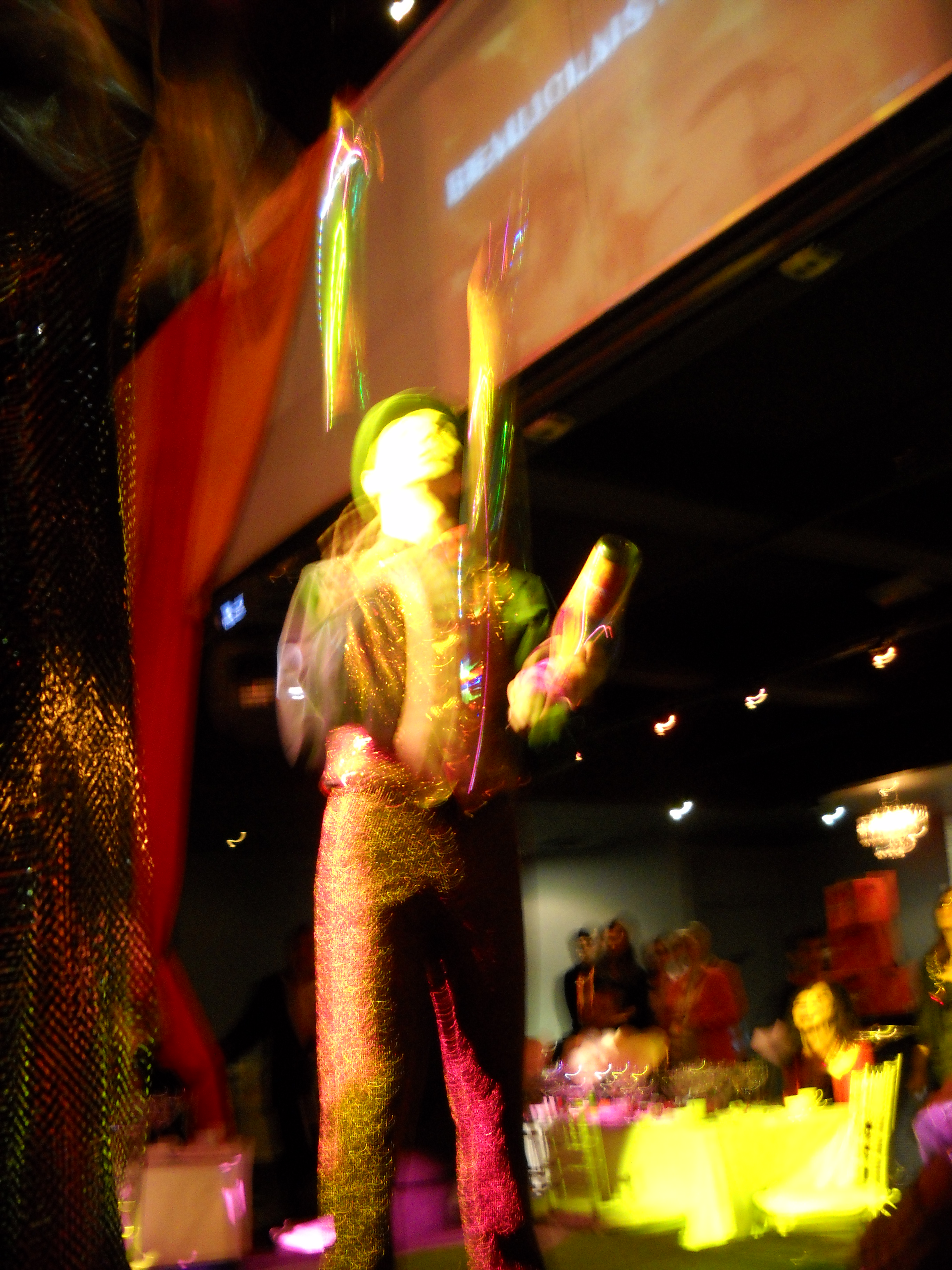
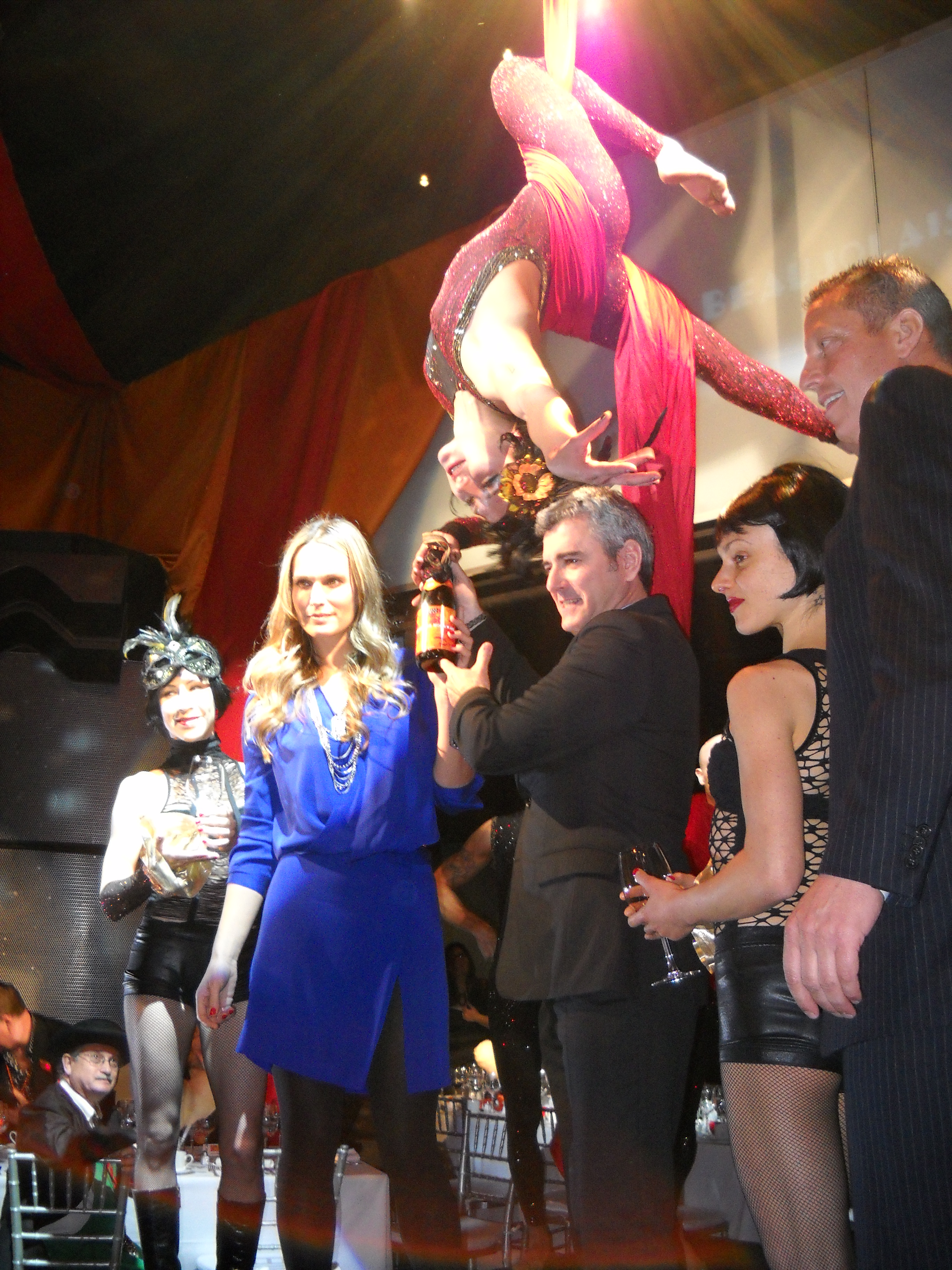
Molly Sims, Franck Duboeuf and Peter Deutsch welcome the Georges Duboeuf Beaujolais Nouveau 2010...cirque style.

Like clockwork, the Beuajolais Nouveau arrived on the third Thursday of November, attended by a circus-style celebration for the 2010 harvest. Actress, model and jewelry designer, Molly Sims, was on hand to toast the first glass from Georges Duboeuf, with George’s son, Franck, serving as Master of Ceremonies under the big top at District 36. The luncheon, prepared by chef Marc Murphy (of Landmarc and now also Benchmarc catering), was accompanied by the Beaujolais Nouveau 2010 and the Morgon Jean Descombes 2009. Other Beaujolais crus were available at the self-pour bar during the initial reception. Overhead, attendees were treated to aerialists dangling from silks, while jugglers, magicians and contortionists dazzled at eye-level.

Beaujolais, whether Nouveau or not, is a wine made in the southernmost part of Burgundy from the Gamay grape. While Gamay is not most people’s favorite grape variety — often associated with prejorative aromas of bubble gum and banana, this year’s wine showed none of these characteristics and was simply pleasing with its ripe cherry fruit and soft tannins. And, it went nicely with the meal.

As a wine, Beaujolais Nouveau has both its share of proponents and detractors, but for me, it is more about the symbolism than the wine itself. Here we are in November, only a few weeks after the harvest and we have much to be thankful for and much to celebrate. Along comes Beaujolais Nouveau, ready to honor the year’s work. Most wines are still preparing for the party (and may take years to do so as they dress in layers of oak, vanilla and toast), but Beaujolais Nouveau and other wines produced in a nouveau-style are not only fully dressed, they are prepared to dance until dawn.

No, it is not a wine on which to meditate, but sometimes all you need is a simple glass of wine, good food and good friends in order to sit back and enjoy the good life. Salut!

Juggler at Beaujolais Nouveau celebration.

Chenin Shines Brightly

AWS Tasting at Grand Cru Classes ~ October 2010

The tasting featured a collection of Chenin Blancs from South Africa and ranged in price from $5.00/bottle to $55.00/bottle. The majority of the wines were dry, but the final wine was a noble late harvest Chenin Blanc

The crowd favorites, based on the AWS evaluation and scoring (20 point scale) were as follows:

Mulderbosch Chenin Blanc 2008, Stellenbosch, South Africa – coming in with an average score of 15.5; I had it at 16
At $13.00, this was a lot of wine for the money – complex aromas of tropical fruit, botrytis and lanolin, richness on the palate, medium+ length

At 16.2, Ken Forrester’s FMC 2007, Stellenbosch, South Africa neared the top of the list, but, at $55.00, the group was less inclined to purchase it. Aromas of nuts, yeast, botrytis and spice; lush tropical fruit, oak, spice, with a caramelized note in the long length.

The highest scoring wine of the night was the Darling Cellars Onyx (Noble Late Harvest) 2008, with an average 16.4. $20.00 for a 375 ml bottle – not too bad for a dessert wine, especially one with the complexity and balance that this one showed. Aromas of honey, licorice, spice and apricot; medium sweet on the palate with honey and tangerine; long length.

Women in Winemaking: Simi & Franciscan

When you were little, what did you want to be when you grew up? Not surprisingly, winemaker was probably not on your list. Similarly, while Janet Myers and Susan Lueker are now both successful Napa Valley winemakers, they each came to their craft by a circuitous route.

Janet grew up in Southern Illinois with a family fruit orchard and maternal grandparents from Italy, but her interest in grapes didn’t come until later. She studied biology in college and initially pursued anthropology. Janet eventually moved to London and, while waiting tables there, developed a love of wine. As her passion strengthened, she chose to study enology at UC Davis. 

Meanwhile, Susan studied chemistry when she first went away to school, but then changed her mind and majored in child development. After working with hospitalized children, which she found quite depressing, she decided to switch careers. Susan had always liked wine and her parents had met at UC Davis, so it seemed like a natural place to investigate. After a great meeting with one of Davis’ professors, Susan enrolled at the university. 

Arriving at the same decision around the same time, Susan and Janet found themselves as lab partners and became friends. Today, Janet is the head winemaker at Franciscan, a post she has held since 2005, while Susan is at Simi, where she has been for the past 10 years.

A recent “Women in Winemaking” dinner featured both winemakers and their wines at the Crosby Hotel in New York. During the reception, guests had the opportunity to taste Simi’s Sauvignon Blanc and Franciscan’s Napa Valley Chardonnay as well as two red wines. Moving to the dining room, additional wines were paired with dinner.

Simi Chardonnay 2007, Russian River Valley, CA
This wine was made from 20-year old vines planted by Zelma Long. It showed butter, apple and citrus aromas on the nose owing to partial malolactic fermentation and ageing in G. Ferrer barrels. Dry and full-bodied on the palate, its flavors included apple, oak, nuts and vanilla.

Franciscan Cuvée Sauvage Chardonnay 2007, Carneros, CA
Named for the use of ambient/wild yeast used, this wine takes twice as long to ferment and Franciscan was the first producer in Napa to bottle a wild ferment wine. This wine has aromas and flavors of oak, yeast and green apple and spice, which can be attributed to the wild yeast, barrel fermentation and lees stirring.

Simi Landslide Vineyard 2006, Alexander Valley, CA
The 290 acre (180 of which are planted) Landslide Vineyard was planted in the mid1980s by Zelma Long and has three different elevations, each of which delivers a unique quality to the grapes. The lowest elevation results in ripe character and softer tannins, while the highest provides vibrant, vivacious fruit. A blend of 85% Cabernet Sauvignon, the remainder made up of the other four Bordeaux varieties, floral, blackberry smoke and cherry aromas greet the nose. A full-bodied palate shows notes of blackcherry, spice, vanilla, oak and smoke. 

Franciscan Magnificat Red Wine 2006, Napa Valley, CA
One of the first Meritage blends, Magnificat was named for Bach’s piece, which was written for five voices. Franciscan has been making this wine since 1984, varying the blend each vintage. Janet noted that, “By varying the blend, we can be more true to the personality of the blend.” The 2006 is produced from 56% Cabernet Sauvignon, 40% Merlot, 3% Malbec and 1% Petit Verdot, with meat, bacon, cherry and smoke aromas. Medium+ tannins, fruit, spice and vanilla linger in the long length.

Chablis 2008 shines at Drouhin’s Domaine de Vaudon

Laurent Drouhin, of Maison Joseph Drouhin, wants consumers  to know a few things about Burgundy. The first is that they don’t make Chardonnay or Pinot Noir. Rather, they make Chassagne-Montrachet, Chambolle-Musigny, Pommard, etc. In his view, the grapes, which are in fact Chardonnay for the whites and Pinot Noir for the reds, are merely a conduit through which the terroir can speak.

Another thing that Laurent would like folks to know is that Chablis, a very special terroir for white wines, is also in Burgundy.

And, finally, while he is proud of his family’s heritage as a negociant (a firm which purchases grapes from multiple growers to make wine), they are equally proud of their status as a land owner and producer, particularly in Chablis.

A recent tasting of the 2008 vintage from Drouhin’s Domaine de Vaudon proves that his pride is justly deserved.

The district level Chablis ($24.50) showed some complexity on the nose with  minerality and citrus fruit, both of which persisted on the palate along with the addition of green apple. The Reserve wine ($29.00), while similar in aromas and flavors, had a more pronounced nose and longer length on the palate.

Moving up in quality, the three Premier Cru wines (from grapes grown on highly rated vineyard land) all presented vibrant acidity, full body and citrus notes. The Premier Cru Montmains ($38.25) seemed to be the most complex of the three, with notes of apple, lime, earth and minerality.

However, it was the jump to the Grand Cru wines (those hailing from one of the seven best vineyards in Chablis) that really showed what world class Chablis is all about. The Grand Cru Bougros ($72.00) – incidently, Laurent pronounces the final “s” – had pronounced minerality, damp earth, bruised apple and a slight woody note on the nose, all of which re-appeared on the palate and remained throughout the exceedingly long finish. Slightly richer, with the perception of riper fruit on the nose and palate, the Grand Cru Vaudesir ($72.00) was slightly fuller and seemed to show a little more of the oak influence on the palate, although the use of oak was still restrained and elegant.

These latter wines were showing beautifully now, but indicated the ability to evolve and gain further complexity with age.

So, whether you drink them young or in time, enjoy these wines to the fullest. Just don’t call them Chardonnay.

Rom: A high point in the Golan Heights

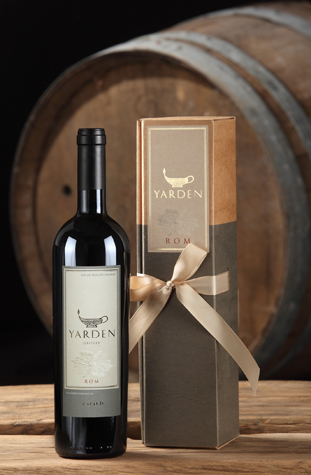
Courtesy Yarden Rom

A graduate of UC Davis, Victor Schoenfeld has been the winemaker for Golan Heights Winery in Israel since 1992. Zelma Long, who needs no introduction in certain circles, began her career at Robert Mondavi Winery and later moved to Simi Winery before pursuing her own interests. In 2002, the two well-regarded winemakers first came together with the goal of better understanding what limited and promoted quality among nine high quality blocks of vines at Golan Heights.

Describing the Golan Heights as a Mediterranean climate in an historical landscape, for Long, her visit “…felt like [she] was in this mythical land.” She saw its unique personality – wines that reflect the area with an extremely unusual diversity of climates within a small area (50 miles x 40 miles). Calling the wines fruit expressive with soft tannins, Zelma likens the wines to a cross between California fruitiness and Bordeaux restraint. She added that they are wines of complex character and concentration.

After working on the initial project together for several years, the two decided that a natural progression was to collaborate on the creation of a new wine. They recognized that blending wine was a very personal and intimate process, one that is not always easy to share with someone, but, their experience has been positive. Their vision for the wine, ROM, was power/intensity, which comes from the grapes and gives the wine potential for longevity; finesse/balance, which reflects winemaking and is also important for ageing; and flavor/complexity, which is enhanced in the winery through blending and ageing. Overall, they sought a wine of both access and ageing.

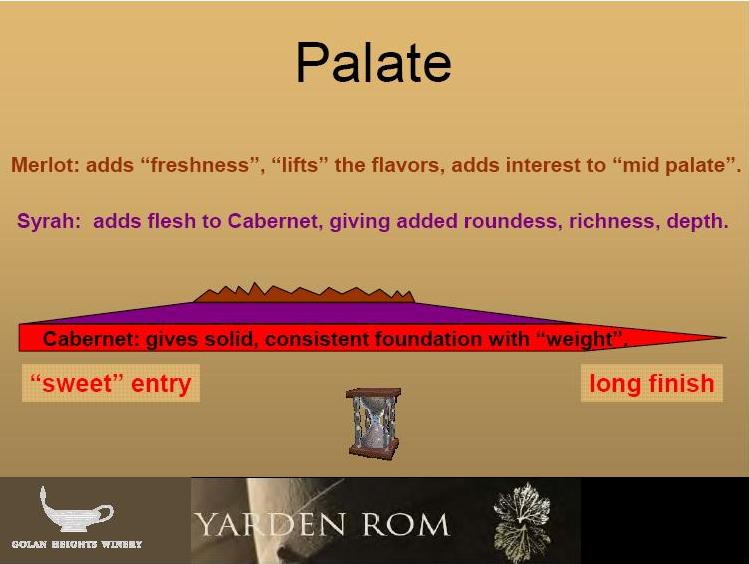
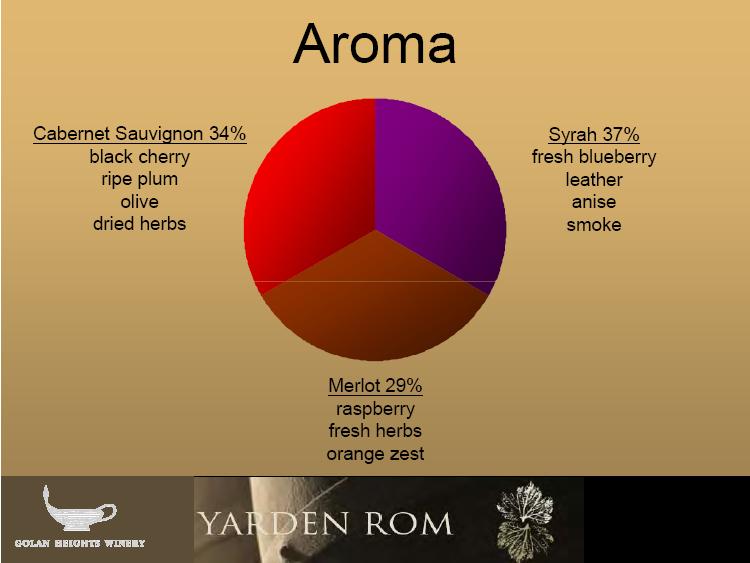
Ultimately, they sought out a blend of Cabernet Sauvignon, Merlot and Syrah, with each variety bringing a distinctive set of aromas and flavor profiles to the final blend. The Cabernet Sauvignon from cooler vineyards brings black cherry and ripe plum, while grapes from the warmer vineyards result in olive and dried herb aromas. Together, these grapes provide solid, consistent foundation to the wine, which is enhanced by Syrah’s darker fruit, savory qualities and roundness, depth and richness. The Merlot adds fresher notes of raspberry, fresh herbs and orange zest and is responsible for lift and fleshing out the mid-palate. From the Hebrew word for a high place, the name Rom symbolizes Victor and Zelma’s pursuit in creating a wine of the highest quality.  [See the graphs below.]

Members of the press had the opportunity to taste through barrel samples of the component wines from the 2008 vintage: Merlot from Odem, Syrah from Tel Phares and Cabernet Sauvignon from El Rom. This exercise provided a glimpse of how the individual grapes came together to create a gestalt, especially when compared with the Rom 2008 barrel sample.

The first wine to be launched, the Yarden Rom 2006, showed beautifully with aromas of plum, blueberry and blackberry. The well-balanced palate offered very concentrated, rich fruit flavors with a hint of herbal notes and firm tannins. The 2007 had brighter red fruit on the nose and was a bit more structured, while the 2008 (barrel sample) was not as integrated, with the wood notes more obvious on the palate, indicating that this is a wine that will improve with time. A limited edition of 6,000 bottles was produced for the 2006 vintage, with an SRP of $160.00.

Courtesy - Yarden Rom

Courtesy - Yarden Rom

The future is now – Bordeaux 2009 white and rose

The 2009 vintage in Bordeaux continues to receive rave reviews, but for now, the only red wines available for purchase are being sold as futures. Instead, consumers can look to Bordeaux’s whites and rosés – yes, you read that right, rosés – for a taste of this vaunted vintage.

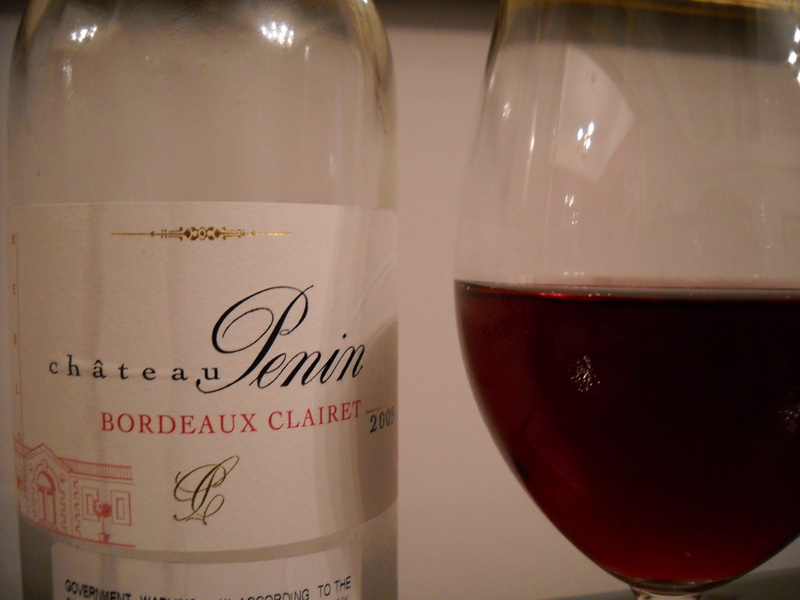
Château Penin AOC Bordeaux Clairet 2009, Bordeaux, France
Located within the area of Entre-deux-Mers in the village of Génissac, Chateau Penin has been in the Carteyron family since 1854. Patrick Carteyron, a member of the fifth generation, has been the current owner as of 1982. The château’s white wine is a blend of Sauvignon Blanc and Sémillon, along with Sauvignon Gris. The remaining range of wines is predominantly produced with Merlot, the most widely planted grape in the Bordeaux region. Two of those wines are rosés – an AOC Bordeaux Clairet and an AOC Bordeaux Rosé.

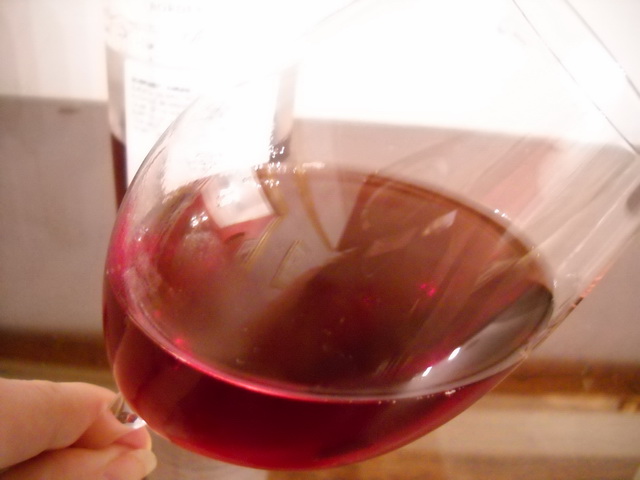
The Château Penin Bordeaux Clairet is 100% Merlot. This wine spends 24-60 hours of maceration on the skins, which accounts for its depth of color. In addition, approximately 25% of the wine underwent malolactic fermentation, rounding out the acidity on the palate, before spending four months ageing on the lees. With its deep rose color, you have to look twice to confirm that this is in fact a rose wine, but its cherry and strawberry aromas confirm its identity. With medium acidity, medium+ body, bright fruit and low tannins, this is a structured and dense wine that drinks more like a chilled red than a rose, but certainly hits the spot on a hot summer’s day.

Château Les Vergnes Bordeaux Blanc 2009, Bordeaux, France
Château Les Vergnes has been involved in viticulture from the very beginning with efforts to establish a national plan to combat phylloxera at the start of the 19th century and experiments with the first use of potassium thiocarbonate in 1879. Today, the château is committed to preserving the environment and qualified for the title, l’Agriculture Raisonnée in 2005 for its sustainable agriculture practices. 

Its Bordeaux Blanc wine is produced from a blend of 55% Sauvignon Blanc, 35% Muscadelle and 10% Sémillon, with grapes sourced from throughout the Bordeaux region. The nose carries aromas of grapefruit, floral and a waxy/lanolin note (likely from the Sémillon). The dry palate boasts vibrant acidity with medium body and flavors of citrus, pith and a slight hint of lanolin, which persist throughout the medium+ length.