Wine Educator’s Dirty Little Secret

The Wine All-in-One for Dummies was published by Wiley in September 2009. I’d received the review copy of the book months ago, but hadn’t gotten around to writing the review. What was the hold up? Had I stashed the book away and forgotten about it? Quite the contrary. Rather, it has been a busy season for me as a wine educator and the book has become an indispensible tool as I prepare for various events and clients.

The book, written by Ed McCarthy, CWE, and Mary Ewing-Mulligan, MW, differs from the previous Wine for Dummies books in that it is a compilation of five separate books, drawing on material previously published in: Wine For Dummies, 4th Edition, California Wine For Dummies®, French Wine For Dummies®, Italian Wine For Dummies®, Red Wine For Dummies®, White Wine For Dummies®, Australian Wine For Dummies®, Canadian Wine For Dummies®, and Champagne For Dummies.

With its soft cover and reasonably-sized format, it is much easier to schlep around than the Oxford Companion to Wine or other similar tome, and, as a basic refresher, it is more than capable of handling the task. Granted, this is not MW exam review material, but it does provide information on grape varieties, wine character/styles and lists of top producers from each region. In this last regard, I can check my wine selections against their list and confirm that the wines I have chosen to purchase for an upcoming event should be indicative of the region and/or the wine style I am trying to illustrate.

Mary and Ed have an engaging writing style, which, when coupled with the symbols used in the for Dummies® series, make it extremely accessible for both amateurs and professionals to use. Admittedly, as a wine professional, I am somewhat embarrassed to be seen with “for Dummies” in the title, but am careful to shield the title when carrying the book around in public. But, that being said, the title doesn’t negate the book’s usefulness, so I continue to call upon it as needed.

When the Bud Breaks

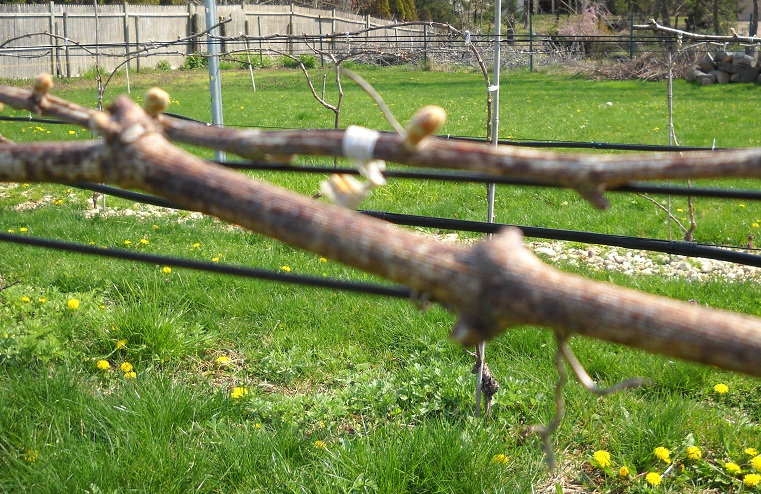
Grapevines are dormant all winter — hibernating from the cold and snow — until the weather reaches an average of 50°F. Well, as you may have noticed, we have had temperatures much higher than that lately. In fact, even though it is only mid-April, we have experienced temperatures as high as 92°F, achieving a new record in Central Park last week.

Consequently, the vines have woken up from their slumber much earlier than expected. And, I mean MUCH earlier. According to figures posted on Vine Views referencing Cornell’s Cooperative Extension as the data source, the average date for bud break on Long Island is April 26 and the earliest was April 17.  Yet, this past weekend, on April 11, 2010, we clearly saw evidence of bud break on our vines as we sat outside enjoying a leisurely breakfast. Or at least we thought we did. It seems that what we actually have is bud swell; bud break doesn’t really occur until the bud unfurls its green leaf.

While bud swell and/or bud break are generally good things, heralding the start of the new viticultural year, the problem with such an early bud break is that Mother Nature can be quite fickle. Sometimes she decides that maybe she isn’t quite ready to proceed with Spring as we thought, bringing cold temperatures and possibly even a frost despite what had seemed like a permanent end to winter. The vine can withstand frost when it is dormant, but it is much more susceptible to damage once it has come out of dormancy, especially since the sap is flowing within it.

In Bordeaux, where climatic similarities with Long Island exist, they experience many of the same worries. Here, the Feast Days of Saints Mamert, Pancrace and Gervais (respectively May 11, 12, and 13) are thought to be the marker as to when the threat of frost has past and the Saints themselves are often referred to as the Saints of Frost and Freeze. Thus, we still have a full month before we can rest easy.

Elsewhere in the U.S., frost this time of year is also a problem. Wes Hagen of Clos Pepe noted that he was on Frost Patrol (waking up in the middle of the night to turn on fans and sprinklers) these past several weeks and had suffered damage due to a deep freeze earlier in April. Fortunely, a recent article published in Practical Winery and Vineyard Magazine offered some possible solutions to reverse the damage, so he may be able to save those vines after all.

Regardless of whether bud break has actually occurred, it is clear that this will be an interesting year since weather plays such an important role in the growth and development of the vine and, ultimately, the grapes themselves. Wine may be a more glamorous product than beans or orange juice, but in the end, it is still farming. Fingers crossed, we will have warm, dry weather stretching long into the fall, but only time will tell what the season will bring.

A Tale of Two Lunches

I woke up on a Monday morning in March with a reasonable agenda — an Italian wine tasting followed by a portfolio tasting. Thus, once I dragged myself out of bed (Mondays are the worst and rainy Mondays are even more horrible), I presumed that I would attend the two events, head home and get some work done in the afternoon (but, we all know about the best laid plans…).

I left our apartment at 10:00 AM to ensure a prompt arrival at the International Culinary Center (formerly known as the French Culinary Institute), which resulted in my being the first to arrive. The weather caused many attendees to be late and necessitated a late start to the event. However, after the delay, the event hit the ground running. It was a small, but dedicated group there to learn from both Adolfo Folonari of Ruffino and Cesare Casella of Salumeria Rosi on the theme of terroir.

Adolfo shared a brief history of Ruffino, noting that the company has been family owned for over 130 years, having been founded by two cousins. Adolfo’s family acquired the company in 1913, continuing the founders’ legacy and now maintains seven estates in the Tuscany region.  He then presented four wines — three of which were Chianti appellations and one Brunello di Montalcino. The wines were very good and showed the diversity within the Ruffino portfolio from the fresh and fruity Ruffino Chianti Superiore DOCG 2008 ($12.99 SRP) to the more complex Ruffino Riserva Ducale Chianti Classico DOCG 2006 ($24.99 SRP) and the modern Ruffino Santedame Chianti Classico Riserva DOCG 2006 ($33.00 SRP).

Participants then had an opportunity to taste the wines again, this time paired with salumi (cured meats), presented by Cesare, who wore a red chef’s coat, with a sprig of rosemary taking the place of a pocket-square. The pairings were well-received, but of greater interest to me, was learning about the effect of terroir on this type of cuisine. For example, Cesare explained that in Alto Adige, the climate is too cold to salt cure the meat and consequently, they use a cold smoke instead. Similarly, in Calabria, smoking is used because it is too hot to use salt curing. In addition, the breed of pig also differs from region to region, affecting the final product.

We then moved from the formal presentation to the luncheon where guests enjoyed three additional salumi and four other Ruffino wines. We were particularly impressed with the Ruffino Lumina Pinot Grigio Venezia Giulia IGT 2009 ($9.99 SRP), which had vibrant acidity and good fruit concentration, from Ruffino’s property in Collio (Alto Adige). After the salumi were cleared, the menu included beans and tuna as well as short ribs with mushroom risotto, followed by vanilla panna cotta. We were seated at round tables and played a sort of musical chairs, with each table getting a chance to chat with Adolfo and Cesare for one course of the meal, as they made their way around the room.

During lunch, I received a phone call from the PR Coordinator at W.J. Deutsch, letting me know about an event that was taking place as she spoke. It sounded interesting, plus I had yet to get to the venue, sd26, so I switched gears and headed over to meet with Stefano Massa of Villa Massa.

I arrived at sd26 and was warmly greeted by Barbara Scalera, but, as I had been unable to find the restroom before departing ICC, I explained that I needed to first go to the Ladies’ Room before she and Stephano could have my undivided attention. The damp weather had wreaked havoc on my hair, but fortunately, I didn’t scare my hosts. I did my best to make myself presentable and was then led to a private dining room upstairs.

I was seated next to Stefano who promptly launched into a story about his journey into Limoncello. He noted that he and his brother, Sergio, were pioneers in crafting quality Limoncello of Sorrento. Stefano’s family had been producing Limoncello at home for family consumption, the recipe for which had been passed down for generations. Their guests really enjoyed their Limoncello and Stefano and Sergio saw an opportunity to produce the liqueur on a commercial basis. Most importantly, they are committed to maintaining the terroir and consequently only use natural ingredients, most notably the Sorrento Oval Lemon, which has had its own Protected Geographical Indication (PGI) since 2000.

About three-quarters of the way into his monologue, food was served, but the first order of business was to taste the Limoncello. Stefano first served it to me cold and then at room temperature. I was advised to first smell the liqueur before taking some onto my tongue and slurping in some air, in a similar fashion as one tastes wine. The fresh lemon aromas were obvious and even more so with the room temperature specimen.

Risotto was the dish of the day, making a second appearance, this time with scallops that had been marinated in the Villa Massa Limoncello. The second course was veal testina, which I didn’t particularly enjoy (the recipe calls for 1 veal head), but the dessert course was lovely. The Italian pastry, Baba, had been prepared with the Limoncello in place of the more traditional rum and was accompanied by a refreshing Limoncello sorbet. I also liked the use of the Limoncello in two cocktails I was served — the first being a blend of Limoncello and tonic water (I actually really like tonic water, so this was a nice “twist” for me). The second cocktail was a modified Mimosa, with Limoncello standing in for orange juice, resulting in a less sweet version of this popular brunch drink.

At a time when it seems that every spirit producer (and some wine producers) is trying to show the versatility of its product by using it as an ingredient, in cocktails or both, I found the Villa Massa Limoncello to be one of the more successful in this arena.

Having now eaten two lunches in a single day, I thanked my hosts and departed the restaurant. Unfortunately, it was now 4:30 PM and I would not have time to make it to the Dreyfus Ashby portfolio tasting as it ended at 5:00 PM and it would take at least that much time to travel to Ardesia Wine Bar, where it was being held. As I said, the best laid plans…, but of course, it was a great (if not fattening) day of tasting.

Bubbling with anticipation

My sights are set on Washington, D.C. this July where I’ll be in attendance for the Society of Wine Educators‘ annual conference.

I am thrilled to be presenting again this year, having co-presented the Certified Wine Educator Preview with Geralyn Brostrom and Ed Korry last year in Sacramento and on Long Island wines in 2007 in Monterrey.

Taking my cue from the patriotic location and aptly-named conference theme of Red, White and Bubbles… A  Capital Perspective on Wine, I proposed a session, “Born in the USA: American Sparklers”, which was accepted for presentation in mid-January.

I don’t want to give too much away at this point since I want to ensure a good turnout for my session, but as I have just finalized the list of producers, I am very excited. The presentation will shed some light on the history of sparkling wine in America and will feature tastings from nine different sparkling wine producers, hailing from eight states. The wines themselves will offer a diverse sampling of sparklers, making for what I hope will be a fun and festive tasting.

Grand Cru Grapevine: Where the Streets Have No Name (April 2010)

Has spring sprung? Writing in mid-March, it certainly feels like it. After a brutal winter, we are itching to get out on the road again and breathe in the fresh air of wine country. A vicarious visit awaits you in our newsletter this month as we explore the numerically-named routes found within the wine regions of Napa, the North Fork, Paso Robles and Santa Barbara. 

Less vicariously, we invite you to hit the road, Jack (or Jill), and head east for our fun and festive wine and chocolate pairing event, held in conjunction with our next-door-neighbor, Macari Vineyards, and Chokola’j. Learn about Sex, Wine & Chocolate when Tracy will jointly present with relationship coach and sex educator, Marcia Baczynski and Susan Kennedy, co-founder of Chokola’j. Join us April 24, 2010 (this is a date change from what was previously announced) from 3:00-5:00 PM; $45.00/person. Kindly RSVP to Kimberly Grimmer at Macari via e-mail or phone (631-298-0100). 

If a trip out east is too far to go, you can catch Tracy in her NYU class, Italian Wines–From North to South, on five consecutive Tuesdays from 6:45-8:45 PM, beginning May 18. Register through NYU now. 

We are also thrilled to announce the launch of Tracy’s new website: It’s a Winederful Life, where she will endeavor to share her tales of “living la vida vino.” 

Drink wisely and well, 

Tracy Ellen Kamens, Ed.D., DWS, CWE 

CEO: Chief Education Officer 

and 

Jared Michael Skolnick 

COO: Cork Opening Officer 

———————————— 

WHERE THE STREETS HAVE NO NAME 

Given that wine regions don’t start out as full-blown wine regions, the touristy wine trails that eventually spring up frequently don’t have idyllic, wine-themed names for the roads and routes that bring visitors from tasting room to tasting room. Rather, the main drag that winds its way past winery after winery is more often like the U2 song – a place “where the streets have no name,” bearing instead the number of the local highway or route. 

While you might have been advised to ‘get your kicks on Route 66,’ those visiting the Napa Valley will be best off if they stick to the parallel wine trails along Route 29 and the Silverado Trail. The former is considered to be the more bustling and trafficked than the latter, but both are home to wonderful wineries lining the roads from Carneros to Calistoga. The highway of Route 29 has lent its “no name” to Vineyard 29, which released its first vintage in 1992. In 2000, Vineyard 29 was acquired by Chuck and Anne McMinn, who subsequently expanded the single vineyard into a full-scale winery, known primarily for its Cabernet Sauvignons. 

Across the country on the North Fork of Long Island, the two parallel roads are Route 25 (aka Main Road) and Route 48 (aka as both “the North Road” and Sound Avenue). Here, the climate is dramatically different – maritime vs. Mediterranean, but the wine trail has also served as inspiration for the eponymously named Vineyard 48. Originally Bidwell Vineyards, Vineyard 48 took on its new name in 2005 when the Sicilian-born, Rose Pipia purchased the property. Over the past 5 years, significant investments in the vineyard and winery have been made and today, the winery is known for its well-crafted wines. 

Back in California, visitors to Paso Robles should travel along Route 46, which meanders past many of the wineries located in Paso Robles West, and then, after crossing Highway 101, takes you along the east side of the region. On the west side of town, the vineyards and winery of Tablas Creek Vineyard are located a little over 8 miles north of Route 46. Founded by the Perrin family of Château de Beaucastel in France’s Chateauneuf-du-Pape and wine importer, Robert Haas, Tablas Creek creates Rhone-style wines – both single varietal and blends – following organic viticultural practices. 

Still further south, California’s Santa Barbara County is home to a diverse wine region spanning from the Santa Maria Valley to Santa Barbara proper. With its unique microclimate, wineries nestled in the Santa Rita Hills specialize in the Burgundian varieties of Pinot Noir and Chardonnay and are found along Highway 246. Here, vineyard manager and winemaker, Wes Hagen tends to the vines grown at Clos Pepe, adhering to sustaintable agricultural methods, including the use of a flock of sheep to assist with weeding. 


TASTING NOTES 


Clos Pepe, Vigneron Select Pinot Noir 2007, Santa Rita Hills, CA, $54.00
Although an appointment is required, it is well worth the effort to travel to this unique property. Wes will greet you himself, providing you with a personal tour of the vineyards, followed by a tasting in his parents’ beautiful home. On the nose, this wine has aromas of cherry, berry, dust and slight oak. Medium-bodied, with vibrant acidity, the wine shows flavors of strawberry, vanilla and a hint of oak, along with minerality in the long finish.

Road 31, Pinot Noir 2006, Napa Valley, CA, $38.00
Owner and winemaker Kent Fortner’s parents both grew up on family farms in rural Kansas, not far from Road 31, a route he has traversed in his 1966 Ford pick-up truck too many times to count. With cranberry, floral and herbal aromas, this medium-bodied wine is dry with medium acidity and bright fruit flavors of raspberry, cranberry and a hint of baking spice.

Tablas Creek Vineyard, Cote de Tablas Blanc 2008, Paso Robles, CA, $25.00
This blend of 42% Viognier, 26% Roussanne, 21% Marsanne and 11% Grenache Blanc is pressed and fermented in stainless steel to preserve the fresh fruit flavors of the wine. Floral and citrus aromas are joined on the palate by minerality, spice and tropical fruit flavors that persist throughout the wine’s long length.

Vineyard 29, CRU Cabernet Sauvignon 2007, Napa Valley, CA, $54.00
With grapes sourced from throughout the Napa Valley, the Cru Cabernet Sauvignon was aged in French oak for 18 months, 50% of which was new oak. Aromas of red and black fruits and floral notes greet the nose, while ripe blackberry, spice, smoke, oak enliven the palate, culminating in medium+ length.

Vineyard 29, Estate Cabernet Franc 2007, Napa Valley, CA, $140.00
The Cabernet Franc grapes for this wine hail from the original property, planted in 2000, and, while initially planted to be blended in with the Cabernet Sauvignon, were found to produce a wonderful wine all on their own. The 2007 saw 20 months in French oak, 90% of which was new, with 146 cases produced. Black fruit, oak and herbal aromas are found on both the nose and palate, along with a hint of spice and noticeable, but ripe, tannins. 


The great sample debate

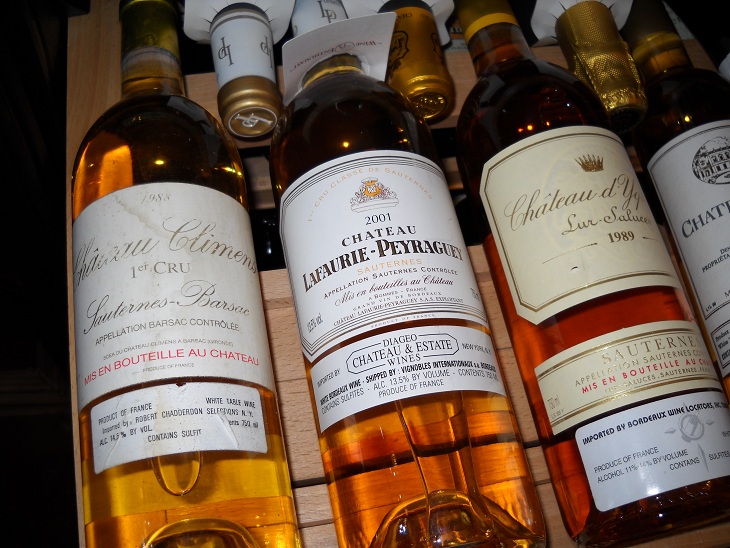
No, I assure you, these were not received as samples (not that I would complain if they were), but I like this photo of mine.

The subject of wine samples seems to be  a hot topic among wine bloggers and other wine writers, especially when it comes to journalistic integrity. Much has already been written on this angle/aspect of the debate elsewhere and, as I am late to the pool party, I won’t attempt to crash it by jumping in at this juncture.

However, an interesting discussion on samples recently presented itself at an event I attended. A public relations representative posed the question of the assembled writers as to their opinon on unsolicited samples.

Some writers noted that they were happy to receive the samples regardless of whether they had been expected or not, while others were less enthused. The PR person had received feedback from a blogger who claimed to dislike receiving unsolicited samples and praised those PR folks who gave him/her the right of refusal before packing up a case and sending it along. Yet, this same person admitted that unsolicited samples received the same care and treatment as solicited ones — being logged and eventually drank (and possibly written about).

Consequently, the PR person was torn between being a good citizen and potentially denying his/her clients possible press or brazenly sending samples — bidden or not — all in the name of PR. Certainly, this is not a major dilemna, but something for those in PR to ponder in the course of their day to day activities.

If there was any consensus, it was that writers want PR people to at least do their homework and understand the writer’s beat. If s/he only writes about bargain wines, don’t send samples of premium wines priced at $50.00 and above. Yes, they are nice to get, but beyond personal consumption, they will not be useful as writing topics. It’s not a new story, but one that is sometimes forgotten in the rush to get samples out the door.

My own opinion is that, in general, I prefer to receive a request prior to getting the samples to ensure that I really do want them and/or that they are of interest to my writing agenda. Yet, I can’t deny that the occasional mystery arrival of wine feels a lot like Christmas or your birthday, but perhaps a bit better — even it its not what you asked for, it always fits.

April Fools arrives early

Photo by: Tracy Ellen Kamens

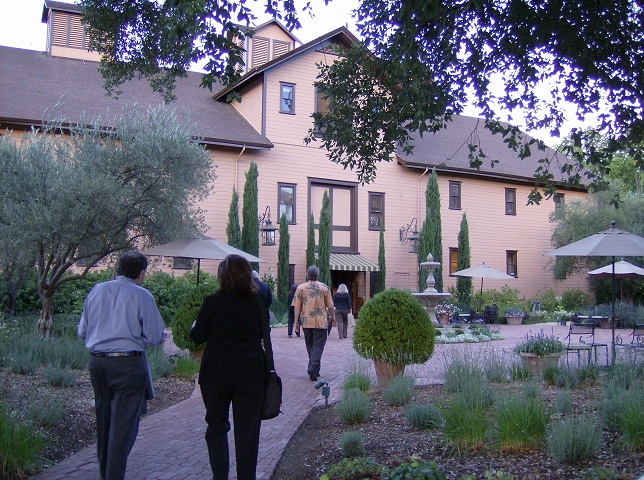
I had the pleasure of visiting Trefethen Family Vineyards a few years ago when I participated in the Napa Valley Vintners’ Wine Educators Academy. On the first evening, we were given a tour of the winery by Janet Trefethen herself and were then treated to a wonderful welcome dinner under the stars in their courtyard. Trefethen wines, were, of course, served with the meal, as were several others from the region. The common theme was wines that are less associated with Napa Valley, but were of equally high quality. Namely, we tasted rosés, Rieslings, Pinot Grigios and other white wines that were ABC — Anything but Chardonnay. All in all it was a perfect night. 

Given my positive experience with the winery, I was excited when I received a package from Trefethen a few weeks ago. It was addressed to my other personna (NY Wine Shopping Examiner), so I presumed it was a sample intended for my column. Accordingly, I looked forward to tasting it. In fact, I was so eager to open the package, that I broke my usual patten of attending to junk mail and bills ahead of personal correspondence, cards and packages (a habit based upon the adage of eating dinner before dessert). 

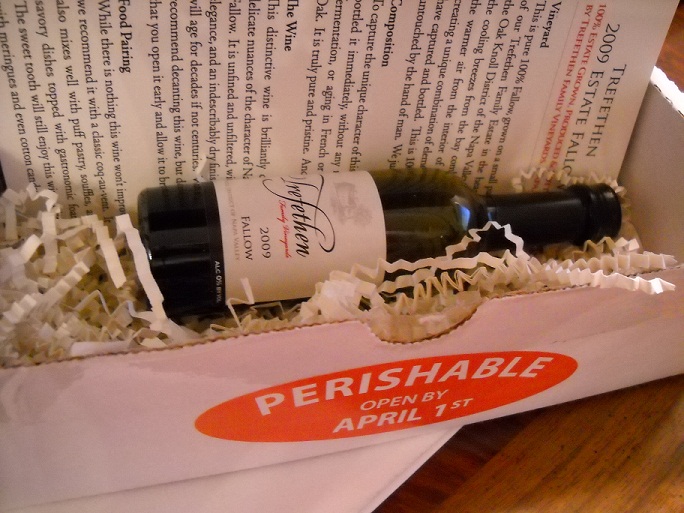
I ripped open the box (okay, for those who know me, I carefully undid the packaging) and was thrilled to see a very small wine bottle nestled inside. What a brilliant idea I thought! Writers don’t necessary need to taste an entire bottle to take notes and write about a wine — a tiny bottle, just a taste, would be perfect. Although, with less to spare and share with my colleague/husband, I became a bit possessive of the bottle and began to inspect my newfound treasure. 

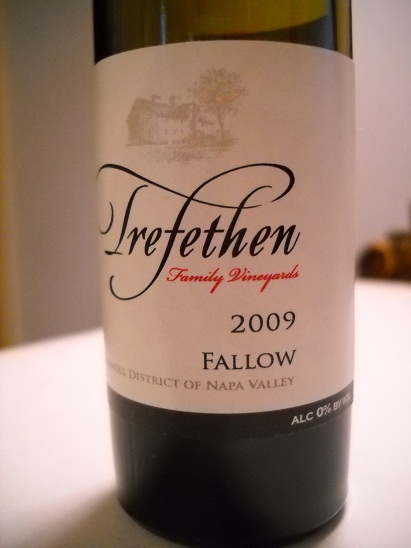
Reading the label, I noted that the wine was called Fallow and was from the 2009 vintage. I turned to read the back label, looking for information on the grape varieties contained therein, then burst out laughing. My precious wine bottle was empty — filled not with wine, but air (78% Nitrogen, 21% Oxygen, 1% Argon and Trace elements, according to the enclosed Tech Sheet). The back label stated, “This is pure Trefethen Fallow, bottled to capture the very essence of the Napa Valley; light, delicate and ethereal. The perfect match with April Fool’s dinner.”  

The Tech Sheet also spoke about the time-honored, but less-used, practice of leaving a portion of farm land fallow — empty — to “naturally recover and come back into balance after harvest.” As proponents of sustainable farming practices, Trefethen still maintains the practice of leaving vineyard land fallow when replanting, the results of which can be found in my tiny bottle. 

I was disappointed not to be able to enjoy a taste of a Trefethen wine, but admired their sense of creativity and humor. All joking aside, if you do get a chance to taste a bottle of Trefethen wine, I highly recommend it. 

How’you doing…Luna?

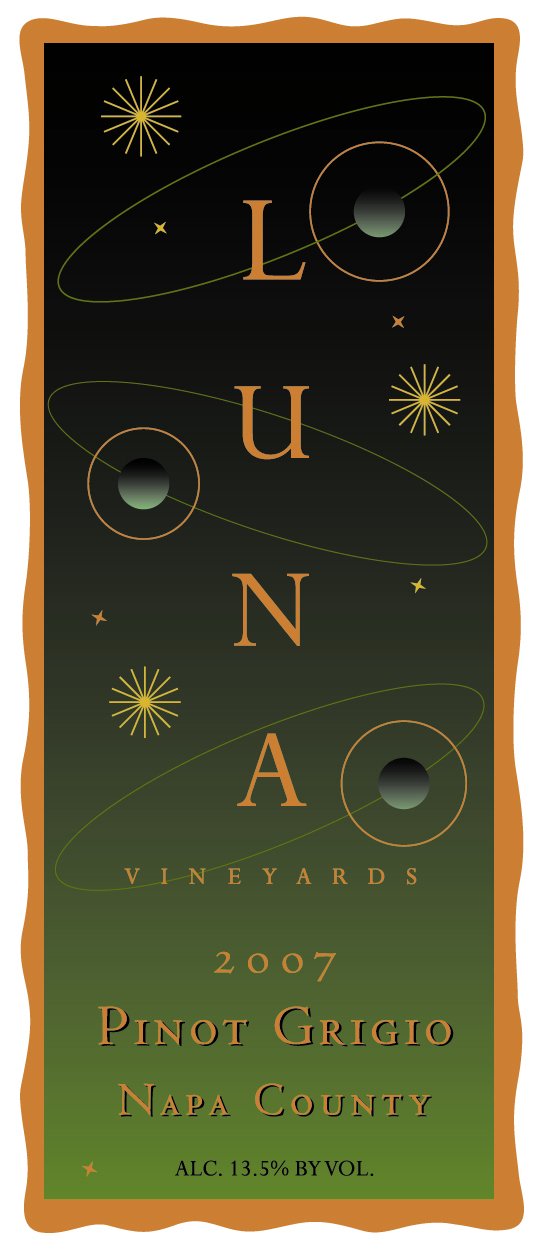
Luna Vineyards Pinot Grigio 2007, Napa Valley, CA

I think this catch phrase is an amalgamtion of a line from Friends (so eloquently recited by Joey) and the name of an internet company that was subsequently purchased by Google, but somehow it has stuck in our household. All of this by way of an introduction to Luna Vineyards in Napa Valley, CA, owned by Mike Moone and George Vare.

Luna Vineyards Pinot Grigio 2007, Napa Valley, CA, $18.00
Winemaking: 95% Pinot Grigio, 5% Chardonnay; 20% fermented in neutral French oak barrels, 30% underwent malolactic fermentation
Aromas: Citrus, floral, hint of stone, slight yeast
Flavors: Orange, citrus zest
Structure: Medium+ acidity, medium-bodied, medium alcohol, medium+ length
Conclusion: Good fruit concentration, with nice aromas, but more limited complexity on the palate.


Luna Vineyards Sangiovese 2007, Napa Valley, CA, $25.00
Winemaking: 90% Sangiovese, 7% Cabernet Sauvignon, 3% Petite Sirah; Aged for 12 months in 25% new French oak barrels.
Aromas: Cherry, oak, spice, tomato leaf
Flavors: Rich, concentrated fruit – cherry, tomato, spice and oak
Structure: Medium-high acidity, medium-bodied, medium alcohol and medium length.
Conclusion: A good quality wine, ready to drink now.


Wine goes primetime

COUGAR TOWN #18, JOSH HOPKINS, COURTENEY COX, CHRISTA MILLER (ABC/ADAM LARKEY)

I admittedly watch way too much television. I wish I could at least defend my bad behavior by claiming to watch documentaries or other educational programming, but I can’t do that. No, truth be told, I watch crap — and lots of it. Case in point, I spent last Wednesday evening watching ABC’s Cougar Town, Courtney Cox’s current sitcom.

The saving grace of last week’s show (and the reason for this post – I promise there is a reason) is that much of it was about wine, which was the first time I could recall wine taking center stage in primetime. The plot centered on Courtney Cox’s character, Jules, and her poor wine drinking habits, i.e. drinking too often and too much. Not expressly stated, but certainly indicated visually, was her equally appalling wine etiquette (or rather the lack of it  — filling the glasses to the very top and slurping from the glass, hands-free). Yes, slurping can be considered appropriate behavior with wine tasting, but in this case it wasn’t.  In addition, Sheryl Crow made an appearance as a wine sales representative. For various reasons, which I will not elaborate, Jules decides to give up wine for a month, but, [spoiler alert] eventually caves in and drinks. As they say, “Everything in moderation…including moderation.”

In any case, it wasn’t that the show was so good, but as noted, it was unusual to see wine given such prominence in a television show’s plot and signals a recognition from the writers of this show, if not the network overall, that wine has finally become an important part of the American culture. We’ll just have to stay tuned to see when and where wine will next appear.

March Madness: Go with Big Reds to cheer on Cornell tonight!

If you have been following the NCAA tournament, aka March Madness, this year, you will have noted that there have been a number of upsets. Admittedly, I don’t really care about basketball, but one of these upsets caught my attention. It is with great alumna pride that I will root for Cornell when they take on Kentucky at the Carrier Dome tonight.

While I won’t be trekking to Syracuse or heading out to a local bar to watch the game, I do plan to celebrate this exciting moment in Cornell’s athletic history with a toast at 10:00 PM when the game starts (technically it starts at 9:57 PM, which makes no sense to me, but in case you plan to watch, I wouldn’t want you to miss a minute or three).

So what to drink on such an occasion? A big red, of course! No puny Pinot Noirs tonight. Instead, I’m going to reach for something big, bold and brash.

Ottimino’s Zinfinity, which I recently drank courtesy of a sample I received, would be a good option. The wine is a blend of 93% Zinfandel, 7% Petite Sirah and spent 20 months in French oak. Its youthful aromas included spice, oak, blueberry and blackberry. The rich, ripe fruit dominated the palate, but was balanced by the acidity, sweet, ripe tannins and flavors of spice, vanilla, oak and smoke.
Ottimino, Zinfinity Zinfandel 2006, Sonoma County, CA (USA), $17.00 SRP

Of course, there are a myriad of other options such as Cabernet Sauvignon, Syrah/Shiraz or Malbec to fit this bill if you choose to go the varietal route, but Amarone, Barolo and Barbaresco would work equally well, should your palate and pocketbook be a bit more sophisticated. Either way, may the best team win and by that I mean, Go Big Red!