Buena Vista Winery unveils new Wine Tool Museum

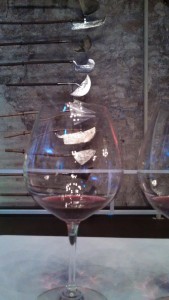
2015-02-16 17.03.39Sharp edges glisten in the spotlight, looking more like an executioner’s axe than something wielded by an enologist. But, these blades actually belong to a collection of pomace cutters, used for removing grape skins from the press.

Indeed, getting from grape to glass takes a series of labor-intensive, time-consuming tasks. Just as diverse and varied are the specialized tools used in each step along the way. From planting vines and harvesting grapes to crafting oak barrels, each instrument has a distinct purpose, propelling the process forward.

Though technology has evolved with time, these implements still hold interest and fascination as well as provide a glimpse back into the past. A unique look at these historic devices will be made public at the equally historic Buena Vista Winery in Somona, CA when it unveils its Wine Tool Museum on March 24, 2015.

Established in 1857 by Agoston Haraszthy, Buena Vista Winery is among the oldest wineries in the U.S. Haraszthy was a true pioneer in the wine industry, leading the way for the use of European varieties and (then) modern methods in the vineyard and winery. After much exploration throughout California (including a stint as San Diego’s first elected sheriff), he was among the first to recognize the potential of Carneros (the southern sub-AVA that spans both Napa and Sonoma), where he chose to locate his Buena Vista Vinicultural Society.

Unfortunately, Haraszthy’s legacy languished first under Prohibition and then under a revolving door of ownership. However, in 2011, the estate was purchased by Jean-Charles Boisset, whose Boisset Collection of wineries also spans Napa and Sonoma as well as Europe.

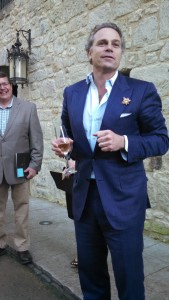
Boisset was intent on restoring glory to the storied winery and has since invested 2015-02-16 15.38.18heavily in the infrastructure. Most notably, the original land-marked cellar building received a full renovation, including a state-of-the-art reinforcement of its walls to protect against earthquakes. While certainly not planned, the seismic retrofit passed its August 2014 test with flying colors; the building didn’t sustain any damage at all!

With the interior renovations now completed, the ground floor serves as home to Jean Charles’ Bubble Lounge, a place to enjoy a range of sparkling wines produced by Buena Vista and several other Boisset properties.

Display cases line the walls of the stairwell and show off a beautiful collection of decanters, setting the stage for the exhibit to come. Upon arrival on the third floor, visitors will be greeted by a 20 minute video presentation guiding them through exhibit and introducing them to the tools, their respective functions and the history of Buena Vista.

The unique opportunity to visually experience the tools of the trade will provide tasters with a deeper understanding of how wine is made and perhaps a greater appreciation for those who toil to make it.

The Art of Storytelling

Once upon a time (aka earlier this month), I traveled to Seattle, which was initially founded with a settlement called New York-Alki, located across Elliott Bay from the present-day city. Established back in 1851, the settlement’s name meant “New York-in a little while,” supposedly for the site’s resemblance to Manhattan island, but also perhaps some wishful thinking on the part of the settlers?

While the early families were lured by land grants given to them by the U.S. government to protect the U.S. from Canada, I was drawn by the opportunity to catch up with friends and colleagues who were in town for the Society of Wine Educators’ annual conference. Although admittedly, my only official conference attendance was at a reception at the Chihuly Garden and Glass exhibit at Seattle Center.

For the remainder of my visit, I played the role of tourist making sure to hit all of the top spots – the Space Needle, Pike Market and the Underground Tour. This latter attraction proved to be among the highlights of my trip despite its lack of a connection to wine.*

Created by Bill Speidel in 1965 as part of his efforts to save the historic neighborhood of Pioneer Square, the tour takes tourists on an adventure one story below Seattle’s streets, Strewn with ancient artifacts (frescoes, building facades and an original Crapper toilet) and more modern detritus (movie props left behinds from the 1970s), the journey is truly a walk back through time.

But, the environment itself would fall flat if it wasn’t for the guides who regale participants with well-rehearsed stories, punctuated by well-timed humor. Suddenly, the cast of characters are brought to life and history is exciting instead of boring.

For example, early resident (and madam) Lou Graham was among those responsible for an intriguing discovery during one of the city’s first censuses. The study revealed that loggers, who accounted for the vast majority of workers in Seattle at the time, made any average of $20/month. Meanwhile, members of the seamstress circle were bringing home $400/month; not bad for a town with limited need for bespoke garments and haberdashery. The astute city council saw their opportunity and levied a $10/week tax for all 2,700 seamstresses on their non-existent sewing machines.

The 1.5 hours flew by rather quickly, bringing the tour to an end, but my interest in Seattle history was piqued and the stories remained fresh in my mind even a week later.

Stories engage us, fascinate us and challenge us much more than simple facts and figures. Yet, when we talk about wine, how frequently do we find ourselves speaking about varietal percentages, acidity levels and types of oak trees.

Instead, isn’t it more interesting to know that Chateau de Villambis in Bordeaux operates its vineyard under a Help Center for Work permitting them to offer work to people with disabilities or that Mas Blanch I Jove in Catalonia supports the arts by commissioning a new sculpture for its vineyard each year?

Just something to consider the next time you teach wine or any other subject for that matter.

*If you take the more adult-themed tour at night (when it is renamed the Underworld Tour), the ticket price includes one cocktail.

Southern Burgundy and Beaujolais offer great wine options with good value

Julienas-2

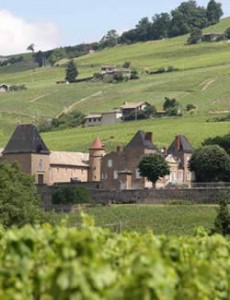
Image of Julienas, courtesy of DiscoverBeaujolais.com

Georges Dubouef Chateau des Capitans 2011 Juliénas, France, $19.00 Beaujolais bashers need not apply. We typically think of Beaujolais in the fall when Beaujolais Nouveau est arrivé – the third Thursday of November. But, Beaujolais is much more than Nouveau and, as a lighter-bodied red, it’s perfect for summer sipping. Produced from the thin skinned Gamay grape, Beaujolais is generally low in tannins, high in acidity, with bright cherry fruit and capable of taking a slight chill.

Nouveau aside, the Beaujolais hierarchy starts at the base with Beaujolais, while wines produced with grapes sourced from the better vineyards (located in 39 well regarded villages) are a step above and labeled as Beaujolais-Villages. Even more rarified as those wines designated as crus, which are named and labeled for one of the ten villages their grapes respectively come from.

Belying its Roman origin having been named for Julius Cesar, Juliénas is located quite northerly in the Beaujolais region where the more granitic soils are found. Situated within the heart of Juliénas, the Chateau des Capitans estate is home to a 19th century castle. Since the site is thought to have been a headquarters for military staff during the Gallo-Roman period, the castle’s name pays homage to the captains who presumably lived there once upon a time.

Tasting note: Aromas of fresh cherries, cinnamon and wet leaves persist on the palate with high acidity, light body and low tannins; nice round mouthfeel and good length.

Georges Duboeuf Domaine les Chenevières 2011, Mâcon-Villages, France, $14.00 Just north of Beaujolais, the Mâconnais district is part of the Burgundy region and is known for its Chardonnay. The district is structured similarly to Beaujolais in that wines feature either the basic appellation of Mâcon, the higher appellation of Mâcon-Villages or the more prized appellations of Pouilly-Fuissé, Pouilly-Loché, Pouilly-Vinzelles, Saint-Véran and Viré-Clessé. However, the district also permits village level wines to append the name of specific villages or communes, as in the case of Mâcon-Lugny.

With a warmer climate than that found in the Cote d’Or district, Mâconnais Chardonnays generally offer up riper and more tropical fruit notes as well as lower price points. Domaine les Chenevières has been the setting for five generations of winemaking for the family that owns it, with portions of the family’s residence built over 300 years ago.

Tasting note: On the nose, this wine displays damp earth, butter and apple notes. The dry palate offers bright acidity, medium-full body and an elegant richness; unwooded with 100% malolactic fermentation.

The new question: To beef or not to beef?

Dario's Dinner

Dario Cecchini, Butcher of Panzano with Julien Niccolini of the Four Seasons

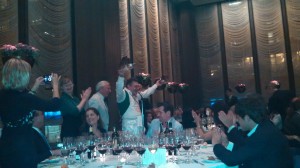
The Four Seasons restaurant welcomed members of the Chianti Classico consorzio at a special dinner last month, in concert with the U.S. Premiere Tasting of Chianti Classico Gran Selezione wines. The dinner featured Chef Dario Cecchini who posed the very important question: To beef or not to be? Since Cecchini is the renowned “Butcher of Panzano,” I think you can guess where his answer lies. The Gran Selezione producers/winery owners were also present at the dinner.

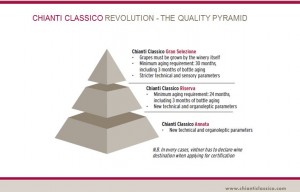
pyramidThe Chianti Classico Gran Selezione is a relatively new category for these wines, added by the Consorzio in 2013. This category ranks higher than the Chianti Classico Riserva wines (see pyramid image) and is used only for the top wines of the region, which are produced exclusively from estate-grown grapes and follow stricter parameters. The Gran Selezione wines must also adhere to longer aging requirements.

Among my favorite wines poured at the dinner were the Castello Vicchimaggio Vigna La Prima 2010, Greve in Chianti (which was lucky because the owner was sitting at my table), Bibbiano Vigna del Capannino 2010, Castellina in Chianti; and Casaloste Don Vincenzo 2009, Greve in Chianti.


Rose Revolution: Better Dead than Red

World winemakers unite! Admittedly I have Communism and Leon Trotsky on the brain thanks to having just finished Barbara Kingsolver’s novel, The Lacuna. However, the notion that winemakers are globally uniting to produce rosé wines is not that far-fetched, at least not in terms of the depth and breadth of these wines now being produced.

While drinking pink wine (at least publically) was previously relegated to newbies quaffing White Zinfandel and other sweet blush wines, today’s rosés run the gamut in hue and are primarily dry in style. With a decade of growth in the U.S. market, rosé continues to be one of the U.S.’s fastest growing wine categories in retail sales; the message is clear: Rosé is here to stay. Tweet that!

A recent “Pink Party” hosted by Winebow showcased the importer’s vast portfolio of rosés, which not only ranged in style (from still to sparkling and pale salmons to deep pinks), but also in origin of production.

As the number one producer of rosé worldwide, it is not surprising that the line-up was heavy in French samples, with appellations that specialize in the pink stuff such as Provence and Tavel well represented. Italian specimens were similarly prevalent, most of which hailed from the southern portion of the boot: Sicily, Sardinia, Campania and Calabria.

But, Winebow’s rosé collection is much more widespread than the wine world’s two top producers. In addition to a reasonable showing of wines from the U.S.’ east and west coasts, more unique appearances came from Croatia, Greece, Lebanon and the Republic of Macedonia.

Adding to the diversity, the sparklers were not only comprised of the usual suspects such as Rosé Champagne and a beautiful rose Cava, but also on hand were lovely bubbles from Austria and Tasmania.

And, vying for most unusual wine of the day was a “100% pure rosé sake” produced from heirloom purple rice.

With such a plethora of rosé wines in the market, it can be quite confusing to the consumer to make sense of it all. But, the easiest way to understand rosé is to think about something with which most people are familiar – tie-dyeing. Tweet this!

Such childhood arts-and-crafts projects provide a simple, but effective tool, for learning about rosé production. Armed with white t-shirts, rubber bands and RIT dye, we saw that leaving the t-shirt in the dye bath for just a few minutes resulted in a pale hue, while soaking it for the full hour delivered the deepest color. Moreover, the instructions advised that higher temperatures and agitation further added to the color saturation.

Apply these same principles to winemaking, substituting grape skins for RIT dye and grape juice/must for t-shirts (no rubber bands required) and, by George, you’ve got it. Now you are ready to join the revolution!

Looking for some rosés to sip this summer (yes, I promise it will be summer one of these days)? Here are some of my favorites from the Pink Party tasting:

SPARKLING WINES
Jansz Sparkling Rose NV, Tasmania, Australia
A blend of Pinot Noir, Chardonnay and Pinot Meunier with just a hint of color. Citrus, mineral and peach notes.

Juvé y Camps Rosé Brut Pinot Noir NV, Cava, Spain
100% Pinot Noir and medium-deep pink in color. Floral and fruit on the nose with red fruit and herbs on the palate.

Lanson Brut Rosé Champagne NV, Champagne, France
A blend of Pinot Noir, Chardonnay and Pinot Meunier. Rich and intense with typical yeasty character along with citrus and a hint of red fruit.

STILL WINES
Adelsheim Rosé 2013, Willamette Valley (OR), USA, $25.00
100% Pinot Noir. Herbs with some depth and slight grip on the palate. Fresh strawberries and melon.

Chateau Mercouri Lampadias Rosé 2013, Ilia, Greece
A 50-50 blend of Avgoustiatis and Agiorgitiko. Simply lovely with good fruit and acidity.

Les Vignobles Gueissard Côtes de Provence Rosé “Les Papilles” 2013, Provence, France
Mourvèdre, Syrah, Cinsault, Grenache, Cabernet Sauvignon and Rolle. Berries and cherries with body and good length.

Zenato Bardolino Chiaretto 2013, Veneto, Italy
Corvina, Rondinella and Merlot. Very fruity with strawberry, raspberry and dried herb aromas and flavors.

It’s Complicated… but does it have to be?

Each year, dozens of high school and college teams gather together to compete in building complex machinery to complete simple tasks. This national competition, held in celebration of cartoonist Rube Goldberg, encourages the creation of far-fetched contraptions to accomplish straight-forward tasks such as hammering a nail or turning a page.

See the Rube Goldberg website for this and other images.

These machines take a circuitous route to getting things done, instead of simply moving from Point A to Point B, there are quite a few stops along the way.

In the context of the Rube Goldberg Machine Contest, such round-about, comical approaches can be a lot of fun, but why do we seem to take a similar tack when explaining simple concepts about wine to our students?

As a refreshing antidote to encyclopedic tomes, Tom Stevenson has written “a [wine] book for people who don’t want to read about wine.” Stevenson’s newest book, Buy the Right Wine Every Time, The No-Fuss, No-Vintage Wine Guide, offers a simple, straightforward approach and focuses on wines that are generally inexpensive, widely available and consistent from year to year.

This is a distinct departure for Stevenson, who is well known for writing the (encyclopedia tome and) go-to-guide, World Encyclopedia of Champagne & Sparking Wine. Presumably much more at home drinking the likes of Bollinger and Taittenger, for this project, Stevenson found himself tasting Barefoot and Turning Leaf and seems to be impressed with these and several other big brands.

The first part of the book emphasizes wine by style, while in the latter section (referred to as the “A-Z of wines”), individual wines are listed alphabetically (naturally) with a few key elements included:

  • What is it?
  • What does it taste like?
  • If you like this, then try with confidence…

The very first entry in this section is the Adami Prosecco Bosco del Gica, which Stevenson rates as Recommended. (His other ratings are To Die For and Highly Recommended). As a consumer-oriented wine book, I would say it is Highly Recommended.

Interestingly, or at least of interest to me as a wine educator, while the label clearly indicates that the wine is Prosecco Superiore DOCG (and not just Prosecco DOC), Stevenson makes absolutely no mention of this fact in his text.

And, in the wine style section, none of the wines listed include the appellation or even country of origin. Truly a case of less is more.

Truthfully, having worked with the Prosecco Superiore consortium, I feel a duty to explain and clarify the differences between the two, but in all honestly, does the average consumer really care as long as the wine tastes good (to them) and fits within their budget? As much as I hate to admit it, the answer is no.

Yet, I do not advocate for a full abdication of complex principles; merely, for the use of clear explanations when they are necessary and appropriate. In this regard, detailed dissertations on appellation laws might be best left for trade training, but significant concepts that link wine and place should be explored, keeping context and audience in mind when guiding such conversations.

Similarly, at a recent seminar on “Why Terroir Matters,” author and educator Marnie Old questioned whether we should be using the term terroir with consumers, noting that discussions of “dirt” tend to turn people off.

In response, Bordeaux merchant and estate owner, Edouard Moueix suggested that, “[Terroir] is a term that was invented to describe something that can’t be easily defined,” but was adamant that terroir is indeed vital to the dialogue on wine. Instead, he proposed that we need to do a better job illuminating this term for consumers to help them understand how terroir distinguishes one wine from another in its identity as well as to clarify that it does not, in fact, mean “dirt.”

Admittedly, a tall order, but as a wine educator I am up for the challenge. What do you think?

Wine Educators Tool Belt Seminar Handout

For those of you who participated in my French Wine Society webinar on the Wine Educators’ Tool Belt, here is a list of resources and bibliography.

Kamens Wine Educators Toolbelt Handout

Goldilocks and the Crus Bourgeois

Once upon a time, there was a little girl named Goldilocks who went for a walk in the forest. After walking for awhile, she came upon a house. She knocked and, when no one answered, she walked right in.

At the table in the kitchen, there were three bowls of porridge. Goldilocks was hungry (walks in the forest tend to do that) and proceeded to taste the porridge from the first bowl.

“This porridge is too hot!” she exclaimed.

Next, she tasted the porridge from the second bowl.

“This porridge is too cold,” she said

So (ever the optimist), she tasted the last bowl of porridge.

“Ahhh, this porridge is just right,” she said happily and ate it all up.

While we know that the bears soon returned home to find Goldilocks fast asleep in Baby Bear’s bed, we can learn a lot from Goldilocks (and not just the part about staying out of people’s –and bear’s– homes).

I recently had the opportunity to present a class on the Crus Bourgeois wines to the staff members of Bottle Rocket Wine & Spirit.

Since it was late (9:00 PM on a Thursday night), cold (polar vortex anyone?) and that they were likely to be tired (did I mention it was late?), I knew that I couldn’t give them too many facts and details. Not only would they easily forget them, it would simply be “too much” information.

I also knew that I couldn’t just talk about the Crus Bourgeois because the assembled group of employees possessed a varied set of existing knowledge about Bordeaux. Such an approach would provide “too little” information. I had to ensure that everyone had at least a basic understanding of the Bordeaux wine region.

Thus, I spent some time reviewing the essential elements of Bordeaux – climate, grape varieties, wine styles and appellations – before discussing and tasting the Crus Bourgeois wines. I acknowledged that some of this would be review for them and was careful not to dwell on irrelevant details. In addition, I made sure to emphasize the information that would be most useful to them in selling Bordeaux wine to their customers.

When I was finished with my presentation, the General Manager pronounced that what I had delivered to his staff was “just right.” I’m sure Goldilocks would be pleased.

Looking to expand your knowledge on Bordeaux and the Crus Bourgeois?

The inaugural issue of my Drink Wisely magazine was “All About Bordeaux,” but admittedly might be “too much” content for some readers. For a more general introduction to Bordeaux, see my Examiner article on Decoding Bordeaux (possibly “too little” for others). Finally, my Wine Portfolio article on the current status of the Crus Bourgeois might be “just right” to bring you up to speed on this important Bordeaux wine category.

Vino Veritas, the ferment and foment of blue frogs

vino-veritas-poster-smMy inbox is constantly bombarded with various press releases, most of which are wine related – new products, recent releases, etc. But, I suspect that I am often included on random releases simply because they somehow found my website (and an active e-mail address).

These latter missives generally have nothing to do with anything I write about or have an interest in. Stowe, VT? Clothing swaps? And, most recently, a request to write about a tool that removes unwanted e-mails from your inbox (do they even see the irony?)

But, on occasion, the query is tangential, but interesting. This month, I was invited to prescreen a movie titled, Vino Veritas (loosely translated as “in wine is truth”). Intrigued by the trailer, I agreed and was pleasantly surprised. I really enjoyed the movie, which is being released via iTunes and VOD through Gravitas Ventures on January 15.

For those of you who may wish to see the movie, I will caution you to stop reading right now. In other words — Spoiler Alert!

But, if I haven’t scared you off, I invite you to keeping reading…

While the publicist characterized the film as being “wine-centric,” his statement is a bit exaggerated because this is NOT a film about wine. Rather, wine is primarily used as a plot device rather than being the main topic of the movie.

Interestingly, as wine consumption becomes more popular in the U.S., it is finding its way into cultural expression – television, movies, books, etc. Yet, despite its increased acceptance, wine (and alcohol in general) is frequently demonized. While this film doesn’t demonize wine, it does cast it in an ominous light – imbuing the wine in question with mystical properties that compel imbibers to tell the truth.

Moreover, wine features heavily as a character trait of one of the protagonists. Appearing to rely on old stereotypes about wine, the film depicts Ridley as being a snob as a result of his knowledge and enjoyment of fine wine and pursuit of formal credentials, while the “common folk” characters reach for beer.

Given that this film is an adaption of David MacGregor’s 2008 play of the same name, I wonder if some of this thinking about wine has changed in the intervening five years.

But, as noted, this is not a wine movie. Instead, it is a film that explores the universal theme of truth, and how it relates to dealing with modern issues such as the burdens of parenthood and owning one’s sexual identity.

Tackling the issue of parenthood, the conversation among the four characters — particularly between the two women – pushes the boundaries of what is socially acceptable to admit as a parent. Mourning the loss of one’s identity (i.e. I want to be more than just __’s mother); the loss of freedom and adventure; and the loss of relationship between husband and wife, under the influence of the “magical wine”, the women break the taboo of expressing any sentiment regarding motherhood as anything other than that of doting mom by openly admitting there are negative aspects associated with being a parent.

Addressing another societal taboo, the film’s discussion of sexual identity centers on sexual expression and, more specifically, how one likes to engage in and enjoy sex. Here, one wife’s admission of her sexual preferences for rough sex is vilified– with the implication that she is a “slut” or “whore” for her sexual deviance. Meanwhile, there appears to be less condemnation of her husband’s sexual transgressions; while not expressly condoning infidelity, it seems to excuse the behavior in a “boys will be boys” sort of way.

As the evening winds to a close, for one couple, the truth will set them free. But for the other, to paraphrase Jack Nicholson in a Few Good Men, they can’t handle the truth.

In fact, this couple is so abhorred by the revelations made by each other that neither can bear to live with this knowledge. Rather than find a way to meet each other’s sexual needs or accept their partner for who they truly are, they would prefer to be blissfully ignorant. What a sad commentary on a marriage, but likely the reality for many actual couples.

Directed by Sarah Knight, the film’s production was unusual in several ways, as described by the Director’s Statement, included in the press kit. Specifically, as a theatre director, Sarah “…only wanted to cast actors with theatre backgrounds as this film was going to live and die on the performances.”

In addition to the performers’ backgrounds, Sarah notes that, “…by the final rehearsal day we just ran the show in its entirety like a play!” and actual shooting took place “…almost completely in sequence.” Finally, they “…often shot very long takes and occasionally filmed entire scenes in one take…”

This nontraditional treatment emphasized the film’s origin as a piece for the stage and pulled the story together in a very fluid, natural way.

Well written, with believable characters, the film is not only enjoyable on a comedic level, but pushes the audience to think about how honesty –real, raw honesty– will impact their lives. Can they bear to reveal their own naked truth to themselves, their spouses, friends or the world at large?

If Vino Veritas is indeed the case, I for one think that we all should drink more wine!